

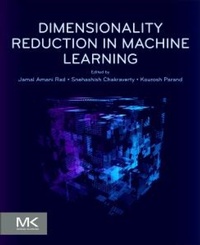
Dimensionality Reduction in Machine Learning
Published on 5. February 2025
Book
Paperback/Softback
330 pages
978-0-443-32818-3 (ISBN)
Description
Dimensionality Reduction in Machine Learning covers both the mathematical and programming sides of dimension reduction algorithms, comparing them in various aspects. Part One provides an introduction to Machine Learning and the Data Life Cycle, with chapters covering the basic concepts of Machine Learning, essential mathematics for Machine Learning, and the methods and concepts of Feature Selection. Part Two covers Linear Methods for Dimension Reduction, with chapters on Principal Component Analysis and Linear Discriminant Analysis. Part Three covers Non-Linear Methods for Dimension Reduction, with chapters on Linear Local Embedding, Multi-dimensional Scaling, and t-distributed Stochastic Neighbor Embedding.
Finally, Part Four covers Deep Learning Methods for Dimension Reduction, with chapters on Feature Extraction and Deep Learning, Autoencoders, and Dimensionality reduction in deep learning through group actions. With this stepwise structure and the applied code examples, readers become able to apply dimension reduction algorithms to different types of data, including tabular, text, and image data.
Finally, Part Four covers Deep Learning Methods for Dimension Reduction, with chapters on Feature Extraction and Deep Learning, Autoencoders, and Dimensionality reduction in deep learning through group actions. With this stepwise structure and the applied code examples, readers become able to apply dimension reduction algorithms to different types of data, including tabular, text, and image data.
More details
Language
English
Place of publication
San Francisco
United States
Publishing group
Elsevier Science & Technology
Target group
Professional and scholarly
Product notice
Paperback (trade)
Unsewn / adhesive bound
Dimensions
Height: 234 mm
Width: 190 mm
Thickness: 16 mm
Weight
680 gr
ISBN-13
978-0-443-32818-3 (9780443328183)
Copyright in bibliographic data and cover images is held by Nielsen Book Services Limited or by the publishers or by their respective licensors: all rights reserved.
Schweitzer Classification
Other editions
Additional editions
Jamal Amani Rad | Snehashish Chakraverty | Kourosh Parand
Dimensionality Reduction in Machine Learning
E-Book
02/2025
Elsevier
€167.99
Available for download
Persons
Dr. Jamal Amani Rad currently works in Choice Modelling Centre and Institute for Transport Studies, University of Leeds, Leeds LS2 9JT, UK He obtained his PhD in Mathematics at the Department of Mathematics at University of Shahid Beheshti. His research interests include modelling, numerics, and analysis of partial differential equations by using meshless methods, with an emphasis on applications from finance.
Dr. Snehashish Chakraverty is a Senior Professor in the Department of Mathematics (Applied Mathematics Group), National Institute of Technology Rourkela, with over 30 years of teaching and research experience. A gold medalist from the University of Roorkee (now IIT Roorkee), he earned his Ph.D. from IIT Roorkee and completed post-doctoral work at the University of Southampton (UK) and Concordia University (Canada). He has also served as a visiting professor in Canada and South Africa. Dr. Chakraverty has authored/edited 38 books and published over 495 research papers. His research spans differential equations (ordinary, partial, fractional), numerical and computational methods, structural and fluid dynamics, uncertainty modeling, and soft computing techniques. He has guided 27 Ph.D. scholars, with 10 currently under his supervision.
He has led 16 funded research projects and hosted international researchers through prestigious fellowships. Recognized in the top 2% of scientists globally (Stanford-Elsevier list, 2020-2024), he has received numerous awards including the CSIR Young Scientist Award, BOYSCAST Fellowship, INSA Bilateral Exchange, and IOP Top Cited Paper Awards. He is Chief Editor of International Journal of Fuzzy Computation and Modelling and serves on several international editorial boards.
Dr. Kourosh Parand is a Professor in International Business University, Toronto, Canada . His main research field is Scientific Computing, Spectral Methods, Meshless methods, Ordinary Differential Equations (ODEs), Partial Differential Equations(PDEs) and Computational Neuroscience Modeling.
Dr. Snehashish Chakraverty is a Senior Professor in the Department of Mathematics (Applied Mathematics Group), National Institute of Technology Rourkela, with over 30 years of teaching and research experience. A gold medalist from the University of Roorkee (now IIT Roorkee), he earned his Ph.D. from IIT Roorkee and completed post-doctoral work at the University of Southampton (UK) and Concordia University (Canada). He has also served as a visiting professor in Canada and South Africa. Dr. Chakraverty has authored/edited 38 books and published over 495 research papers. His research spans differential equations (ordinary, partial, fractional), numerical and computational methods, structural and fluid dynamics, uncertainty modeling, and soft computing techniques. He has guided 27 Ph.D. scholars, with 10 currently under his supervision.
He has led 16 funded research projects and hosted international researchers through prestigious fellowships. Recognized in the top 2% of scientists globally (Stanford-Elsevier list, 2020-2024), he has received numerous awards including the CSIR Young Scientist Award, BOYSCAST Fellowship, INSA Bilateral Exchange, and IOP Top Cited Paper Awards. He is Chief Editor of International Journal of Fuzzy Computation and Modelling and serves on several international editorial boards.
Dr. Kourosh Parand is a Professor in International Business University, Toronto, Canada . His main research field is Scientific Computing, Spectral Methods, Meshless methods, Ordinary Differential Equations (ODEs), Partial Differential Equations(PDEs) and Computational Neuroscience Modeling.
Content
Part 1: Introduction to Machine Learning and Data Life Cycle
1. Basics of Machine Learning
2. Essential Mathematics for Machine Learning
3. Feature Selection Methods
Part 2: Linear Methods for Dimension Reduction
4. Principal Component Analysis
5. Linear Discriminant Analysis
Part 3: Non-Linear Methods for Dimension Reduction
6. Linear Local Embedding
7. Multi-dimensional Scaling
8. t-distributed Stochastic Neighbor Embedding
Part 4: Deep Learning Methods for Dimension Reduction
9. Feature Extraction and Deep Learning
10. Autoencoders
11. Dimensionality reduction in deep learning through group actions
1. Basics of Machine Learning
2. Essential Mathematics for Machine Learning
3. Feature Selection Methods
Part 2: Linear Methods for Dimension Reduction
4. Principal Component Analysis
5. Linear Discriminant Analysis
Part 3: Non-Linear Methods for Dimension Reduction
6. Linear Local Embedding
7. Multi-dimensional Scaling
8. t-distributed Stochastic Neighbor Embedding
Part 4: Deep Learning Methods for Dimension Reduction
9. Feature Extraction and Deep Learning
10. Autoencoders
11. Dimensionality reduction in deep learning through group actions