

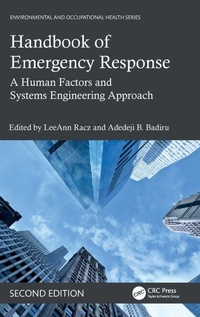
Handbook of Emergency Response
A Human Factors and Systems Engineering Approach, Second Edition
2nd Edition
Published on 12. September 2025
Book
Hardback
514 pages
978-1-041-07348-2 (ISBN)
Description
Despite pre-emptive preparations, disasters can and do occur and are a fact of life. Whether natural disasters, catastrophic accidents, or terrorist attacks, the risk cannot be completely eliminated. A carefully prepared response is your best defense. This fully updated second edition of the Handbook of Emergency Response presents practical advice and guidelines on how to plan the coordinated execution of emergency response.
This handbook incorporates human factors and a systems engineering approach to emergency response project management. It provides cutting-edge research in developing a systematic structure for communication, cooperation, and coordination. Managing a project in the wake of a tragedy is complicated and involves various emotional, sentimental, reactive, and chaotic responses. This is the time when a structured communication model is most needed. This second edition includes important lessons learned and developments since the first edition was published, as well as additional information devoted to systems thinking and industrial engineering in planning for responses to emergencies. The reader will develop a thorough understanding of how to handle an emergency response using a systems approach.
The handbook is an ideal purchase for any student or practitioner of human factors, safety, systems engineering, events management, local or federal governance, or those in the emergency services.
This handbook incorporates human factors and a systems engineering approach to emergency response project management. It provides cutting-edge research in developing a systematic structure for communication, cooperation, and coordination. Managing a project in the wake of a tragedy is complicated and involves various emotional, sentimental, reactive, and chaotic responses. This is the time when a structured communication model is most needed. This second edition includes important lessons learned and developments since the first edition was published, as well as additional information devoted to systems thinking and industrial engineering in planning for responses to emergencies. The reader will develop a thorough understanding of how to handle an emergency response using a systems approach.
The handbook is an ideal purchase for any student or practitioner of human factors, safety, systems engineering, events management, local or federal governance, or those in the emergency services.
More details
Series
Edition
2nd edition
Language
English
Place of publication
London
United Kingdom
Publishing group
Taylor & Francis Ltd
Target group
Professional and scholarly
Academic and Professional Reference
Illustrations
66 s/w Abbildungen, 5 s/w Photographien bzw. Rasterbilder, 61 s/w Zeichnungen, 39 s/w Tabellen
39 Tables, black and white; 61 Line drawings, black and white; 5 Halftones, black and white; 66 Illustrations, black and white
Dimensions
Height: 240 mm
Width: 161 mm
Thickness: 33 mm
Weight
948 gr
ISBN-13
978-1-041-07348-2 (9781041073482)
Copyright in bibliographic data and cover images is held by Nielsen Book Services Limited or by the publishers or by their respective licensors: all rights reserved.
Schweitzer Classification
Other editions
Additional editions
LeeAnn Racz | Adedeji B. Badiru
Handbook of Emergency Response
A Human Factors and Systems Engineering Approach, Second Edition
E-Book
09/2025
2nd Edition
CRC Press
€231.99
Available for download
LeeAnn Racz | Adedeji B. Badiru
Handbook of Emergency Response
A Human Factors and Systems Engineering Approach, Second Edition
E-Book
09/2025
2nd Edition
CRC Press
€231.99
Available for download
Persons
LeeAnn Racz is a Supervising Engineer at ToxStrategies LLC in Fort Walton Beach, FL. Prior to this initiative, she was President and Founder of ClearView Environmental Engineering and Consulting, and she served for 23 years as a bioenvironmental engineer and civil engineer in the US Air Force. Dr Racz is a licensed professional engineer, certified industrial hygienist, and board-certified environmental engineer. She earned a BS in Environmental Engineering from California Polytechnic State University, San Luis Obispo, an MS in Biological and Agricultural Engineering from the University of Idaho, and a PhD in Civil and Environmental Engineering from the University of Utah. She has authored dozens of refereed journal articles, conference proceedings, magazine articles, and presentations, and edited six handbooks. Dr Racz is a member of several professional organizations and honor societies and has received numerous prestigious teaching and research awards.
Adedeji B. Badiru is Dean Emeritus and a retired Professor of Systems Engineering at the Air Force Institute of Technology (AFIT). He is a registered professional engineer and a fellow of the Institute of Industrial Engineers, as well as a fellow of the Nigerian Academy of Engineering. He has a BS degree in Industrial Engineering, an MS in Mathematics and an MS in Industrial Engineering from Tennessee University, and a PhD in Industrial Engineering from the University of Central Florida. He is the author of several books and technical journal articles and has received several awards and recognitions for his accomplishments. His special skills, experience, and interests center on research mentoring of faculty and graduate students.
Adedeji B. Badiru is Dean Emeritus and a retired Professor of Systems Engineering at the Air Force Institute of Technology (AFIT). He is a registered professional engineer and a fellow of the Institute of Industrial Engineers, as well as a fellow of the Nigerian Academy of Engineering. He has a BS degree in Industrial Engineering, an MS in Mathematics and an MS in Industrial Engineering from Tennessee University, and a PhD in Industrial Engineering from the University of Central Florida. He is the author of several books and technical journal articles and has received several awards and recognitions for his accomplishments. His special skills, experience, and interests center on research mentoring of faculty and graduate students.
Content
1. Resilient Organizations Overcome Challenges to Unified Response. 2. A Multi-layered Dynamic Systems Model of Disaster Response. 3. Creating Effective Response Communications. 4. Effectively Communicating Risk and Uncertainty to the Public in Crises. 5. Time Is a Murderer: The Cost of Critical Path Drag in Emergency Response. 6. Evacuation Planning, Analysis, and Management. 7. Planning and Management of Transportation Systems for Evacuation. 8. Modeling and Simulation of Fuel Availability at Gas Stations During Extreme Events. 9. Deciphering the Code of False Alarms to Understand Public Response to Emergency Warnings. 10. Damage Assessment and the Use of Technology after Disasters: Implications for Emergency Managers and Others Involved in an Important Function. 11. Revisiting Human Behavior after Disasters: The Possibility of Anti-Social Activity and its Relation to Disaster Assistance. 12. Current Threats to Biosecurity. 13. An Integrated Approach to Planning for and Responding to Ionizing Radiation Incidents. 14. Understanding the Impacts of Heat. 15. Coordinated Project Management for Emergency Response. 16. DEJI Systems Model: Factors and Elements for Emergency Response. 17. Cooperation and Compliance in Emergency Response. 18. Emergency Response: Systems-based Use of Finland's Concept of Sisu. 19. Emergency Response Process Improvement Using Lean Six Sigma Techniques. 20. Learning Curve Application for Emergency Response. 21. Systems Engineering Framework for Environmental Conservation and Restoration Management. 22. Climate-Change Drivers for Emergency Response. 23. Qualitative Impact of Climate Change, Infrastructure Integrity, Sustainability, and Environmental Degradation on Emergency Response Programs.