

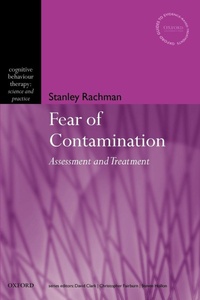
The Fear of Contamination
Assessment and treatment
Published on 27. April 2006
Book
Paperback/Softback
212 pages
978-0-19-929693-4 (ISBN)
Description
From a leading figure in the field of psychotherapy, this new book is the first dedicated to the topic of the fear of contamination. The fear of contamination is the driving force behind compulsive washing, the most common manifestation of obsessive compulsive disorder. It is one of the most extraordinary of all human fears. People who have an abnormally elevated fear of contamination over-estimate the probability and the potential seriousness of becoming contaminated. They believe that they are more susceptible than other people to contamination. People who labour under the illusion that they are particularly vulnerable to contamination are persistently anxious, excessively vigilant and highly avoidant.
The fear is complex, powerful, probably universal, easily provoked, intense, and difficult to control. Usually it is caused by physical contact with a contaminant and spreads rapidly and widely. When a person feels contaminated it drives a strong urge to remove the contamination, usually by washing. The fear and subsequent urges over-ride other behaviour. A fear of contamination can also be established mentally and without physical contact. The fear can arise after exposure to violation, physical or non-physical, and from self-contamination.
The book starts by defining the disorder, before considering the various manifestations of this fear, examining both mental contamination and contact contamination, and feelings of disgust. Most significantly, it develops a theory for how this problem can be treated, providing clinical guidelines - based around cognitive behavioural techniques.
The fear is complex, powerful, probably universal, easily provoked, intense, and difficult to control. Usually it is caused by physical contact with a contaminant and spreads rapidly and widely. When a person feels contaminated it drives a strong urge to remove the contamination, usually by washing. The fear and subsequent urges over-ride other behaviour. A fear of contamination can also be established mentally and without physical contact. The fear can arise after exposure to violation, physical or non-physical, and from self-contamination.
The book starts by defining the disorder, before considering the various manifestations of this fear, examining both mental contamination and contact contamination, and feelings of disgust. Most significantly, it develops a theory for how this problem can be treated, providing clinical guidelines - based around cognitive behavioural techniques.
More details
Series
Language
English
Place of publication
Oxford
United Kingdom
Target group
Professional and scholarly
Illustrations
Tables and line drawings
Dimensions
Height: 234 mm
Width: 156 mm
Thickness: 12 mm
Weight
330 gr
ISBN-13
978-0-19-929693-4 (9780199296934)
Copyright in bibliographic data and cover images is held by Nielsen Book Services Limited or by the publishers or by their respective licensors: all rights reserved.
Schweitzer Classification
Other editions
Additional editions
Book
04/2006
Oxford University Press
€149.60
Shipment within 15-20 days
Person
Fellow of the Royal Society of Canada
American Psychological Association - Distinguished Scientific Contribution 1984
American Psychological Association - Distinguished Scientific Contribution 1984
Content
1. Introduction ; 2. Contamination defined and classified ; 3. Contact contamination ; 4. Mental contamination ; 5. Contamination after actual or perceived violation ; 6. Phenomena of contamination ; 7. Illusions of vulnerability ; 8. Disgust and the DSM ; 9. Assessing contamination ; 10. Towards a cognitive theory of contamination ; 11. Treatment