

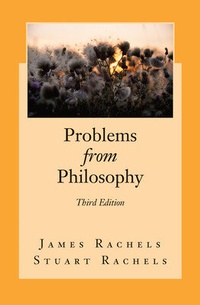
Problems from Philosophy
3rd Edition
Published on 16. February 2011
Book
Paperback/Softback
224 pages
978-0-07-353589-0 (ISBN)
Description
Problems from Philosophy is an introduction to philosophy which is organized around the great philosophical problems-the existence of God, the nature of the mind, human freedom, the limits of knowledge, and the truth about ethics. It begins by reflecting on the life of the first great philosopher, Socrates. Then it takes up the fundamental question of whether God exists. Next comes a discussion of death and the soul, which leads to a chapter about persons. The later chapters of the book are about whether objective knowledge is possible in science and ethics. Each chapter is self-contained and may be read independently of the others.
Problems from Philosophy represents the final work of author and philosopher James Rachels. In it, he brings the same liveliness and clarity to the introduction of philosophy that he brings to his best-selling ethics text, The Elements of Moral Philosophy. The second and third edition have been revised by Rachels' son Stuart, who carefully has carefully refined his father's work to further strengthen its clarity and accessibility.
Problems from Philosophy represents the final work of author and philosopher James Rachels. In it, he brings the same liveliness and clarity to the introduction of philosophy that he brings to his best-selling ethics text, The Elements of Moral Philosophy. The second and third edition have been revised by Rachels' son Stuart, who carefully has carefully refined his father's work to further strengthen its clarity and accessibility.
More details
Other editions
Previous edition
James Rachels | Stuart Rachels
Problems from Philosophy
Book
04/2008
2nd Edition
McGraw Hill Higher Education
€49.51
Article exhausted; check for reprint
Persons
James Rachels, the distinguished American moral philosopher, was born in Columbus, Georgia. He graduated from Mercer University in Macon in 1962. He received his PhD in 1967 from the University of North Carolina, Chapel Hill. He taught at the University of Richmond, New York University, the University of Miami, Duke University, and the University of Alabama at Birmingham, where he spent the last twenty-six years of his career. 1971 saw the publication of Rachels groundbreaking textbook Moral Problems, which ignited the movement in America away from teaching ethical theory towards teaching concrete practical issues. Moral Problems sold 100,000 copies over three editions. In 1975, Rachels wrote Active and Passive Euthanasia, arguing that the distinction so important in the law between killing and letting die has no rational basis. Originally appearing in the New England Journal of Medicine, this essay has been reprinted roughly 300 times and is a staple of undergraduate education. The End of Life (1986) was about the morality of killing and the value of life. Created from Animals (1990) argued that a Darwinian world-view has widespread philosophical implications, including drastic implications for our treatment of nonhuman animals. Can Ethics Provide Answers? (1997) was Rachels first collection of papers (others are expected posthumously). Rachels McGraw-Hill textbook, The Elements of Moral Philosophy, is now in its fourth edition and is easily the best-selling book of its kind.Over his career, Rachels wrote 5 books and 85 essays, edited 7 books and gave about 275 professional lectures. His work has been translated into Dutch, Italian, Japanese, and Serbo-Croatian. James Rachels is widely admired as a stylist, as his prose is remarkably free of jargon and clutter. A major theme in his work is that reason can resolve difficult moral issues. He has given reasons for moral vegetarianism and animal rights, for affirmative action (including quotas), for the humanitarian use of euthanasia, and for the idea that parents owe as much moral consideration to other peoples children as they do to their own. James Rachels died of cancer on September 5th, 2003, in Birmingham, Alabama.
Stuart Rachels is Associate Professor of Philosophy at the University of Alabama. He has revised several of James Rachels books, including Problems from Philosophy (second edition, 2009) and The Right Thing to Do (fifth edition, 2010), which is the companion anthology to this book. Stuart won the United States Chess Championship in 1989 at the age of 20, and he is a Bronze Life Master at bridge. His website is www.jamesrachels.org/stuart.
Stuart Rachels is Associate Professor of Philosophy at the University of Alabama. He has revised several of James Rachels books, including Problems from Philosophy (second edition, 2009) and The Right Thing to Do (fifth edition, 2010), which is the companion anthology to this book. Stuart won the United States Chess Championship in 1989 at the age of 20, and he is a Bronze Life Master at bridge. His website is www.jamesrachels.org/stuart.
Content
Contents Preface About the Third Edition 1.THE LEGACY OF SOCRATES 1.1 Why Was Socrates Condemned? 1.2 Why Did Socrates Believe He Had to Die? 2.GOD AND THE ORIGIN OF THE UNIVERSE 2.1 Is It Reasonable to Believe in God? 2.2 The Argument from Design 2.3 Evolution and Intelligent Design 2.4 The First Cause Argument 2.5 The Idea That God Is a Necessary Being 3.THE PROBLEM OF EVIL 3.1 Why Do Good People Suffer? 3.2 God and Evil 3.3 Free Will and Moral Character 4.DO WE SURVIVE DEATH? 4.1 The Idea of an Immortal Soul 4.2 Is There Any Credible Evidence of an Afterlife? 4.3 Hume's Argument against Miracles 5.THE PROBLEM OF PERSONAL IDENTITY 5.1 The Problem 5.2 Personhood at a Time 5.3 Personhood over Time 5.4 Bodily Continuity 5.5 Memory 6.BODY AND MIND 6.1 Descartes and Elizabeth 6.2 Materialist Theories of the Mind 6.3 Doubts about Materialist Theories 7.COULD A MACHINE THINK? 7.1 Brains and Computers 7.2 An Argument That Machines Could Think 7.3 The Turing Test 7.4 Why the Turing Test Fails 8.THE CASE AGAINST FREE WILL 8.1 Are People Responsible for What They Do? 8.2 Determinism 8.3 Psychology 8.4 Genes and Behavior 9.THE DEBATE OVER FREE WILL 9.1 The Determinist Argument 9.2 The Libertarian Response 9.3 The Compatibilist Response 9.4 Ethics and Free Will 10. OUR KNOWLEDGE OF THE WORLD AROUND US 10.1 Vats and Demons 10.2 Idealism 10.3 What Evidence for These Views Might Be Like 10.4 Descartes' Theological Response 10.5 Direct vs. Indirect Realism 10.6 Vision and the Brain 10.7 Conclusion 11. ETHICS AND OBJECTIVITY 11.1 Thrasymachus's Challenge 11.2 Is Ethics Just a Matter of Social Conventions? 11.3 Ethics and Science 11.4 The Importance of Human Interests 12. WHY SHOULD WE BE MORAL? 12.1 The Ring of Gyges 12.2 Ethics and Religion 12.3 The Social Contract 12.4 Morality and Benevolence 13. THE MEANING OF LIFE 13.1 The Problem of the Point of View 13.2 Happiness 13.3 Death 13.4 Religion and the Indifferent Universe 13.5 The Meaning of Particular LivesAppendix: How to Evaluate ArgumentsNotes on SourcesIndex