

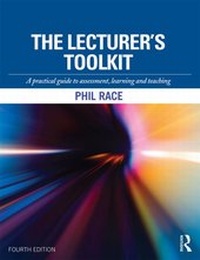
The Lecturer's Toolkit
A practical guide to assessment, learning and teaching
4th Edition
Published on 2. December 2014
Book
Paperback/Softback
286 pages
978-1-138-78645-5 (ISBN)
Description
The Lecturer's Toolkit is a wide-ranging, down-to-earth, practical resource for lecturers and teachers in universities and colleges. Jargon-free and written with authority, clarity and candour, the Toolkit addresses a broad range of aspects of assessment, feedback, learning and teaching, and helps develop many facets of professional practice.
Built around a central agenda of improving the quality of student learning, the Toolkit is outcomes-focused. Building on the strengths of its predecessors, this fourth edition includes strengthened emphasis on assessment and feedback, and designing large-group teaching for the digital age, when students can get easy access to a vast range of learning resource materials online. Coverage includes:
how students really learn;
designing assessment and feedback to enhance learning;
lectures in the digital age;
making small-group teaching work;
resource-based learning in the digital age;
looking after yourself;
challenges and reflections.
Fully updated and expanded, this fourth edition of the Toolkit will be an essential and flexible resource for every higher education professional.
Built around a central agenda of improving the quality of student learning, the Toolkit is outcomes-focused. Building on the strengths of its predecessors, this fourth edition includes strengthened emphasis on assessment and feedback, and designing large-group teaching for the digital age, when students can get easy access to a vast range of learning resource materials online. Coverage includes:
how students really learn;
designing assessment and feedback to enhance learning;
lectures in the digital age;
making small-group teaching work;
resource-based learning in the digital age;
looking after yourself;
challenges and reflections.
Fully updated and expanded, this fourth edition of the Toolkit will be an essential and flexible resource for every higher education professional.
Reviews / Votes
"If you currently favour traditional lecturing and written examinations, The Lecturer's Toolkit may contain a series of revelations. If instead you have a passion for active teaching and assessment and you are looking for a refined and highly readable compendium of wisdom and insight, this book comes highly recommended." -Education in ChemistryMore details
Edition
4th New edition
Language
English
Place of publication
London
United Kingdom
Publishing group
Taylor & Francis Ltd
Target group
Professional and scholarly
Edition type
New edition
Illustrations
7 s/w Abbildungen, 13 s/w Tabellen, 7 s/w Zeichnungen
7 Line drawings, black and white; 13 Tables, black and white; 7 Illustrations, black and white
Dimensions
Height: 248 mm
Width: 189 mm
Weight
567 gr
ISBN-13
978-1-138-78645-5 (9781138786455)
Copyright in bibliographic data and cover images is held by Nielsen Book Services Limited or by the publishers or by their respective licensors: all rights reserved.
Schweitzer Classification
Other editions
New editions
Book
10/2019
5th Edition
Routledge
€56.00
Article exhausted; check for reprint
Additional editions
Book
12/2014
4th Edition
Routledge
€163.42
Article exhausted; check for reprint
Previous edition
Book
08/2006
3rd Edition
Routledge
€67.03
Article exhausted; check for reprint
Person
Phil Race is a Visiting Professor at Plymouth University and at University Campus, Suffolk, and Emeritus Professor of Leeds Metropolitan University. He is a Principal Fellow of the Higher Education Academy, and a National Teaching Fellow. He continues to travel widely in the UK and abroad giving conference keynotes and running staff development workshops in universities and colleges. His other publications include Making Learning Happen (2014) and How to Get a Good Degree (2007). For further information, visit www.phil-race.co.uk.
Content
Preface to the fourth edition Acknowledgements Chapter 1: How students really learn Chapter 2: Designing assessment and feedback to enhance learning Chapter 3: Lectures in the digital age Chapter 4: Making small-group teaching work Chapter 5: Resource-based learning in the digital age Chapter 6: Looking after yourself Chapter 7: Challenges and reflections References