

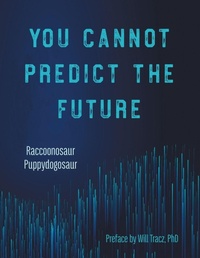
You Cannot Predict the Future
Published on 12. October 2018
Book
Paperback/Softback
162 pages
978-1-7325864-0-6 (ISBN)
Description
Almost all activities in contemporary software projects try to predict the future – analyzing, architecting, programming, testing, budgeting, and scheduling. Since nobody can yet reliably predict the future, those activities cannot possibly work as well as desired.
Unknowns: Unknowns lie at the root of all software problems, otherwise someone could just fix them. Unknowns make bugs and enhancements inevitable.
Bride-of-Agile: Sponsoring-organization obligations to projects concern politics and resources. Bride-of-Agile practices include working through continual change, fostering diversity and debate, and dealing with problem stakeholders.
Determinism versus Emergence: Determinism enables productive use of existing tools and practices. Emergence provides opportunities to write new programs that will benefit others. Recent skirmishes between Waterfall and Agile extend the 2500-year-long battle within philosophy and science over causality and free will.
Polish versus Rot: The Sunrise problem sheds light on the concept of good enough for now. Quality improves through polish – analysis, programming, and testing. Quality worsens through rot – changing expectations, usages, and technologies. Technical debt embodies the economic tradeoffs of deferring polish and rot.
Coping with Surprise: Subjective search underlies Agile and Bride-of-Agile practices, helping everyone to be less wrong and to cope with surprises. Plans are essential but, alas, even the best laid plans go oft astray.
More details
Language
English
Product notice
Paperback (trade)
Unsewn / adhesive bound
Illustrations
8 Illustrations
Dimensions
Height: 280 mm
Width: 216 mm
Thickness: 10 mm
Weight
426 gr
ISBN-13
978-1-7325864-0-6 (9781732586406)
Copyright in bibliographic data and cover images is held by Nielsen Book Services Limited or by the publishers or by their respective licensors: all rights reserved.
Schweitzer Classification