

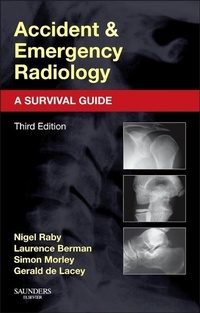
Accident and Emergency Radiology: A Survival Guide
3rd Edition
Published on 1. September 2014
Book
Paperback/Softback
384 pages
978-0-7020-4232-4 (ISBN)
Description
Since it was first published, Accident and Emergency Radiology: A Survival Guide has become the classic in-my-pocket-reference and an indispensable aid to all those who work in the Emergency Department. The core and substantial value lies in the step-by-step analytical approaches which help you to answer this question: "These images look normal to me, but . . . how can I be sure that I am not missing a subtle but important abnormality?"
"This book will provide essential reading and support to A&E trainees, medical students, radiology trainees, reporting radiographers and clinical nurse specialists, all of whom may be faced with trauma cases requiring accurate diagnosis and treatment." Reviewed by: RAD Magazine Feb 2015
"... Very nearly flawless...contains just the right amount of information to accommodate readers from trainees through to consultant or attending level." Reviewed by African Journal of Emergency Medicine , Jun 2015
Ensure accuracy in reading and interpretation of any given image. Common sources of error and diagnostic difficulty are highlighted.
Prevent mistakes. Pitfalls and associated abnormalities are emphasized throughout.
Avoid misdiagnoses. Normal anatomy is outlined alongside schemes for detecting variants of the norm. Each chapter concludes with a summary of key points. Will provide a useful overview of the most important features in diagnosis and interpretation.
Easily grasp difficult anatomical concepts. Radiographs accompanied by clear, explanatory line-drawings.
Spend less time searching with an improved layout and design with succinct, easy-to-follow text. A templated chapter approach helps you access key information quickly. Each chapter includes key points summary, basic radiographs, normal anatomy, guidance on analyzing the radiographs, common injuries, rare but important injuries, pitfalls, regularly overlooked injuries, examples, and references.
Grasp the nuances of key diagnostic details. Updated and expanded information, new radiographs, and new explanatory line drawings reinforce the book's aim of providing clear, practical advice in diagnosis.
Avoid pitfalls in the detection of abnormalities that are most commonly overlooked or misinterpreted.
Access the complete contents and illustrations online at Expert Consult-fully searchable!
"This book will provide essential reading and support to A&E trainees, medical students, radiology trainees, reporting radiographers and clinical nurse specialists, all of whom may be faced with trauma cases requiring accurate diagnosis and treatment." Reviewed by: RAD Magazine Feb 2015
"... Very nearly flawless...contains just the right amount of information to accommodate readers from trainees through to consultant or attending level." Reviewed by African Journal of Emergency Medicine , Jun 2015
Ensure accuracy in reading and interpretation of any given image. Common sources of error and diagnostic difficulty are highlighted.
Prevent mistakes. Pitfalls and associated abnormalities are emphasized throughout.
Avoid misdiagnoses. Normal anatomy is outlined alongside schemes for detecting variants of the norm. Each chapter concludes with a summary of key points. Will provide a useful overview of the most important features in diagnosis and interpretation.
Easily grasp difficult anatomical concepts. Radiographs accompanied by clear, explanatory line-drawings.
Spend less time searching with an improved layout and design with succinct, easy-to-follow text. A templated chapter approach helps you access key information quickly. Each chapter includes key points summary, basic radiographs, normal anatomy, guidance on analyzing the radiographs, common injuries, rare but important injuries, pitfalls, regularly overlooked injuries, examples, and references.
Grasp the nuances of key diagnostic details. Updated and expanded information, new radiographs, and new explanatory line drawings reinforce the book's aim of providing clear, practical advice in diagnosis.
Avoid pitfalls in the detection of abnormalities that are most commonly overlooked or misinterpreted.
Access the complete contents and illustrations online at Expert Consult-fully searchable!
Reviews / Votes
"It contains just the right amount of information to accommodate readers from trainees through to consultant or attending level; it can just as easily be used for revision as it can for reference". Reviewed by African Journal of Emergency Medicine , Jun 2015"Since the publication of the first edition in 1995, this book has been essential reading for anyone working in the acute world of a casualty department. This book will provide essential reading and support to A&E trainees, medical students, radiology trainees, reporting radiographers and clinical nurse specialists, all of whom may be faced with trauma cases requiring accurate diagnosis and treatment. It will [also] remind more senior clinical staff about some of the less frequent signs and principles relating to radiograph interpretation." Reviewed by RAD Magazine, Feb 2015
More details
Edition
3rd edition
Language
English
Place of publication
London
United Kingdom
Publishing group
Elsevier Health Sciences
Target group
Professional and scholarly
Physicians and other health care professionals working in the Emergency Department.
Illustrations
Approx. 510 illustrations (70 in full color); Illustrations
Dimensions
Height: 216 mm
Width: 139 mm
Thickness: 22 mm
Weight
676 gr
ISBN-13
978-0-7020-4232-4 (9780702042324)
Copyright in bibliographic data and cover images is held by Nielsen Book Services Limited or by the publishers or by their respective licensors: all rights reserved.
Schweitzer Classification
Other editions
Additional editions
Nigel Raby | Laurence Berman | Simon Morley
Accident and Emergency Radiology: A Survival Guide
E-Book
04/2014
3rd Edition
Saunders
€37.99
Available for download
Previous edition
Book
01/2005
2nd Edition
Saunders
€76.94
Article exhausted; check for reprint
Persons
By Nigel Raby, FRCR, Consultant Radiologist,Western Infirmary, Glasgow Consultant Radiologist; Laurence Berman, MB, BS, FRCP, FRCR, Lecturer and Honorary Consultant Radiologist, University of Cambridge and Addenbrooke's Hospital, Cambridge Consultant Radiologist; Simon Morley, FRCR, Consultant Radiologist, University College Hospitals, London, UK and Gerald de Lacey, MA, FRCR, Consultant Radiologist to www.radiology-courses.com and formerly Consultant Radiologist at Northwick Park Hospital, London, UK
Author
Consultant Radiologist,Western Infirmary, Glasgow
Consultant Radiologist
Consultant Radiologist
Lecturer and Honorary Consultant Radiologist, University of Cambridge and Addenbrooke's Hospital, Cambridge
Consultant Radiologist
Consultant Radiologist
Consultant Radiologist, University College Hospitals, London, UK
Consultant Radiologist to www.radiology-courses.com and formerly Consultant Radiologist at Northwick Park Hospital, London, UK
Content
Basic Principles
Skull
Face
Shoulder
Elbow
Wrist and Distal Forearm
Hand and Fingers
Cervical Spine
Thoracic and Lumbar Spine
Pelvis
Hip and Proximal Femur
Knee
Ankle and Hindfoot
Midfoor and Forefoot
Chest
Abdomen
Penetrating Foreign Bodies
Swallowed Foreign Bodies
Particular Paediatric Points
Glossary
Skull
Face
Shoulder
Elbow
Wrist and Distal Forearm
Hand and Fingers
Cervical Spine
Thoracic and Lumbar Spine
Pelvis
Hip and Proximal Femur
Knee
Ankle and Hindfoot
Midfoor and Forefoot
Chest
Abdomen
Penetrating Foreign Bodies
Swallowed Foreign Bodies
Particular Paediatric Points
Glossary