

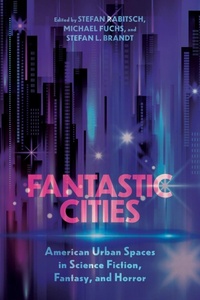
Fantastic Cities
American Urban Spaces in Science Fiction, Fantasy, and Horror
Published on 4. February 2022
Book
Paperback/Softback
322 pages
978-1-4968-3663-2 (ISBN)
Description
Metropolis, Gotham City, Mega-City One, Panem's Capitol, the Sprawl, Caprica City-American (and Americanized) urban environments have always been a part of the fantastic imagination. Fantastic Cities: American Urban Spaces in Science Fiction, Fantasy, and Horror focuses on the American city as a fantastic geography constrained neither by media nor rigid genre boundaries. Fantastic Cities builds on a mix of theoretical and methodological tools that are drawn from criticism of the fantastic, media studies, cultural studies, American studies, and urban studies.
Contributors explore cultural media across many platforms such as Christopher Nolan's Dark Knight Trilogy, the Arkham Asylum video games, the 1935 movie serial The Phantom Empire, Kim Stanley Robinson's fiction, Colson Whitehead's novel Zone One, the vampire films Only Lovers Left Alive and A Girl Walks Home Alone at Night, Paolo Bacigalupi's novel The Water Knife, some of Kenny Scharf's videos, and Samuel Delany's classic Dhalgren. Together, the contributions in Fantastic Cities demonstrate that the fantastic is able to "real-ize" that which is normally confined to the abstract, metaphorical, and/or subjective. Consequently, both utopian aspirations for and dystopian anxieties about the American city become literalized in the fantastic city.
Contributions by Carl Abbott, Jacob Babb, Marleen S. Barr, Michael Fuchs, John Glover, Stephen Joyce, Sarah Lahm, James McAdams, Cynthia J. Miller, Fernando Gabriel Pagnoni Berns, Chris Pak, Maria Isabel Perez Ramos, Stefan Rabitsch, J. Jesse Ramirez, A. Bowdoin Van Riper, Andrew Wasserman, Jeffrey Andrew Weinstock, and Robert Yeates.
Contributors explore cultural media across many platforms such as Christopher Nolan's Dark Knight Trilogy, the Arkham Asylum video games, the 1935 movie serial The Phantom Empire, Kim Stanley Robinson's fiction, Colson Whitehead's novel Zone One, the vampire films Only Lovers Left Alive and A Girl Walks Home Alone at Night, Paolo Bacigalupi's novel The Water Knife, some of Kenny Scharf's videos, and Samuel Delany's classic Dhalgren. Together, the contributions in Fantastic Cities demonstrate that the fantastic is able to "real-ize" that which is normally confined to the abstract, metaphorical, and/or subjective. Consequently, both utopian aspirations for and dystopian anxieties about the American city become literalized in the fantastic city.
Contributions by Carl Abbott, Jacob Babb, Marleen S. Barr, Michael Fuchs, John Glover, Stephen Joyce, Sarah Lahm, James McAdams, Cynthia J. Miller, Fernando Gabriel Pagnoni Berns, Chris Pak, Maria Isabel Perez Ramos, Stefan Rabitsch, J. Jesse Ramirez, A. Bowdoin Van Riper, Andrew Wasserman, Jeffrey Andrew Weinstock, and Robert Yeates.
More details
Language
English
Place of publication
Jackson
United States
Target group
Professional and scholarly
Product notice
Paperback (trade)
Illustrations
35 b&w illustrations
Dimensions
Height: 234 mm
Width: 156 mm
Thickness: 19 mm
Weight
550 gr
ISBN-13
978-1-4968-3663-2 (9781496836632)
Copyright in bibliographic data and cover images is held by Nielsen Book Services Limited or by the publishers or by their respective licensors: all rights reserved.
Schweitzer Classification
Other editions
Additional editions
Stefan Rabitsch | Michael Fuchs | Stefan L. Brandt
Fantastic Cities
American Urban Spaces in Science Fiction, Fantasy, and Horror
E-Book
02/2022
NYU Press
€29.49
Available for download
Persons
Stefan Rabitsch is author of Star Trek and the British Age of Sail: The Maritime Influence Throughout the Series and the Films and coeditor of Set Phasers to Teach! Star Trek in Research and Teaching.
Michael Fuchs is coeditor of Intermedia Games-Games Inter Media: Video Games and Intermediality; ConFiguring America: Iconic Figures, Visuality, and the American Identity; Placing America: American Culture and Its Spaces; and Landscapes of Postmodernity: Concepts and Paradigms of Critical Theory.
Stefan L. Brandt is professor of American studies at the University of Graz in Austria. He is author of The Culture of Corporeality: Aesthetic Experience and the Embodiment of America, 1945-1960 and coeditor of Ecomasculinities: Negotiating Male Gender Identity in U.S. Fiction; Space Oddities: Difference and Identity in the American City; Making National Bodies: Cultural Identity and the Politics of the Body in (Post-)Revolutionary America; and Transnational American Studies.
Michael Fuchs is coeditor of Intermedia Games-Games Inter Media: Video Games and Intermediality; ConFiguring America: Iconic Figures, Visuality, and the American Identity; Placing America: American Culture and Its Spaces; and Landscapes of Postmodernity: Concepts and Paradigms of Critical Theory.
Stefan L. Brandt is professor of American studies at the University of Graz in Austria. He is author of The Culture of Corporeality: Aesthetic Experience and the Embodiment of America, 1945-1960 and coeditor of Ecomasculinities: Negotiating Male Gender Identity in U.S. Fiction; Space Oddities: Difference and Identity in the American City; Making National Bodies: Cultural Identity and the Politics of the Body in (Post-)Revolutionary America; and Transnational American Studies.