

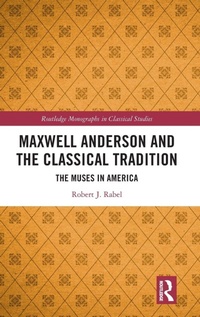
Maxwell Anderson and the Classical Tradition
The Muses in America
1st Edition
Published on 15. April 2025
Book
Hardback
222 pages
978-1-032-78283-6 (ISBN)
Description
This book sheds new light on the dramatic works of the American playwright, poet, and lyricist Maxwell Anderson, assessing the pervasive influence of Greek and Roman antiquity on his plays that dominated Broadway in the first half of the twentieth century.
Anderson is an important, though often forgotten, figure in the history of American drama and the Classical Tradition. The book highlights Anderson's remarkably creative use of classical antiquity, while also illustrating how he served as a first-hand witness and reactor to some of the main social and political events of his time. It explores Anderson's major theatrical works and adaptations of ancient Greek drama and poetry, including Winterset, The Winged Victory, the never-published Ulysses Africanus, and Bad Seed, as well as his later minor works. Anderson found in tragedians such as Aeschylus, Sophocles, and Euripides ideal models for the dramatic portrayal of human emotion amidst the social and political backdrop of the United States from the interwar period to the nuclear age, which this book seeks to explore at length for the first time.
This volume is of interest to students and scholars of Classical Reception and the Classical Tradition, as well as those working on twentieth century American literature, drama, history, and politics.
Anderson is an important, though often forgotten, figure in the history of American drama and the Classical Tradition. The book highlights Anderson's remarkably creative use of classical antiquity, while also illustrating how he served as a first-hand witness and reactor to some of the main social and political events of his time. It explores Anderson's major theatrical works and adaptations of ancient Greek drama and poetry, including Winterset, The Winged Victory, the never-published Ulysses Africanus, and Bad Seed, as well as his later minor works. Anderson found in tragedians such as Aeschylus, Sophocles, and Euripides ideal models for the dramatic portrayal of human emotion amidst the social and political backdrop of the United States from the interwar period to the nuclear age, which this book seeks to explore at length for the first time.
This volume is of interest to students and scholars of Classical Reception and the Classical Tradition, as well as those working on twentieth century American literature, drama, history, and politics.
More details
Series
Language
English
Place of publication
London
United Kingdom
Publishing group
Taylor & Francis Ltd
Target group
College/higher education
Professional and scholarly
Postgraduate and Undergraduate Advanced
Illustrations
10 s/w Abbildungen, 10 s/w Photographien bzw. Rasterbilder
10 Halftones, black and white; 10 Illustrations, black and white
Dimensions
Height: 240 mm
Width: 161 mm
Thickness: 17 mm
Weight
520 gr
ISBN-13
978-1-032-78283-6 (9781032782836)
Copyright in bibliographic data and cover images is held by Nielsen Book Services Limited or by the publishers or by their respective licensors: all rights reserved.
Schweitzer Classification
Other editions
Additional editions
E-Book
04/2025
Routledge
€60.99
Available for download
E-Book
04/2025
Routledge
€60.99
Available for download
Person
Robert J. Rabel is Professor of Classics at the University of Kentucky, Lexington, Kentucky. He has also taught at Dartmouth College, Hanover, New Hampshire. He is the author of Plot and Point of View in the Iliad (1997) and editor of Approaches to Homer, Ancient and Modern (2005). He has also written articles on Homer, Greek tragedy, Greek and Roman philosophy, Greek history, Roman epic, Classics and film, and Classical influences on American drama. He is currently writing a book applying the modern theory of political realism to the Iliad and the movie Troy, to be titled Getting Real about the Trojan War.
Content
Introduction; 1. To Anderson through Aeschylus: Winterset and the Oresteia; 2. To Anderson through Euripides: The Wingless Victory and the Medea; 3. To Anderson Through Homer: The Ulysses Africanus of Maxwell Anderson and Kurt Weill; 4. To Anderson Through Aristotle, Sophocles, and William March: Bad Seed; 5. Late Minor Works; Afterward: Maxwell Who?