

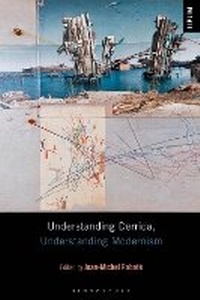
Understanding Derrida, Understanding Modernism
Published on 30. May 2019
Book
Hardback
328 pages
978-1-5013-3186-2 (ISBN)
Description
This volume makes a significant contribution to both the study of Derrida and of modernist studies. The contributors argue, first, that deconstruction is not "modern"; neither is it "postmodern" nor simply "modernist." They also posit that deconstruction is intimately connected with literature, not because deconstruction would be a literary way of doing philosophy, but because literature stands out as a "modern" notion. The contributors investigate the nature and depth of Derrida's affinities with writers such as Joyce, Kafka, Antonin Artaud, Georges Bataille, Paul Celan, Maurice Blanchot, Theodor Adorno, Samuel Beckett, and Walter Benjamin, among others.
With its strong connection between philosophy and literary modernism, this highly original volume advances modernist literary study and the relationship of literature and philosophy.
With its strong connection between philosophy and literary modernism, this highly original volume advances modernist literary study and the relationship of literature and philosophy.
Reviews / Votes
Understanding Derrida, Understanding Modernism is a superb, transformative exercise of critical thought, attuned to both contextual and philosophical-ethical differance; it allows Derrida's work to be read next to, and by, a multi-angled and often eccentric philosophical and literary modernism. In a scholarship of industrial proportions, it stands out as writing after one of the most revolutionary thinkers of all time. * Textual Practice * Rabate's collection releases Derrida from negative and narrow appreciations of deconstruction to reveal a multifaceted philosopher with contrasting concerns and projects for the study of literary modernism and modernity. Simultaneously, modernism and modernity are throughout proven as apposite lenses for contextualizing and apprehending Derrida's various pursuits. [...] In concretely outlining Derrida's links to canonical modernisms, and repeatedly insisting on the continued relevance of Derrida's philosophical rigour, Rabate's collection lays the groundwork for the elaboration of such connections in the future. * Journal of Modern Literature * The 14 diverse and original essays in this volume-along with Rabate's important introduction and brilliant glossary of Derrida keywords-make it an immensely useful resource for understanding Derrida's relation to major European modernists...More important, however, are the local insights these essays provide on topics such as Baudelaire's ethics of almsgiving, the difference between Agamben and Derrida on reading Kafka, the relation of Bataille's "general economy" to Derrida's "arche-writing," the agon between Derrida and Sartre vis-a-vis Genet... Summing Up: Highly recommended. * CHOICE * Derrida as a reader of modernism; Derrida as a modernist: both these propositions-and the relationship between them-are explored in this fascinating collection of essays, ably introduced and edited by Rabate. The volume makes a fresh contribution to our understanding of the reach and richness of Derrida's work as well as the multifaceted character of modernist literature and philosophy. * Derek Attridge, Emeritus Professor of English, University of York, UK, and author of The Singularity of Literature (2004) * Who, or better yet, what speaks in 'literature' for Derrida? This long-awaited book offers thought-provoking answers to this question, examined here through close readings of Derrida's countersignatures to writers such as Baudelaire, Kafka, Celan, Joyce, Blanchot, Beckett, and Cixous. Neither a theory nor a critical method, Derrida's approach gives us something else to ponder: the conditions of the impossible enacted by the event of literature. This impressive volume thus allows us to better understand how Derrida reconfigures the concept of modernity, beyond all labels, genres, or periodizations. Moreover, this book is itself a remarkable and timely contribution to the 'humanities to come' Derrida so pressingly called for. Whether it concern the Law, the absolute singularity of the other, the secret and testimony, or democracy, literature always lies affirmatively and performatively at the very core of Derrida's thought. * Ginette Michaud, Professor of French Literature, Universite de Montreal, Canada *More details
Series
Language
English
Place of publication
New York
United States
Publishing group
Bloomsbury Publishing Plc
Target group
College/higher education
Dimensions
Height: 229 mm
Width: 152 mm
Weight
612 gr
ISBN-13
978-1-5013-3186-2 (9781501331862)
Copyright in bibliographic data and cover images is held by Nielsen Book Services Limited or by the publishers or by their respective licensors: all rights reserved.
Schweitzer Classification
Other editions
Additional editions
Jean-Michel Rabate
Understanding Derrida, Understanding Modernism
E-Book
05/2019
1st Edition
Bloomsbury Academic USA
€38.49
Available for download
Person
Jean-Michel Rabate is one of the world's foremost literary theorists. Since 1992, he has been professor of English and Comparative Literature at the University of Pennsylvania, USA. Professor Rabate has authored or edited more forty books on modernism, psychoanalysis, contemporary art, philosophy, and writers like Beckett, Pound and Joyce. Recent books include Crimes of the Future (Bloomsbury, 2014), The Cambridge Introduction to Psychoanalysis and Literature (2014), The Pathos of Distance (Bloomsbury, 2016), and Rust (Bloomsbury, 2018). He is one of the founders and curators of Slought Foundation in Philadelphia (slought.org) and the Managing Editor of the Journal of Modern Literature. Since 2008, he has been a Fellow of the American Academy of Arts and Sciences.
Content
Introduction: Derrida's modernity and our modernism
Jean-Michel Rabate, University of Pennsylvania, USA
Part 1. Rethinking the main concepts of modernism
1. Trickster Economy: Derrida's Baudelaire, and the Role of Money, Counterfeits, and Alms in the Modern City
Marit Grotta, University of Oslo, Norway
2. Kant's Celestial Economy; a Footnote to The Gift of Death
Eddis N. Miller, Pace University, USA
3. Derrida and Kafka: A Talmudic Disputation Before the Law
Vivian Liska, Antwerp University, Belgium
4. Derrida with Heidegger: Poetic Language, Animality, World
Jennifer Anna Gosetti-Ferencei, Fordham University, USA
5. To Wound the Language: Derrida Reads Celan
Miriam Jerade, University of Mexico, Mexico
Part 2. Engaging with the poetics of canonical modernism
6. Derrida's Joyce
Sam Slote, Trinity College, Dublin
7. Derrida re-voicing Artaud
Alheli Alvarado, Columbia University, USA
8. Derrida on Bataille: from dueling to duet
Claire Lozier, University of Leeds, UK
9. A Cross in the margin, Inscription and Erasure in Derrida and Pound
Mark Byron, University of Sydney, Australia
10. Derrida after Valery (after Derrida)
Suzanne Guerlac, University of California, Berkeley, USA
Part 3. Differance as performance: pushing modernism beyond its borders
11. Three ways of looking at Derrida's encounter with Austin
Raoul Moati, University of Chicago, USA
12. Writing in the Shadow of Sartre's Genet, Derrida's Glas and the Ethics of Biography
Robert Doran, Rochester University, USA
13. Derrida, Cixous, and (Feminine) Writing
Marta Segarra, University of Barcelona, Spain
14. Reading between the lines: Derrida, Blanchot, Beckett
Leslie Hill, University of Warwick, UK
Part 4. Glossary
Jean-Michel Rabate
Aporia
Auto-immunity
Biography/Autobiography/Autothanatography
Deconstruction
Differance
Hauntology
Hospitality
Iterability
Lies
Methods
Performative
Poetry
Undecidability
Writing / Texting
Index
Jean-Michel Rabate, University of Pennsylvania, USA
Part 1. Rethinking the main concepts of modernism
1. Trickster Economy: Derrida's Baudelaire, and the Role of Money, Counterfeits, and Alms in the Modern City
Marit Grotta, University of Oslo, Norway
2. Kant's Celestial Economy; a Footnote to The Gift of Death
Eddis N. Miller, Pace University, USA
3. Derrida and Kafka: A Talmudic Disputation Before the Law
Vivian Liska, Antwerp University, Belgium
4. Derrida with Heidegger: Poetic Language, Animality, World
Jennifer Anna Gosetti-Ferencei, Fordham University, USA
5. To Wound the Language: Derrida Reads Celan
Miriam Jerade, University of Mexico, Mexico
Part 2. Engaging with the poetics of canonical modernism
6. Derrida's Joyce
Sam Slote, Trinity College, Dublin
7. Derrida re-voicing Artaud
Alheli Alvarado, Columbia University, USA
8. Derrida on Bataille: from dueling to duet
Claire Lozier, University of Leeds, UK
9. A Cross in the margin, Inscription and Erasure in Derrida and Pound
Mark Byron, University of Sydney, Australia
10. Derrida after Valery (after Derrida)
Suzanne Guerlac, University of California, Berkeley, USA
Part 3. Differance as performance: pushing modernism beyond its borders
11. Three ways of looking at Derrida's encounter with Austin
Raoul Moati, University of Chicago, USA
12. Writing in the Shadow of Sartre's Genet, Derrida's Glas and the Ethics of Biography
Robert Doran, Rochester University, USA
13. Derrida, Cixous, and (Feminine) Writing
Marta Segarra, University of Barcelona, Spain
14. Reading between the lines: Derrida, Blanchot, Beckett
Leslie Hill, University of Warwick, UK
Part 4. Glossary
Jean-Michel Rabate
Aporia
Auto-immunity
Biography/Autobiography/Autothanatography
Deconstruction
Differance
Hauntology
Hospitality
Iterability
Lies
Methods
Performative
Poetry
Undecidability
Writing / Texting
Index