

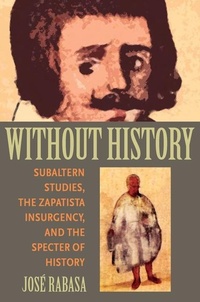
Without History
Subaltern Studies, the Zapatista Insurgency, and the Specter of History
Published on 27. June 2010
Book
Paperback/Softback
368 pages
978-0-8229-6065-2 (ISBN)
Description
On December 22, 1997, forty-five unarmed members of the indigenous organization Las Abejas (The Bees) were massacred during a prayer meeting in the village of Acteal, Mexico. The members of Las Abejas, who are pacifists, pledged their support to the Zapatista Army of National Liberation, a primarily indigenous group that has declared war on the state of Mexico. The massacre has been attributed to a paramilitary group composed of ordinary citizens acting on their own, although eyewitnesses claim the attack was planned ahead of time and that the Mexican government was complicit.
In Without History, Jos\u00e9 Rabasa contrasts indigenous accounts of the Acteal massacre and other events with state attempts to frame the past, control subaltern populations, and legitimatize its own authority. Rabasa offers new interpretations of the meaning of history from indigenous perspectives and develops the concept of a communal temporality that is not limited by time, but rather exists within the individual, community, and culture as a living knowledge that links both past and present.
Due to a disconnection between indigenous and state accounts as well as the lack of archival materials (many of which were destroyed by missionaries), the indigenous remain outside of, or without, history, according to most of Western discourse. The continued practice of redefining native history perpetuates the subalternization of that history, and maintains the specter of fabrication over reality.
Rabasa recalls the works of Marx, Lenin, and Gramsci, as well as contemporary south Asian subalternists Ranajit Guha and Dipesh Chakrabarty, among others. He incorporates their conceptions of communality, insurgency, resistance to hegemonic governments, and the creation of autonomous spaces as strategies employed by indigenous groups around the globe, but goes further in defining these strategies as millennial and deeply rooted in Mesoamerican antiquity. For Rabasa, these methods and the continuum of ancient indigenous consciousness are evidenced in present day events such as the Zapatista insurrection.
In Without History, Jos\u00e9 Rabasa contrasts indigenous accounts of the Acteal massacre and other events with state attempts to frame the past, control subaltern populations, and legitimatize its own authority. Rabasa offers new interpretations of the meaning of history from indigenous perspectives and develops the concept of a communal temporality that is not limited by time, but rather exists within the individual, community, and culture as a living knowledge that links both past and present.
Due to a disconnection between indigenous and state accounts as well as the lack of archival materials (many of which were destroyed by missionaries), the indigenous remain outside of, or without, history, according to most of Western discourse. The continued practice of redefining native history perpetuates the subalternization of that history, and maintains the specter of fabrication over reality.
Rabasa recalls the works of Marx, Lenin, and Gramsci, as well as contemporary south Asian subalternists Ranajit Guha and Dipesh Chakrabarty, among others. He incorporates their conceptions of communality, insurgency, resistance to hegemonic governments, and the creation of autonomous spaces as strategies employed by indigenous groups around the globe, but goes further in defining these strategies as millennial and deeply rooted in Mesoamerican antiquity. For Rabasa, these methods and the continuum of ancient indigenous consciousness are evidenced in present day events such as the Zapatista insurrection.
Reviews / Votes
A valuable contribution to scholarship on Latin American cultural studies and, in particular, Mexican culture and history. * <i>Choice</i> * Sheds new insights on the agency of postcolonial subjects (individuals, indigenous organizations, and local communities) that have survived outside of the Eurocentric conception of history. * <i>Latin American Research Review</i> * Truly outstanding and original. Rabasa provides a solid genealogy of indigenous thinking in dialogue with Western epistemes. He opens a universe of meaning for scholars interested in the ideological richness of the first confrontations between Europeans and Amerindians and explains the possibilities for the production of knowledge-all the way to the present, where history is still a terrain of struggle for contesting ideas and displaying the resiliency of subaltern epistemes. * Ileana Rodriguez, The Ohio State University * This collection brings together Jose Rabasa's groundbreaking essays on the EZLN and Tepoztlan as exemplary instances of subaltern discourse and struggle. Drawing on Marx, Gramsci, and contemporary subaltern theory, Rabasa argues for a conceptualization of the indigenous as outside history, capitol, and the state. This book is obligatory reading for those concerned with critical theory and Latin American cultural studies. * Cynthia Steele, University of Washington *More details
Series
Language
English
Place of publication
Pittsburgh PA
United States
Target group
College/higher education
Product notice
Paperback (trade)
Illustrations
17 illustrations
Dimensions
Height: 234 mm
Width: 160 mm
Thickness: 24 mm
Weight
522 gr
ISBN-13
978-0-8229-6065-2 (9780822960652)
Copyright in bibliographic data and cover images is held by Nielsen Book Services Limited or by the publishers or by their respective licensors: all rights reserved.
Schweitzer Classification
Other editions
Additional editions

E-Book
06/2010
United Methodist Publishing House
€59.49
Available for download
Person
Jose Rabasa teaches in the department of romance languages and literatures at Harvard University. He is the author of Inventing America: Spanish Historiography and the Formation of Eurocentrism and Writing Violence on the Northern Frontier: The Historiography of Sixteenth-Century New Mexico and Florida and the Legacy of Conquest.