

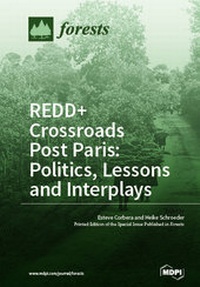
REDD+ Crossroads Post Paris: Politics, Lessons and Interplays
Politics, Lessons and Interplays
MDPI (Publisher)
1st Edition
Published on 26. January 2018
Book
Paperback/Softback
414 pages
978-3-03842-707-0 (ISBN)
Description
Reducing Emissions from Deforestation and Degradation, conserving and enhancing forest carbon stocks, and sustainably managing forests (REDD+), has become a reference framework for national forest governance across many tropical and sub-tropical forest countries. These countries have used international funding to re-organize forest and conservation policy around the idea of mitigating climate change, including the development of carbon accounting protocols and national REDD+ strategies. In parallel, international conservation organizations have promoted small-scale pilot project activities, in order to capture the economic value of any resulting land-use emission reductions, mostly through voluntary carbon markets.
This collection contributes with new evidence to the burgeoning research on REDD+. The first section of the collection includes eight articles that explore the politics of REDD+ design, which analyze how various governments have designed and rolled out their REDD+ strategies, and how and why a range of public and private actors become (or not) involved in such processes. These contributions explore which rationales, techniques, views and values are being contested and constructed in the design of REDD+ national strategies, which conflicts have emerged and why, or how coordination across competing actors and interests has been pursued.
The second section encompasses six articles that examine the lessons of REDD+ early actions, which describe or quantify the effects of such interventions on local environments and participants' socio-economic status and cultural contexts. Finally, the third section includes five articles that explore the interplays between REDD+ and other land-use policy domains, which focus on the synergies and contradictions between the aims and policy programs conforming REDD+ national strategies and other land-use policies. Specifically, these contributions explore if REDD+ is able to improve forest sector regulations in host countries and to to align other development and land-use planning policies with REDD+ objectives and aspirations.
This collection contributes with new evidence to the burgeoning research on REDD+. The first section of the collection includes eight articles that explore the politics of REDD+ design, which analyze how various governments have designed and rolled out their REDD+ strategies, and how and why a range of public and private actors become (or not) involved in such processes. These contributions explore which rationales, techniques, views and values are being contested and constructed in the design of REDD+ national strategies, which conflicts have emerged and why, or how coordination across competing actors and interests has been pursued.
The second section encompasses six articles that examine the lessons of REDD+ early actions, which describe or quantify the effects of such interventions on local environments and participants' socio-economic status and cultural contexts. Finally, the third section includes five articles that explore the interplays between REDD+ and other land-use policy domains, which focus on the synergies and contradictions between the aims and policy programs conforming REDD+ national strategies and other land-use policies. Specifically, these contributions explore if REDD+ is able to improve forest sector regulations in host countries and to to align other development and land-use planning policies with REDD+ objectives and aspirations.
More details
Language
English
Place of publication
Basel
Switzerland
Target group
Professional and scholarly
College/higher education
Scholars/ Professionals
Edition type
New edition
Product notice
Klappenbroschur
Unsewn / adhesive bound
Laminated cover
Illustrations
Illustrations
Dimensions
Height: 244 mm
Width: 170 mm
Thickness: 29 mm
Weight
885 gr
ISBN-13
978-3-03842-707-0 (9783038427070)
Schweitzer Classification