

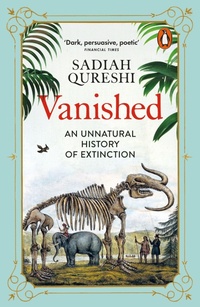
Vanished
An Unnatural History of Extinction
Will be published approx. on 27. August 2026
Book
Paperback/Softback
496 pages
978-0-14-198856-6 (ISBN)
Description
SHORTLISTED FOR THE ROYAL SOCIETY TRIVEDI SCIENCE BOOK PRIZE 2025 & BSHS PICKSTONE PRIZE 2026
A GUARDIAN & TELEGRAPH BEST SCIENCE BOOK 2025
WATERSTONES BEST POPULAR SCIENCE BOOK 2025
'A vital and important book' David Olusoga
From an award-winning historian of race, science and empire, a path-breaking and poignant history of extinction as a scientific idea, an imperial legacy and a political choice
Anyone alive today is among a tiny fraction of the once living: over 90% of species that ever existed are now extinct. How did we come to think of ourselves as survivors in a world where species can vanish forever, or as capable of pushing our planet to the verge of a sixth mass extinction?
Extinction, Sadiah Qureshi shows us, is a surprisingly modern concept - and a phenomenon that's not as natural as we might think. In Europe until the late eighteenth century, species were considered perfect and unchanging creations of God. Then in the age of revolutions, scientists gathered enough fossil evidence to determine that mammoth bones, for example, were not just large elephants but a lost species that once roamed the Earth alongside ancient humans. Extinction went from being regarded as theologically dangerous to pervasive, and even inevitable.
Yet Vanished shows us that extinction is more than a scientific idea; it's a political choice that has led to devasting consequences. Europeans and Americans quickly used the notion that extinction was a natural process to justify persecution and genocide, predicting that nations from Newfoundland's Beothuk to Aboriginal Australians were doomed to die out from imperial expansion.
Exploring the tangled and unnatural histories of extinction and empire, Vanished weaves together pioneering original research and breath-taking storytelling to show us extinction is both an evolutionary process and a human act: one which illuminates our past, and may alter our future.
A GUARDIAN & TELEGRAPH BEST SCIENCE BOOK 2025
WATERSTONES BEST POPULAR SCIENCE BOOK 2025
'A vital and important book' David Olusoga
From an award-winning historian of race, science and empire, a path-breaking and poignant history of extinction as a scientific idea, an imperial legacy and a political choice
Anyone alive today is among a tiny fraction of the once living: over 90% of species that ever existed are now extinct. How did we come to think of ourselves as survivors in a world where species can vanish forever, or as capable of pushing our planet to the verge of a sixth mass extinction?
Extinction, Sadiah Qureshi shows us, is a surprisingly modern concept - and a phenomenon that's not as natural as we might think. In Europe until the late eighteenth century, species were considered perfect and unchanging creations of God. Then in the age of revolutions, scientists gathered enough fossil evidence to determine that mammoth bones, for example, were not just large elephants but a lost species that once roamed the Earth alongside ancient humans. Extinction went from being regarded as theologically dangerous to pervasive, and even inevitable.
Yet Vanished shows us that extinction is more than a scientific idea; it's a political choice that has led to devasting consequences. Europeans and Americans quickly used the notion that extinction was a natural process to justify persecution and genocide, predicting that nations from Newfoundland's Beothuk to Aboriginal Australians were doomed to die out from imperial expansion.
Exploring the tangled and unnatural histories of extinction and empire, Vanished weaves together pioneering original research and breath-taking storytelling to show us extinction is both an evolutionary process and a human act: one which illuminates our past, and may alter our future.
Reviews / Votes
Highly readable and academically rigorous... traces the entanglements of race, empire and colonialism to better understand extinction -- Maya Goodfellow * Guardian * Dark, persuasive, detailed, poetic... exquisitely attuned to the (often overlooked) historical and political contexts in which scientific ideas thrive -- Anjana Ahuja * Financial Times * Qureshi's definitive account demonstrates that histories of extinction, empire, race and genocide must be written and read together... Acknowledging extinction's unnatural history may help us choose otherwise -- Helen Anne Curry * TLS * Groundbreaking -- Andrew Robinson * Nature * Qureshi's rigorous, fascinating narrative traces how understanding the regrettable impermanence of species such as the dodo and the Tasmanian tiger was reformulated, by dull minds in powerful places, into a justification for exploitation * Telegraph Greatest Books of 2025 * A poignant, compassionate exploration of the tangled and unnatural histories of extinction and empire. Professor Qureshi skilfully interweaves fascinating original research and compelling storytelling to show us that extinction is both an evolutionary process and a human act: one which illuminates our past, and may alter our future * Forbes * Wide-ranging... Qureshi deftly considers how narratives of extinction have shaped how we see the world-and each other -- A Smithsonian Magazine Best Science Book 2025 Vital... a breathtaking account of extinction * New Indian Express * Both authoritative and readable, panoramic in its scope and incisive in its argument... a truly original, challenging and consequential book -- Gary Younge Illuminating and disturbing in equal measure. A poignant and powerfully written account of the intellectual revolution that birthed the concept of extinction; a concept deployed to both justify and animate colonialism and even extermination. A vital and important book -- David OlusogaMore details
Language
English
Place of publication
London
United Kingdom
Product notice
Paperback (UK-B)
Dimensions
Height: 198 mm
Width: 129 mm
Thickness: 15 mm
Weight
368 gr
ISBN-13
978-0-14-198856-6 (9780141988566)
Copyright in bibliographic data and cover images is held by Nielsen Book Services Limited or by the publishers or by their respective licensors: all rights reserved.
Schweitzer Classification
Other editions
Additional editions
E-Book
06/2025
Penguin Books Ltd
€14.99
Available for download
Person
Sadiah Qureshi is a writer and historian of science, race and empire. Currently a Chair of Modern British History at the University of Manchester, she has written for the London Review of Books, Times Literary Supplement and New Statesman. She cannot bear the thought of living in a world without trees or tigers.