

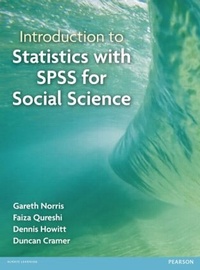
Introduction to Statistics with SPSS for Social Science
1st Edition
Published on 31. May 2012
Book
Paperback/Softback
490 pages
978-1-4082-3759-5 (ISBN)
Description
This is a complete guide to statistics and SPSS for social science students. Statistics with SPSS for Social Science provides a step-by-step explanation of all the important statistical concepts, tests and procedures. It is also a guide to getting started with SPSS, and includes screenshots to illustrate explanations. With examples specific to social sciences, this text is essential for any student in this area.
More details
Other editions
Additional editions
Faiza Qureshi | Gareth Norris | Dennis Howitt
Introduction to Statistics with SPSS for Social Science
Book
07/2017
1st Edition
Routledge
€297.11
Shipment within 10-20 days
Gareth Norris | Faiza Qureshi | Dennis Howitt
Introduction to Statistics with SPSS for Social Science
E-Book
09/2014
1st Edition
Routledge
€64.49
Available for download
Gareth Norris | Faiza Qureshi | Dennis Howitt
Introduction to Statistics with SPSS for Social Science
E-Book
09/2014
1st Edition
Routledge
€64.49
Available for download
Persons
Faiza Qureshi
Content
Part One Descriptive Statistics.
Chapter 1 Why you need statistics: types of data
Chapter 2 Describing variables: Tables and diagrams
Chapter 3 Describing variables numerically: averages, variation and spread
Chapter 4 Shapes of distributions of scores
Chapter 5 - Standard deviation, z-scores and standard error: the standard unit of measurement in statistics
Chapter 6 Relationships between two or more variables: diagrams and tables
Chapter 7 Correlation coefficients: Pearson correlation and Spearmans rho
Chapter 8 Regression and standard error
Part Two: Comparing Two or More Variables and the Analysis of Variance.
Chapter 9 - The analysis of a questionnaire/survey project
Chapter 10 The related t-test: Comparing two samples of correlated/related scores
Chapter 11 the unrelated t-test: comparing two samples of unrelated/uncorrelated scores
Chapter 12 Chi-square: Differences between samples of frequency data
Part Three: Introduction to Analysis of Variance
Chapter 13 Analysis of variance (ANOVA): introduction to one-way unrelated or uncorrelated ANOVA
Chapter 14 Two way analysis of variance for unrelated/uncorrelated scores: two studies for the price of one?
Chapter 15 Analysis of covariance (ANCOVA): controlling for additional variables
Chapter 16 Multivariate analysis of variance (MANOVA)
Part Four: More advanced correlational statistics and techniques
Chapter 17 - Partial correlation: spurious correlation, third or confounding variables (control variables), suppressor variables
Chapter 18 Factor analysis: simplifying complex data
Chapter 19 Multiple regression and multiple correlation
Chapter 20 Multinomial logistic regression: Distinguishing between several different categories or groups
Chapter 21 - Bionomial logistic regression
Chapter 22 - Log-linear methods: The analysis of complex contingency tables
Chapter 1 Why you need statistics: types of data
Chapter 2 Describing variables: Tables and diagrams
Chapter 3 Describing variables numerically: averages, variation and spread
Chapter 4 Shapes of distributions of scores
Chapter 5 - Standard deviation, z-scores and standard error: the standard unit of measurement in statistics
Chapter 6 Relationships between two or more variables: diagrams and tables
Chapter 7 Correlation coefficients: Pearson correlation and Spearmans rho
Chapter 8 Regression and standard error
Part Two: Comparing Two or More Variables and the Analysis of Variance.
Chapter 9 - The analysis of a questionnaire/survey project
Chapter 10 The related t-test: Comparing two samples of correlated/related scores
Chapter 11 the unrelated t-test: comparing two samples of unrelated/uncorrelated scores
Chapter 12 Chi-square: Differences between samples of frequency data
Part Three: Introduction to Analysis of Variance
Chapter 13 Analysis of variance (ANOVA): introduction to one-way unrelated or uncorrelated ANOVA
Chapter 14 Two way analysis of variance for unrelated/uncorrelated scores: two studies for the price of one?
Chapter 15 Analysis of covariance (ANCOVA): controlling for additional variables
Chapter 16 Multivariate analysis of variance (MANOVA)
Part Four: More advanced correlational statistics and techniques
Chapter 17 - Partial correlation: spurious correlation, third or confounding variables (control variables), suppressor variables
Chapter 18 Factor analysis: simplifying complex data
Chapter 19 Multiple regression and multiple correlation
Chapter 20 Multinomial logistic regression: Distinguishing between several different categories or groups
Chapter 21 - Bionomial logistic regression
Chapter 22 - Log-linear methods: The analysis of complex contingency tables