

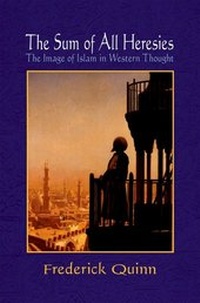
The Sum of All Heresies
The Image of Islam in Western Thought
Published on 29. November 2007
Book
Hardback
232 pages
978-0-19-532563-8 (ISBN)
Description
Current global tensions and the spread of terrorism have resurrected in the West a largely negative perception of Islamic society, an ill will fueled by centuries of conflict and prejudice. Shedding light on the history behind these hostile feelings, Frederick Quinn's timely volume traces the Western image of Islam from its earliest days to recent times.
Quinn establishes four basic themes around which the image of Islam gravitates throughout history: the Prophet as Antichrist, heretic, and Satan; the Prophet as Fallen Christian, corrupted monk, or Arab Lucifer; the prophet as sexual deviant, polygamist, and charlatan, and the Prophet as Wise Easterner, Holy Person, and dispenser of wisdom. A feature of the book is a strong portrayal of Islam in literature, art, music, and popular culture, drawing on such sources as Cervantes's Don Quixote; the Orientalism of numerous visual artists; the classical music of Monteverdi and Mozart; and more recent cultural manifestations, such as music hall artists like Peter Dawson and Edith Piaf; and stage or silver screen representations like The Garden of Allah, The Sheik, Aladdin, and The Battle of Algiers. Quinn argues that an outpouring of positive information on basically every aspect of Islamic life has yet to vanquish the hostile and malformed ideas from the past. Conflict, mistrust, and misunderstanding characterize the Muslim-Christian encounter, and growing examples of cooperation are often overshadowed by anger and suspicion.
In this important book, Quinn highlights long-standing historical prejudices but also introduces the reader to some of the landmark voices in history that have worked toward a greater understanding of Islam.
Quinn establishes four basic themes around which the image of Islam gravitates throughout history: the Prophet as Antichrist, heretic, and Satan; the Prophet as Fallen Christian, corrupted monk, or Arab Lucifer; the prophet as sexual deviant, polygamist, and charlatan, and the Prophet as Wise Easterner, Holy Person, and dispenser of wisdom. A feature of the book is a strong portrayal of Islam in literature, art, music, and popular culture, drawing on such sources as Cervantes's Don Quixote; the Orientalism of numerous visual artists; the classical music of Monteverdi and Mozart; and more recent cultural manifestations, such as music hall artists like Peter Dawson and Edith Piaf; and stage or silver screen representations like The Garden of Allah, The Sheik, Aladdin, and The Battle of Algiers. Quinn argues that an outpouring of positive information on basically every aspect of Islamic life has yet to vanquish the hostile and malformed ideas from the past. Conflict, mistrust, and misunderstanding characterize the Muslim-Christian encounter, and growing examples of cooperation are often overshadowed by anger and suspicion.
In this important book, Quinn highlights long-standing historical prejudices but also introduces the reader to some of the landmark voices in history that have worked toward a greater understanding of Islam.
Reviews / Votes
Quinn constucts a strong historical account of the positive and negative interactions between Western civilizations and Islam. * Middle East Journal *More details
Language
English
Place of publication
New York
United States
Target group
College/higher education
Illustrations
17 b/w halftones and 4 line illus.
Dimensions
Height: 155 mm
Width: 236 mm
Thickness: 28 mm
Weight
494 gr
ISBN-13
978-0-19-532563-8 (9780195325638)
Copyright in bibliographic data and cover images is held by Nielsen Book Services Limited or by the publishers or by their respective licensors: all rights reserved.
Schweitzer Classification
Other editions
Additional editions
E-Book
11/2007
1st Edition
OUP eBook
€20.99
Available for download
E-Book
11/2007
1st Edition
OUP eBook
€14.49
Available for download
Person
Frederick Quinn is Adjunct Professor of History at Utah State University, in Logan, Utah. An Episcopal Priest and a retired senior Foreign Service officer who worked in North Africa, he is the author of several books on history, religion, and law.