

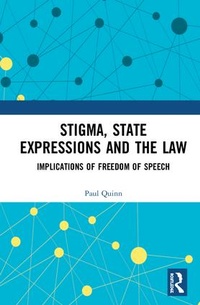
Stigma, State Expressions and the Law
Implications of Freedom of Speech
1st Edition
Published on 24. May 2019
Book
Hardback
316 pages
978-1-138-08770-5 (ISBN)
Description
This book demonstrates the difficulties the law is likely to encounter in regulating the expressive activities of the state, particularly with regard to the stigmatization of vulnerable groups and minorities.
Freedom of speech is indispensable to a democratic society, enabling it to operate with a healthy level of debate and discussion. Historically, legal scholars have underappreciated the power of stigmatization, instead focusing on anti-discrimination law, and the implicit assumption that the state is permitted to communicate freely with little fear of legal consequences. Whilst integral to a democratic society, the freedom of a state to express itself can however also be corrosive, allowing influential figures and organizations the possibility to stigmatize vulnerable groups within society. The book takes this idea and, uniquely weaving legal analysis with extant psychological and sociological research, shows that current legal approaches to stigmatization are limited. Starting with a deep insight into what constitutes state expressions and how they can become stigmatizing, the book then goes on to look into the capacity the law currently has to limit these expressions and asks even if it could, should it?
This fascinating study of an increasingly topical subject will be of interest to any legal scholar working in the field of freedom of expression and discrimination law.
Freedom of speech is indispensable to a democratic society, enabling it to operate with a healthy level of debate and discussion. Historically, legal scholars have underappreciated the power of stigmatization, instead focusing on anti-discrimination law, and the implicit assumption that the state is permitted to communicate freely with little fear of legal consequences. Whilst integral to a democratic society, the freedom of a state to express itself can however also be corrosive, allowing influential figures and organizations the possibility to stigmatize vulnerable groups within society. The book takes this idea and, uniquely weaving legal analysis with extant psychological and sociological research, shows that current legal approaches to stigmatization are limited. Starting with a deep insight into what constitutes state expressions and how they can become stigmatizing, the book then goes on to look into the capacity the law currently has to limit these expressions and asks even if it could, should it?
This fascinating study of an increasingly topical subject will be of interest to any legal scholar working in the field of freedom of expression and discrimination law.
More details
Language
English
Place of publication
London
United Kingdom
Publishing group
Taylor & Francis Ltd
Target group
College/higher education
Dimensions
Height: 234 mm
Width: 156 mm
Weight
453 gr
ISBN-13
978-1-138-08770-5 (9781138087705)
Copyright in bibliographic data and cover images is held by Nielsen Book Services Limited or by the publishers or by their respective licensors: all rights reserved.
Schweitzer Classification
Other editions
Additional editions
Book
12/2021
1st Edition
Routledge
€65.80
Shipment within 10-20 days
E-Book
05/2019
1st Edition
Routledge
€59.49
Available for download
E-Book
05/2019
1st Edition
Routledge
€59.49
Available for download
Person
Paul Quinn is Professor at the Vrije Universiteit Brussel (Brussels Free University).
Content
Introduction
1 What are state expressions and how can they be stigmatizing?
2 Defining stigma and its potential harm
3 Developing a normative approach towards the use of stigmatizing state expressions
4 Stigmatizing state expression as hate speech
5 The importance of the lack of binding effects produced by SSEs
6 Stigmatizing state expressions ? a threat to privacy?
7 Carte blanche to stigmatize or a pragmatic reality in a liberal democracy?
Author's note
1 What are state expressions and how can they be stigmatizing?
2 Defining stigma and its potential harm
3 Developing a normative approach towards the use of stigmatizing state expressions
4 Stigmatizing state expression as hate speech
5 The importance of the lack of binding effects produced by SSEs
6 Stigmatizing state expressions ? a threat to privacy?
7 Carte blanche to stigmatize or a pragmatic reality in a liberal democracy?
Author's note