

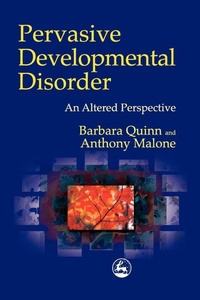
Pervasive Developmental Disorder
An Altered Perspective
Published on 1. April 2000
Book
Paperback/Softback
160 pages
978-1-85302-876-2 (ISBN)
Description
Pervasive Developmental Disorder, or PDD, is the umbrella term used to cover the whole family of autistic spectrum disorders - including autism and Asperger Syndrome. Within this group there is a subgroup called NOS - not otherwise specified - which covers the conditions which do not quite meet the diagnostic criteria for autism or Asperger Syndrome. Because PDD covers such a wide spectrum, it presents very differently from child to child.
Written principally for parents, this is a book which explains what it means for your child to be diagnosed with PDD, NOS, autism or Asperger Syndrome, and where you go from there. The authors describe the symptoms of PDD, what a diagnosis means, how a child fits into the diagnostic terminology and the diagnostic procedures involved. They also review associated disorders such as OCD, and discuss the different treatments and therapies available.
The book includes frequently-asked questions, as well as the experiences of other parents. It is accessible, informative and supportive, a practical introduction to PDD.
Written principally for parents, this is a book which explains what it means for your child to be diagnosed with PDD, NOS, autism or Asperger Syndrome, and where you go from there. The authors describe the symptoms of PDD, what a diagnosis means, how a child fits into the diagnostic terminology and the diagnostic procedures involved. They also review associated disorders such as OCD, and discuss the different treatments and therapies available.
The book includes frequently-asked questions, as well as the experiences of other parents. It is accessible, informative and supportive, a practical introduction to PDD.
Reviews / Votes
`Writing mainly for parents, the authors provide realistic and practical information, richly brought to life by the stories of families in which even the simplest of events (such as going shopping or cutting hair) is frighteningly complex. The theme that runs through this survey of play, language and social reciprocity is that autistic individuals have a unique world view. No form of intervention, no matter how intensively pursued, can or should change this altered perspective. Sensibly, these authors put parents at the helm of decision-making, and they describe a wide range of educational opportunities that can enable autistic individuals to function more effectively in the family, at school or at work, including techniques based on behaviour modification. It explains components of programmes such as the picture exchange communication system (PECS), applied behavioural analysis (ABA) and TEACCH. "Different methods work for different children," they write, displaying a pragmatism that is the real strength of this excellent guide.' -- Times Educational SupplementMore details
Language
English
Place of publication
London
United Kingdom
Target group
Professional and scholarly
Product notice
Paperback (UK-trade)
Dimensions
Height: 234 mm
Width: 156 mm
Thickness: 9 mm
Weight
254 gr
ISBN-13
978-1-85302-876-2 (9781853028762)
Copyright in bibliographic data and cover images is held by Nielsen Book Services Limited or by the publishers or by their respective licensors: all rights reserved.
Schweitzer Classification
Other editions
Additional editions
E-Book
04/2000
Jessica Kingsley Publishers
€23.99
Available for download
Persons
Barbara Quinn is a Nurse Clinician at the Division of Developmental and Behavioral Pediatrics at Albany Medical College. She has a graduate degree in Educational Psychology. She is a freelance writer who brings sixteen years of nursing experience and work with families to her writing. Anthony Malone is Division Head for the Division of Developmental and Behavorial Pediatrics at Albany Medical College and has spent his career helping families understand developmental disabilities. He also has an active private pediatric practice and cares for many children with special needs. He is a member of the American Academy of Pediatrics, the Society for Behavioral and Developmental Pediatrics and the American Academy of Cerebral Palsy and Developmental Medicine.
Content
Preface. 1. What is Pervasive Developmental Disorder? 2. Social Reciprocity. 3. Communication. 4. Impairment in Play Style. 5. More Characteristics. 6. The Evaluation Process. 7. What can be Done? A Medical Perspective. 8. What can be Done? An Educational Perspective. 9. Additional Options. 10. Up Close and Personal: Parents Share their Stories. References. Index.