

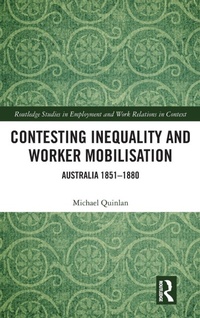
Contesting Inequality and Worker Mobilisation
Australia 1851-1880
1st Edition
Published on 11. August 2020
Book
Hardback
326 pages
978-0-367-86178-0 (ISBN)
Description
Contesting Inequality and Worker Mobilisation: Australia 1851-1880 provides a new perspective on how and why workers organise, and what shapes that organisation.
The author's 2018 Origins of Worker Mobilisation examined the beginning of worker organisation, arguing inequality at work, and regulatory subordination of labour, drove worker resistance, initially by informal organization that slowly transitioned to formal organisation. This new volume analyses worker mobilisation in the period 1851-1880, drawing data from a unique relational database recording every instance of organisation. It assesses not only the types of organization formed, but also the issues and objectives upon which mobilisation was founded. It examines the relationship between formal and informal organisation, including their respective influences in reshaping working conditions and the life-circumstances of working communities. It relates the examination of worker mobilisation to both historical and contemporary contexts and examines mobilisation by different categories of labour. The book identifies important effects of mobilisation on economic inequality, hours of work (including the eight-hour day and the beginnings of the weekend) and the development of democracy.
It will be of interest to researchers, academics, and students in the fields of social mobilisation, social and economic history, industrial relations, labour regulation, labour history, and employment relations.
The author's 2018 Origins of Worker Mobilisation examined the beginning of worker organisation, arguing inequality at work, and regulatory subordination of labour, drove worker resistance, initially by informal organization that slowly transitioned to formal organisation. This new volume analyses worker mobilisation in the period 1851-1880, drawing data from a unique relational database recording every instance of organisation. It assesses not only the types of organization formed, but also the issues and objectives upon which mobilisation was founded. It examines the relationship between formal and informal organisation, including their respective influences in reshaping working conditions and the life-circumstances of working communities. It relates the examination of worker mobilisation to both historical and contemporary contexts and examines mobilisation by different categories of labour. The book identifies important effects of mobilisation on economic inequality, hours of work (including the eight-hour day and the beginnings of the weekend) and the development of democracy.
It will be of interest to researchers, academics, and students in the fields of social mobilisation, social and economic history, industrial relations, labour regulation, labour history, and employment relations.
Reviews / Votes
"Imaginative. Precise. Easy to read. Informative. Insightful. All these are apt descriptions of this book. Yet, they do not do it justice. It is work which constitutes a major contribution to scholarship and policy-making. It does so by inviting, no, by forcing, mainstream scholars and policy-makers to re-think their starting positions... This is a book which should be read by all of us who are students of, and activists in, capital-labour relations. We will profit in the best way: we will be enriched intellectually and, perhaps, inspired to do better."Harry Glasbeek, York University, Canada
"[This work] by Quinlan in many respects constitutes an outstanding resource for coming to grips with the detail of the origins and development of Australian labour law specifically."
John Howe, University of Melbourne and Richard Mitchell, Monash University
"Michael Quinlan has produced a valuable contribution to Australian labour history, distinguished by originality and by assiduous research. It deserves to be widely read and to inspire future work of equivalent scope and methodological range."
Sean Scalmer, University of Melbourne
More details
Series
Language
English
Place of publication
London
United Kingdom
Publishing group
Taylor & Francis Ltd
Target group
College/higher education
Illustrations
4 s/w Abbildungen, 4 s/w Zeichnungen, 24 s/w Tabellen
24 Tables, black and white; 4 Line drawings, black and white; 4 Illustrations, black and white
Dimensions
Height: 235 mm
Width: 157 mm
Thickness: 23 mm
Weight
647 gr
ISBN-13
978-0-367-86178-0 (9780367861780)
Copyright in bibliographic data and cover images is held by Nielsen Book Services Limited or by the publishers or by their respective licensors: all rights reserved.
Schweitzer Classification
Other editions
Additional editions
Book
04/2022
1st Edition
Routledge
€66.00
Shipment within 15-20 days
E-Book
08/2020
1st Edition
Routledge
€59.49
Available for download
E-Book
08/2020
1st Edition
Routledge
€59.49
Available for download
Person
Michael Quinlan is emeritus professor of industrial relations, University of NSW and adjunct professor School of History and Humanities, University of Tasmania.
Content
1. The Collective Impulse, Mobilisation and Political Economy. 2. Overview of Organisation, Methods and Patterns of Struggle. 3. Transport and Maritime Activities. 4. Worker Organisation in Agriculture and Rural Industry. 5. Mining. 6. Worker Organisation in Building and Construction. 7. Metal/Engineering, Printing and Transport Equipment. 8. Apparel, Footwear, Food/Beverages and other Manufacturing. 9. Retailing/Warehouses, Hospitality, Commercial and Personal Services. 10. Workers in Government and Community Service. 11. Wider Alliances, Peak-Union Bodies and Political Organisation. 12. Concluding Observations.