

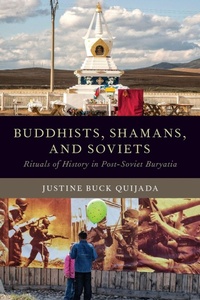
Buddhists, Shamans, and Soviets
Rituals of History in Post-Soviet Buryatia
Published on 10. December 2020
Book
Paperback/Softback
258 pages
978-0-19-753642-1 (ISBN)
Description
History in the Soviet Union was a political project. From the Soviet perspective, Buryats, an indigenous Siberian ethnic group, were a "backwards" nationality that was carried along on the inexorable march towards the Communist utopian future. When the Soviet Union ended, the Soviet version of history lost its power and Buryats, like other Siberian indigenous peoples, were able to revive religious and cultural traditions that had been suppressed by the Soviet state. In the process, they also recovered knowledge about the past that the Soviet Union had silenced. Borrowing the analytic lens of the chronotope from Bakhtin, Quijada argues that rituals have chronotopes which situate people within time and space. As they revived rituals, Post-Soviet Buryats encountered new historical information and traditional ways of being in time that enabled them to re-imagine the Buryat past, and what it means to be Buryat. Through the temporal perspective of a reincarnating Buddhist monk, Dashi-Dorzho Etigelov, Buddhists come to see the Soviet period as a test on the path of dharma. Shamanic practitioners, in contrast, renegotiate their relationship to the past by speaking to their ancestors through the bodies of shamans. By comparing the versions of history that are produced in Buddhist, shamanic and civic rituals, Buddhists, Shamans and Soviets offers a new lens for analyzing ritual, a new perspective on how an indigenous people grapples with a history of state repression, and an innovative approach to the ethnographic study of how people know about the past.
Reviews / Votes
Buddhists, Shamans, and Soviets not only offers a fresh and insightful approach to post -- Soviet Buryatia. It is a field building study that will surely inspire future studies of history making in the ruins of authoritarian regimes still haunted by the dead. * Matthew W. King, Journal of the American Academy of Religion * Firmly grounded in secondary literature, Buddhists, Shamans, and Soviets is a formidable achievement. What stands out the most is the extensive fieldwork behind it and the richness of the material collected by Quijada, as exemplified by her nuanced and fascinating look at the celebration of the figure of Dashi-Dorzho Etigilov... * Vassily A. Klimentov, Europe-Asia Studies * Buddhists, shamans, and Soviets is a very welcome addition to the multiperspective literature on Siberia's and more broadly northern Eurasia's past and present. The study is written in a vivid and highly readable manner. * Ivan Sablin, University of Heidelberg, Inner Asia * ...the breadth of the study allows the author to meaningfully analyse religion as a major part of public and private life in the region, insightfully tracking its entanglements with the secular. Overall, the book presents a valuable contribution to the study of the region and to ritual studies, and will be a valuable resource to anyone interested in ritual and history, Buryatia, and post-Soviet Eurasia. * Kristina Jonutyte, Vytautas Magnus University, Religion, State & Society * This is a beautifully written book that offers engaging ethnography that is both subtle and smart. Quijada takes us on a fascinating journey that reveals how a turn to religion can bring to light new histories in a region that has long captivated the attention of anthropologists. This book should be read by anyone who thinks anthropologically about religion." -Catherine Wanner, author of Communities of the Converted: Ukrainians and Global Evangelism In Justine Buck Quijada's thoroughly engaging ethnography of contemporary Buryatia, a miraculously preserved Buddhist corpse counters the artificiality of Lenin's 'scientifically preserved' remains and the body of a Russian Orthodox saint visits the local Cathedral where celebratory bells drown out the drum beats inaugurating a new urban center for shaman practice. Simultaneously inhabiting the chronotypes of multiple historic pasts-indigenous, Buddhist, Russian Orthodox, Soviet-the rituals and celebrations of Quijada's subjects blur and blend and defy any attempt to effectively categorize them by religion, ethnicity, or nationality politics. The result is a provocative read for anyone interested in these subjects. * Laurel Kendall, Chair, Division of Anthropology, American Museum of Natural History * In this highly innovative study, Dr. Quijada shows that rituals do not just make history, but do so through distinctive genres that come from seemingly contradictory domains: Soviet, shamanic, and Buddhist. By combining ritual studies with insights from linguistic anthropology she illustrates how rhetorical referencing can change an event that has occurred in the past. * Manduhai Buyandelger, author of Tragic Spirits: Shamanism, Memory, and Gender in Contemporary Mongolia *More details
Series
Language
English
Place of publication
New York
United States
Target group
Professional and scholarly
Illustrations
47 black and white illustrations
Dimensions
Height: 234 mm
Width: 156 mm
Thickness: 14 mm
Weight
398 gr
ISBN-13
978-0-19-753642-1 (9780197536421)
Copyright in bibliographic data and cover images is held by Nielsen Book Services Limited or by the publishers or by their respective licensors: all rights reserved.
Schweitzer Classification
Other editions
Additional editions
Book
03/2019
Oxford University Press Inc
€175.20
Shipment within 15-20 days
E-Book
02/2019
1st Edition
OUP eBook
€20.99
Available for download
E-Book
02/2019
1st Edition
OUP eBook
€20.99
Available for download
Person
Justine Buck Quijada is Assistant Professor in the Department of Religion at Wesleyan University, where she teaches courses on shamanism, secularism, and ritual. She is co-editor of Atheist Secularism and its Discontents: A Comparative Study of Religion and Communism in Eurasia.
Content
Acknowledgements
Note on Transliterations, Translations and Photographs
Chronology
Introduction: If you want to have a future you have to have a good relationship to your past
Chapter 1: An Inauguration for Etigelov: Multiple Genres of History in Buryatia
Chapter 2: Soviet Selves: Victory Day
Chapter 3: City Day, Hospitality, the Friendship of the Peoples and Multikulturalizm
Chapter 4: Etigelov at Maidari: The Once and Future Buddhist
Chapter 5: Opening the Center, Opening the Roads
Chapter 6: Porous Selves: Yuri's Initiation
Epilogue
Bibliography
Notes
Index
Note on Transliterations, Translations and Photographs
Chronology
Introduction: If you want to have a future you have to have a good relationship to your past
Chapter 1: An Inauguration for Etigelov: Multiple Genres of History in Buryatia
Chapter 2: Soviet Selves: Victory Day
Chapter 3: City Day, Hospitality, the Friendship of the Peoples and Multikulturalizm
Chapter 4: Etigelov at Maidari: The Once and Future Buddhist
Chapter 5: Opening the Center, Opening the Roads
Chapter 6: Porous Selves: Yuri's Initiation
Epilogue
Bibliography
Notes
Index