

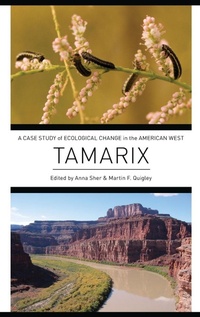
Tamarix
A Case Study of Ecological Change in the American West
Published on 21. March 2013
Book
Hardback
514 pages
978-0-19-989820-6 (ISBN)
Description
Few plant species have had as much combined scientific, public, and political attention as exotic Tamarix spp (tamarisk, saltcedar), attracting the public eye in the early 2000's when widespread drought in the West corresponded to assertions that the introduced tree used as much water as whole cities. This edited volume contains 24 essays by 44 authors on the hybrid swarm that represents invasive tamarisk, including its biology, ecology, politics, history, management, and even the philosophical and ethical issues involved with designating a particular species as "good" or "bad". These works reflect the controversy that has arisen around its role in our ecosystems and what should (or should not) be done about it, particularly in the context of the release of a biological control agent. This is the first text to examine these many facets of this interesting plant with an engaging and sometimes surprising collection of written works from the most important researchers in the field, representing the full spectrum of scientific perspectives.
Reviews / Votes
"Tamarisk is not just about the impacts of an exotic species, but is in fact an outstanding entry pointinto many of the most important ecological and conservation questions that scientists and land managers are grappling with today; Do non-native species provide important ecosystem services? What is the best way to manage a landscape dominated by non-native species? What are the ethical and ecological reasons for removing non-native species? Becauseof this well-written book, the tamarisk will become a key example for introducing young scientists and land managers to the complexities of dealing with exotics species in established ecosystems." -- Richard
Primack, Boston University and author of Essentials of Conservation Biology
"A comprehensive treatment of one of the highest-profile invasive species in North America, and surely the most controversial. We owe Sher and Quigley a hearty thanks for assembling a cast of authorities on the biological, historical, sociological, political, and economic facets of the spread and management of salt cedar. Everyone from concerned laypersons through ecologists and botanists will enjoy reading this book and learn a lot from it." -- Daniel
Simberloff, Nancy Gore Hunger Professor of Environmental Studies, University of Tennessee and founder of the Institute of Biological Invasions
"This book represents the most comprehensive work yet published of the biology, ecology, and sociological impacts of Tamarix. Most impressive is the unbiased approach, broad perspective, and science-based standards used to address the many controversial issues related to positive benefits or negative impacts of Tamarix." -- Joe DiTomaso, University of California, Davis, and author of Aquatic and Riparian Weeds of the West
"With 44 of the world's top Tamarisk researchers, Drs. Sher and Quigley have assembled the first comprehensive book on this important woody genus in the western United States. This is tremendously valuable book is a must have for all who study or manage Tamarix." -- Mike Dombeck, Chief Emeritus, U.S. Forest Service
More details
Language
English
Place of publication
New York
United States
Target group
College/higher education
Professional and scholarly
Researchers studying this organism or ecosystem, graduate and upper-level undergraduate students in ecology and biology, and professionals such as policy makers and land managers.
Illustrations
111 b&w
Dimensions
Height: 240 mm
Width: 161 mm
Thickness: 32 mm
Weight
931 gr
ISBN-13
978-0-19-989820-6 (9780199898206)
Copyright in bibliographic data and cover images is held by Nielsen Book Services Limited or by the publishers or by their respective licensors: all rights reserved.
Schweitzer Classification
Other editions
Additional editions
E-Book
02/2013
1st Edition
OUP eBook
€101.99
Available for download
Persons
Dr. Anna Sher has been investigating the ecology of tamarisk trees for nearly 20 years and on two continents. She is currently a biology professor at the University of Denver, where her lab is currently focused on restoration of riparian ecosystems and plant communities that arise after the removal of Tamarix. She is frequently asked to speak on the subject of Tamarix and has been the president of the board of the Tamarisk Coalition, a non-profit dedicated to riparian ecosystem health.
Dr. Martin Quigley is a plant ecologist and licensed landscape architect. He is currently the Kurtz Professor of Botany at the University of Denver, where he teaches Conservation Biology, Ethnobotany, Ecology, and Restoration Ecology. He strives to make explicit the connection between science and design in maintenance and restoration of fragmented landscapes.
Dr. Martin Quigley is a plant ecologist and licensed landscape architect. He is currently the Kurtz Professor of Botany at the University of Denver, where he teaches Conservation Biology, Ethnobotany, Ecology, and Restoration Ecology. He strives to make explicit the connection between science and design in maintenance and restoration of fragmented landscapes.
Content
Foreword ; Julie Stromberg ; 1. Introduction to the Paradox Plant ; Anna Sher ; PART I: BIOLOGY AND RANGE ; 2. Genetics of Tamarix ; John Gaskin ; 3. Measuring Extent and Projections of Tamarix distribution in North America ; Catherine Jarnevich, Paul Evangelista, J. Graham ; 4. Evapotranspiration by tamarisk in the Colorado River Basin ; Erika Zavaleta ; 5. Tamarisk: Ecohydrology of a Successful Plant ; Pamela Nagler and Edward Glenn ; 6. Water use by Tamarix ; James Cleverly ; 7. Tamarix, hydrology and fluvial geomorphology ; Daniel A. Auerbach, David M. Merritt, Patrick B. Shafroth ; 8. Tamarisk and Salinity: an overview ; Michelle Ohrtman, Ken Lair ; PART II: ECOLOGY ; 9. Tamarix from organism to landscape ; Kevin Hultine+ and Tom Dudley ; 10. Tamarix as Wildlife Habitat ; Heather Bateman, Eben Paxton and William Longland ; 11. Tamarisk in riparian woodlands: a birds eye view ; Mark Sogge, Eben H. Paxton, and Charles van Riper III ; 12. Tamarix as invertebrate habitat ; Stephanie Strudley and Peter Dalin ; 13. Tamarix and soil ecology ; Kelley Meinhardt and Catherine Gehring ; 14. fire ecology of Tamarix ; Gail Drus ; 15. Tamarix: passenger or driver of ecosystem change? ; Tyler D. Johnson ; PART III: THE HUMAN ELEMENT ; 16. Tamarisk Introduction, Naturalization and Control in the United States, 1818-1952 Matthew Chew ; 17. The Politics of a Tree: How a species became national policy ; Tim Carlson ; 18. A Philosophical Framework for Assessing the Value of the Tamarisk ; Naomi Reshotko ; 19. The horticulture of Tamarix ; Martin F. Quigley ; PART IV: MANAGEMENT ; 20. Tamarix management: Lessons and techniques ; Cameron Douglass, Scott Nissen and Charlie Heart ; 21. Tamarisk management at Bosque del Apache National Wildlife Refuge ; Gina Dello Russo ; 22. Bring on the beetles! The history and impact of tamarisk biological control ; Dan Bean, Tom Dudley and Kevin Hultine ; 23. Riparian restoration in the context of Tamarix control ; Patrick. B. Shafroth, David Merritt, Mark Briggs, Vanessa Beauchamp, Kenneth Lair, Michael Scott, and Anna Sher ; 24. Revegetation After Tamarisk Removal: what grows next? ; Robin Bay ; 25. The future of Tamarix ; Anna Sher ; GLOSSARY ; INDEX