

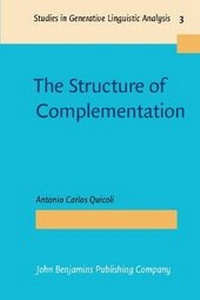
The Structure of Complementation
Published on 1. January 1982
Book
Paperback/Softback
172 pages
978-90-6439-165-1 (ISBN)
Description
The study of complementation has received considerable attention in generative studies. Following Rosenbaum's (1967) pioneering study of the English complement system, there are extensive studies by Lakoff (1965), Ross (1967), Perlmutter (1971) and a large number of publications. More recent detailed studies are Emonds (1970) and Bresnan (1972) . These studies have increased enormously the body of factual knowledge about the complement system of English, and about the phenomenon of complementation in general. As a consequence there are a number of empirical hypotheses about the structure of human languages which must now be tested against facts of different languages. Of these hypotheses, perhaps the most interesting is that the grammars of all languages make use of the principle of the transformational cycle. Testing this hypothesis constitutes one of the main concerns of the present book. Furthermore, these studies have also raised numerous interesting empirical issues of great importance for linguistic theory, most of which are still awaiting fresh evidence from different languages in order to be settled. This study is directed towards resolving some of these issues by adducing relevent data, primarily from Portuguese.
More details
Series
Language
English
Place of publication
Amsterdam
Netherlands
Target group
Professional and scholarly
Weight
340 gr
ISBN-13
978-90-6439-165-1 (9789064391651)
Copyright in bibliographic data and cover images is held by Nielsen Book Services Limited or by the publishers or by their respective licensors: all rights reserved.
Schweitzer Classification
Other editions
Additional editions
Antonio Carlos Quicoli
The Structure of Complementation
E-Book
01/1982
1st Edition
John Benjamins Publishing Company
€84.49
Available for download
Person
Content
1. Acknowledgements; 2. Foreword; 3. I. INTRODUCTION; 4. II. ON THE PORTUGUESE VERB PARECER; 5. III. ON 'MISSING SUBJECTS' IN PORTUGUESE; 6. IV. SOME PROPERTIES OF AGREEMENT RULES; 7. Bibliography