

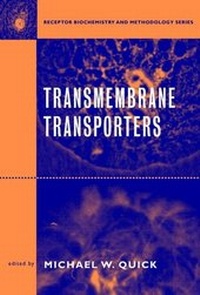
Transmembrane Transporters
Published on 18. October 2002
Book
Hardback
312 pages
978-0-471-06513-5 (ISBN)
Unfortunately, price unknown
Article exhausted; check different version
Description
Transmembrane transporters represent a class of proteins designed to move molecules across biological membranes. Likely present in all subcellular compartments of all cells of all organisms, transporters perform a myriad of diverse functions, such as the acquisition of nutrients, regulation of metabolite concentrations, removal of toxins, maintenance of ionic and chemical gradients, and secretion of macromolecules and nucleic acids. Transmembrane Transporters provides readers with a state-of-the-art molecule update on transmembrane transporters, focusing on the methodological approaches currently employed to better understand how transporters work and how they can be used in cutting-edge therapies.
The book's authors begin each chapter with an overview of the important biological questions presently being considered in their field, then present scientific approaches to address these questions. In explaining approaches, the authors cover experimental approaches, conceptual frameworks, data obtained, and pitfalls common to the techniques. Easy-to-reference protocol sections offer flow diagrams and illustrations to better elucidate new and unfamiliar techniques. Coverage in Transmembrane Transporters includes:
* Informatics
* Expression strategies
* High-throughput screening
* Molecular genetics
* Structural analyses, such as NMR, crystallization, freeze fracture, and chimeras
* Functional analyses, such as imaging, electrophysiology, and microdialysis
Transmembrane Transporters provides readers new to the field with an accessible introduction to the wide variety of transporter research approaches, while offering practicing researchers a thorough analysis of the cutting-edge work currently being performed. This text proves a compelling resource for students and professionals in neuroscience, molecular biology, biochemistry, and biophysics.
Reviews / Votes
"...superb, wide-ranging, and up-to-date volume is highly recommended for researchers, college instructors, and graduate and advanced undergraduate students..." (The Quarterly Review of Biology, Vol. 7, March 2004) "...introduces many technologies to be used in future studies....people, who are interested in transporter research, can get new ideas for next research from this book." (Pharmaceutical Research, Vol. 20, No. 12, December 2003)More details
Product info
gebunden
Series
Edition
1. Auflage
Language
English
Place of publication
New York
United States
Publishing group
John Wiley & Sons Inc
Target group
College/higher education
Professional and scholarly
Product notice
sewn/stitched
Cloth over boards
Illustrations
Photos: 11 B&W, 0 Color; Drawings: 49 B&W, 0 Color; Tables: 6 B&W, 0 Color
Dimensions
Height: 262 mm
Width: 181 mm
Thickness: 20 mm
Weight
780 gr
ISBN-13
978-0-471-06513-5 (9780471065135)
Schweitzer Classification
Other editions
Additional editions
Person
Michael W. Quick received his Ph.D. from Emory University in 1992. Following postdoctoral training at the California Institute of Technology, he joined the faculty at the University of Alabama at Birmingham. His work focuses on the mechanisms by which neurotransmitter transporter function and expression are regulated.
Content
Series Preface.
Preface.
Contributors.
Families of Transporters and Their Classification (M. Saier).
Yeast as a Model System for Studying Glucose Transport (E. Boles).
Neurotransmitter Transporters of Drosophila (M. Burg & W. Pak).
Transgenic Mice in Monoamine Transporter Research (S. Jones).
Searching for Novel Genetic Variation in Neurotransmitter Transporters (R. Blakely & A. Belous).
Nonviral Gene Transfer Allows Up- and Down-Expression of the Brain Serotonin Transporter with Functional Consequences (M. Martres, et al.).
Methods in Studying the Regulation and Trafficking of Transmembrane Transporters (S. Deken, et al.).
Chemical Modification Strategies for Structure-Function Studies (G. Rudnick).
Methanethiosulfonate Reagent Accessibility Studies, Cysteine-Scanning Mutagenesis, Protein Overexpression, and Functional Reconstitution: A Strategy for Studying the Structure/Function Relationships within the Mitochondrial Citrate Transport Protein (R. Kaplan).
Peptide Mapping of Dopamine Transporter Ligand and Substrate Interaction Sites (M. Lowe, et al.).
Mass Spectrometry of Membrane Transport Proteins (J. Whitelegge, et al.).
Amperometric Recording of Amphetamine-Induced Dopamine Efflux (D. Sulzer, et al.).
Voltage Clamp and Fluorometric Techniques for Studying Glutamate Transporter Function (A. Tzingounis, et al.).
Studies of Glial Glutamate Transporters in Hippocampal Microcultures (S. Mennerick, et al.).
Imaging Monoamine Transporters in the Brain (H. Kung & M. Kung).
Measuring and Modeling the Spatiotemporal Profile of GABA at the Synapse (L. Overstreet, et al.).
Index.