

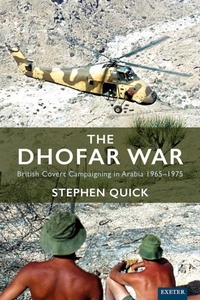
The Dhofar War
British Covert Campaigning in Arabia 1965-1975
Published on 15. July 2025
Book
Paperback/Softback
252 pages
978-1-80413-207-4 (ISBN)
Description
Finalist for the SAHR Chapple Prize for Best First Book on British Military History
Between 1965 and 1975, Britain discreetly supported the Sultanate of Oman in achieving a historic Cold War-era counterinsurgency win in its remote Dhofar Province. To date, this role has traditionally been represented either in terms of a narrow operational success or has been reduced to one of failure-oriented peripheral player. The Dhofar War: British Covert Campaigning in Arabia 1965-1975 re-examines the historical record to present a more balanced verdict of the war and the overall importance of the UK's role.
In an original approach, the author puts forward the case that the hitherto undersold scale of UK military and non-martial assistance to Oman during the Dhofar War was the primary war-winning factor. Alongside this, he makes the key assertion that Britain's role changed significantly throughout-from dominance in facilitating the war's prosecution, to one that was more advisory or support oriented as the Sultanate fought back against a communist-backed insurgency.
With in-depth research undertaken in archives and collections in the UK and Oman, the author caters for a broad international audience. The book will be of interest to students and scholars of military, counterinsurgency and Middle Eastern/Arabian Peninsula history, the military and governmental policy community, and members of the public with an interest in this region's history.
Between 1965 and 1975, Britain discreetly supported the Sultanate of Oman in achieving a historic Cold War-era counterinsurgency win in its remote Dhofar Province. To date, this role has traditionally been represented either in terms of a narrow operational success or has been reduced to one of failure-oriented peripheral player. The Dhofar War: British Covert Campaigning in Arabia 1965-1975 re-examines the historical record to present a more balanced verdict of the war and the overall importance of the UK's role.
In an original approach, the author puts forward the case that the hitherto undersold scale of UK military and non-martial assistance to Oman during the Dhofar War was the primary war-winning factor. Alongside this, he makes the key assertion that Britain's role changed significantly throughout-from dominance in facilitating the war's prosecution, to one that was more advisory or support oriented as the Sultanate fought back against a communist-backed insurgency.
With in-depth research undertaken in archives and collections in the UK and Oman, the author caters for a broad international audience. The book will be of interest to students and scholars of military, counterinsurgency and Middle Eastern/Arabian Peninsula history, the military and governmental policy community, and members of the public with an interest in this region's history.
Reviews / Votes
The Dhofar War is a precious monograph that offers a new look at a much-discussed conflict. It sheds new light on a major episode in the modern history of the Arabian Peninsula, when the decline of the British Empire led to new forms of Western influence in the region. It also provides a nuanced case study about the complexities of counter-insurgency campaigns that remains relevant today. -- Jean-Loup Samaan * Singapore Middle East Institute * Quick does an excellent job in weaving the strands of his narrative together across six key chapters... a substantive contribution to understanding the British legacy in the Sultanate -- Professor Clive Jones * The Middle East Journal * Quick is to be congratulated for his scholarly, interesting study of a pertinent, successful British 'COIN' case study that will be of great value to military history and students of the British army. -- Matthew Hughes * Journal of the Society for Army Historical Research * In this comprehensive and balanced account of the Dhofar War, the author's arguments are effectively presented and backed up with research. The book is interesting not only due to its non-political bent, but also that it informs the modern public about a war few of them are even aware of. -- Christopher Miskimon * Warfare History Network *More details
Language
English
Place of publication
Exeter
United Kingdom
Target group
Professional and scholarly
Dimensions
Height: 234 mm
Width: 156 mm
Thickness: 16 mm
Weight
435 gr
ISBN-13
978-1-80413-207-4 (9781804132074)
DOI
10.47788/QBOS3439
Copyright in bibliographic data and cover images is held by Nielsen Book Services Limited or by the publishers or by their respective licensors: all rights reserved.
Schweitzer Classification
Other editions
Additional editions
Book
05/2024
University of Exeter Press
€130.20
Shipment within 3-4 weeks
Person
Stephen Quick is a lecturer at the Abu Dhabi-based Rabdan Academy and holds a PhD from King's College London. Living in the Middle East for over a decade, his research interests include Britain's post-World War Two counterinsurgency campaigns and Arabian Peninsula history.
Content
1. Introduction: A Rare Cold War Success
2. The Dhofar War: Origins, Players, and Timeline
3. Politics and Diplomacy
4. Military Strategy
5. Military Operations and Tactics
6. Non-Kinetic Military and Informal Support
7. Conclusion: 'Cut from a Different Cloth'
Notes
Bibliography
Index
2. The Dhofar War: Origins, Players, and Timeline
3. Politics and Diplomacy
4. Military Strategy
5. Military Operations and Tactics
6. Non-Kinetic Military and Informal Support
7. Conclusion: 'Cut from a Different Cloth'
Notes
Bibliography
Index