

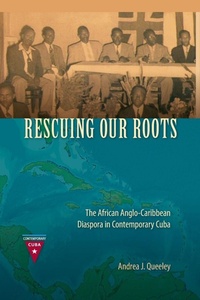
Rescuing Our Roots
The African Anglo-Caribbean Diaspora in Contemporary Cuba
Published on 30. June 2017
Book
Paperback/Softback
280 pages
978-0-8130-5461-2 (ISBN)
Description
Provides invaluable insight into the histories and lives of Cubans who trace their origins to the Anglo-Caribbean."-Robert Whitney, author of State and Revolution in Cuba: Mass Mobilization and Political Change, 1920-1940
"Adds a missing piece to the existing literature about the renewal of black activism in Cuba, all the while showing the links and fractures between pre- and post-1959 society."-Devyn Spence Benson, Louisiana State University
In the early twentieth century, laborers from the British West Indies immigrated to Cuba, attracted by employment opportunities. The Anglo-Caribbean communities flourished, but after 1959, many of their cultural institutions were dismantled: the revolution dictated that in the name of unity there would be no hyphenated Cubans. This book turns an ethnographic lens on their descendants who-during the Special Period in the 1990s-moved to "rescue their roots" by revitalizing their ethnic associations and reestablishing ties outside the island.
Based on Andrea J. Queeley's fieldwork in Santiago and Guantanamo, Rescuing Our Roots looks at local and regional identity formations as well as racial politics in revolutionary Cuba. Queeley argues that, as the island experienced a resurgence in racism due in part to the emergence of the dual economy and the reliance on tourism, Anglo-Caribbean Cubans revitalized their communities and sought transnational connections not just in the hope of material support but also to challenge the association between blackness, inferiority, and immorality. Their desire for social mobility, political engagement, and a better economic situation operated alongside the fight for black respectability.
Unlike most studies of black Cubans, which focus on Afro-Cuban religion or popular culture, Queeley's penetrating investigation offers a view of strategies and modes of black belonging that transcend ideological, temporal, and spatial boundaries.
"Adds a missing piece to the existing literature about the renewal of black activism in Cuba, all the while showing the links and fractures between pre- and post-1959 society."-Devyn Spence Benson, Louisiana State University
In the early twentieth century, laborers from the British West Indies immigrated to Cuba, attracted by employment opportunities. The Anglo-Caribbean communities flourished, but after 1959, many of their cultural institutions were dismantled: the revolution dictated that in the name of unity there would be no hyphenated Cubans. This book turns an ethnographic lens on their descendants who-during the Special Period in the 1990s-moved to "rescue their roots" by revitalizing their ethnic associations and reestablishing ties outside the island.
Based on Andrea J. Queeley's fieldwork in Santiago and Guantanamo, Rescuing Our Roots looks at local and regional identity formations as well as racial politics in revolutionary Cuba. Queeley argues that, as the island experienced a resurgence in racism due in part to the emergence of the dual economy and the reliance on tourism, Anglo-Caribbean Cubans revitalized their communities and sought transnational connections not just in the hope of material support but also to challenge the association between blackness, inferiority, and immorality. Their desire for social mobility, political engagement, and a better economic situation operated alongside the fight for black respectability.
Unlike most studies of black Cubans, which focus on Afro-Cuban religion or popular culture, Queeley's penetrating investigation offers a view of strategies and modes of black belonging that transcend ideological, temporal, and spatial boundaries.
More details
Language
English
Place of publication
Florida
United States
Target group
Professional and scholarly
Product notice
Paperback (trade)
Unsewn / adhesive bound
Illustrations
16 black & white photographs
Dimensions
Height: 229 mm
Width: 152 mm
Thickness: 16 mm
Weight
413 gr
ISBN-13
978-0-8130-5461-2 (9780813054612)
Copyright in bibliographic data and cover images is held by Nielsen Book Services Limited or by the publishers or by their respective licensors: all rights reserved.
Schweitzer Classification
Person
Andrea J. Queeley is assistant professor of anthropology and African diaspora studies at Florida International University.