

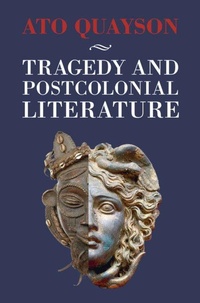
Tragedy and Postcolonial Literature
Published on 21. January 2021
Book
Hardback
346 pages
978-1-108-83098-0 (ISBN)
Description
This book examines tragedy and tragic philosophy from the Greeks through Shakespeare to the present day. It explores key themes in the links between suffering and ethics through postcolonial literature. Ato Quayson reconceives how we think of World literature under the singular and fertile rubric of tragedy. He draws from many key works - Oedipus Rex, Philoctetes, Medea, Hamlet, Macbeth, and King Lear - to establish the main contours of tragedy. Quayson uses Shakespeare's Othello, Chinua Achebe, Wole Soyinka, Tayeb Salih, Arundhati Roy, Toni Morrison, Samuel Beckett and J.M. Coetzee to qualify and expand the purview and terms by which Western tragedy has long been understood. Drawing on key texts such as The Poetics and The Nicomachean Ethics, and augmenting them with Frantz Fanon and the Akan concept of musuo (taboo), Quayson formulates a supple, insightful new theory of ethical choice and the impediments against it. This is a major book from a leading critic in literary studies.
Reviews / Votes
'... [This book] is a powerful insight, suggestive enough, one would have thought, to fuel a book-length inquiry into the distinctiveness of postcolonial tragedy.' Rajeswari Sunder Rajan, Modern Philology 'The book's connections to the fields of literature, philosophy, and history are apparent, as is its layered, meticulously crafted thesis. Relevant and applicable to a variety of critical reassessments in various fields within the humanities. Recommended.' J. Neal, Choice 'The contribution of Ato Quayson's book is undoubtedly found in the dialogue and the pooling of plural knowledge, reporting on the suffering and ethnic discriminations of which colonized populations have been victims.' Jean Zaganiaris, Anabases (translated from French) JeanMore details
Language
English
Place of publication
Cambridge
United Kingdom
Target group
Professional and scholarly
Illustrations
Worked examples or Exercises
Dimensions
Height: 235 mm
Width: 157 mm
Thickness: 25 mm
Weight
716 gr
ISBN-13
978-1-108-83098-0 (9781108830980)
Copyright in bibliographic data and cover images is held by Nielsen Book Services Limited or by the publishers or by their respective licensors: all rights reserved.
Schweitzer Classification
Other editions
Additional editions
Ato Quayson
Tragedy and Postcolonial Literature
Book
05/2025
Cambridge University Press
€33.40
Shipment within 15-20 days
Ato Quayson
Tragedy and Postcolonial Literature
E-Book
01/2021
Cambridge University Press
€29.49
Available for download
Ato Quayson
Tragedy and Postcolonial Literature
E-Book
01/2021
Cambridge University Press
€31.49
Available for download
Person
Ato Quayson is Professor of English at Stanford University, California. He has previously taught at the University of Cambridge, the University of Toronto, and at New York University, and has held fellowships at the University of Oxford, Harvard University, the University of California, Berkeley, Australian National University, and Wellesley College, among others.
Content
1. Introduction. Tragedy and the maze of moments; 2. Shakespeare: Ethical cosmopolitanism and Shakespeare's Othello; 3. Chinua Achebe: History and the conscription to colonial modernity in Chinua Achebe's rural novels; 4. Wole Soyinka: Ritual dramaturgy and the social imaginary in Wole Soyinka's tragic theatre; 5. Tayeb Salih: Archetypes, self-authorship, and melancholia: Tayeb Salih's Seasons of Migration to the North; 6. Toni Morrison: Form, freedom and ethical choice in Toni Morrison's Beloved; 7. J. M. Coetzee: On moral residue and the affliction of second thoughts: J.M. Coetzee's Waiting for the Barbarians; 8. Arundhati Roy: Enigmatic variations, language games and the arrested bildungsroman: Arundhati Roy's The God of Small Things; 9. Samuel Beckett: Distressed embodiment and the burdens of boredom: Samuel Beckett's Postcolonialism; 10. Conclusion: Postcolonial tragedy and the question of method.