

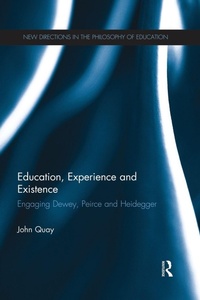
Education, Experience and Existence
Engaging Dewey, Peirce and Heidegger
1st Edition
Published on 21. August 2015
Book
Paperback/Softback
224 pages
978-1-138-94128-1 (ISBN)
Description
Education, Experience and Existence proposes a new way of understanding education that delves beneath the conflict, confusion and compromise that characterize its long history. At the heart of this new understanding is what John Dewey strove to expound: a coherent theory of experience. Dewey's reputation as a pragmatist is well known, but where experience is concerned pragmatism is only half the story. The other half is phenomenological, as crafted by Martin Heidegger. Encompassing both is Charles Sanders Peirce, whose philosophy draws pragmatism and phenomenology together in an embrace which enables a truly experiential philosophy to emerge.
The book approaches the problem of confusion in education and philosophy by beginning with our most basic understandings of existence. Existence as an interaction is the starting point of modern science, and existence as individuality offers an aesthetic origin, attending to existence as a simple unity. In our contemporary world where scientific ways of thinking are privileged, the aesthetic whole is often overlooked, especially in education. Yet both are connected. A coherent theory of experience is therefore a marriage between phenomenology and pragmatism, enabling each to maintain its position by acknowledging how both are required.
The book is divided into three main parts:
- confusion in philosophy and education
- a coherent theory of experience
- a coherent theory of education.
Quay suggests that education benefits from such a coherent theory of experience by better comprehending its connection to life. More than just knowing, more than just doing, education is about being. This book will be of interest to philosophers, educators and educational philosophers.
The book approaches the problem of confusion in education and philosophy by beginning with our most basic understandings of existence. Existence as an interaction is the starting point of modern science, and existence as individuality offers an aesthetic origin, attending to existence as a simple unity. In our contemporary world where scientific ways of thinking are privileged, the aesthetic whole is often overlooked, especially in education. Yet both are connected. A coherent theory of experience is therefore a marriage between phenomenology and pragmatism, enabling each to maintain its position by acknowledging how both are required.
The book is divided into three main parts:
- confusion in philosophy and education
- a coherent theory of experience
- a coherent theory of education.
Quay suggests that education benefits from such a coherent theory of experience by better comprehending its connection to life. More than just knowing, more than just doing, education is about being. This book will be of interest to philosophers, educators and educational philosophers.
More details
Series
Language
English
Place of publication
London
United Kingdom
Publishing group
Taylor & Francis Ltd
Target group
College/higher education
Postgraduate and Professional
Dimensions
Height: 234 mm
Width: 156 mm
Thickness: 14 mm
Weight
386 gr
ISBN-13
978-1-138-94128-1 (9781138941281)
Copyright in bibliographic data and cover images is held by Nielsen Book Services Limited or by the publishers or by their respective licensors: all rights reserved.
Schweitzer Classification
Other editions
Additional editions
E-Book
07/2013
1st Edition
Routledge
€76.49
Available for download
E-Book
07/2013
1st Edition
Routledge
€76.49
Available for download
Book
05/2013
1st Edition
Routledge
€241.90
Shipment within 15-20 days
Person
John Quay is Senior Lecturer at the Graduate School of Education, University of Melbourne, Australia.
Content
Part I: Confusion in Philosophy and Education Education, Philosophy and Existence Part II: A Coherent Theory of Experience Reflective Experience and the Logical Difference. The Challenge of Non-reflective (Aesthetic) Experience. The Ontological Difference. The Way of Phenomenology. Heidegger's Questioning of Be-ing Part III: A Coherent Theory of Education Four Causes of Educational Confusion. Educating Through Occupations as Ways of Be-ing.