

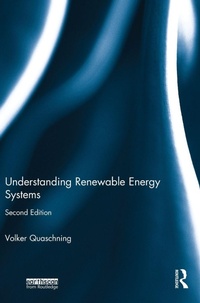
Understanding Renewable Energy Systems
2nd Edition
Published on 11. April 2016
Book
Hardback
424 pages
978-1-138-78194-8 (ISBN)
Description
By mid-century, renewable energy must cover all of our energy supply if we are to phase out nuclear and successfully stop climate change.
Now updated and expanded, the 2nd edition of this textbook covers the full range of renewable energy systems and now also includes such current trends as solar power storage, power-to-gas technologies, and the technology paths needed for a successful and complete energy transition. The topics are treated in a holistic manner, bringing together maths, engineering, climate studies and economics, and enabling readers to gain a broad understanding of renewable energy technologies and their potential.Numerous examples are provided for calculations, and graphics help visualize the various technologies and mathematical methodologies. Understanding Renewable Energy Systems is an ideal companion for students of renewable energy at universities or technical colleges on courses such as renewable energy, electrical engineering, engineering technology, physics, process engineering, building engineering, environment, applied mechanics and mechanical engineering, as well as scientists and engineers in research and industry.
Now updated and expanded, the 2nd edition of this textbook covers the full range of renewable energy systems and now also includes such current trends as solar power storage, power-to-gas technologies, and the technology paths needed for a successful and complete energy transition. The topics are treated in a holistic manner, bringing together maths, engineering, climate studies and economics, and enabling readers to gain a broad understanding of renewable energy technologies and their potential.Numerous examples are provided for calculations, and graphics help visualize the various technologies and mathematical methodologies. Understanding Renewable Energy Systems is an ideal companion for students of renewable energy at universities or technical colleges on courses such as renewable energy, electrical engineering, engineering technology, physics, process engineering, building engineering, environment, applied mechanics and mechanical engineering, as well as scientists and engineers in research and industry.
More details
Edition
2nd edition
Language
English
Place of publication
London
United Kingdom
Publishing group
Taylor & Francis Ltd
Target group
College/higher education
Professional and scholarly
Illustrations
436 s/w Abbildungen, 120 s/w Photographien bzw. Rasterbilder, 200 s/w Zeichnungen, 116 s/w Tabellen
116 Tables, black and white; 200 Line drawings, black and white; 120 Halftones, black and white; 436 Illustrations, black and white
Dimensions
Height: 250 mm
Width: 175 mm
Thickness: 27 mm
Weight
910 gr
ISBN-13
978-1-138-78194-8 (9781138781948)
Copyright in bibliographic data and cover images is held by Nielsen Book Services Limited or by the publishers or by their respective licensors: all rights reserved.
Schweitzer Classification
Other editions
Additional editions
Volker Quaschning
Understanding Renewable Energy Systems
Book
04/2016
2nd Edition
Routledge
€109.10
Shipment within 10-20 days
Volker Quaschning
Understanding Renewable Energy Systems
E-Book
03/2016
2nd Edition
Routledge
€100.99
Available for download
Volker Quaschning
Understanding Renewable Energy Systems
E-Book
03/2016
2nd Edition
Routledge
€100.99
Available for download
Previous edition

Volker Quaschning
Understanding Renewable Energy Systems
Book
12/2005
Earthscan Ltd
€163.42
Article exhausted; check for reprint
Person
Volker Quaschning currently teaches and conducts research in the Renewable Energy Systems Department at Berlin's University of Applied Sciences (HTW), Germany. He has many years of experience in various fields of renewable energy, both within Germany and abroad.
Content
1. Energy and Climate Protection 2. Insolation 3. Non-concentrating Solar Thermal 4. Concentrated Solar Power 5. Photovoltaics 6. Wind Energy 7. Hydropower 8. Geothermal Energy 9. Using Biomass 10. Hydrogen Production, Fuel Cells and Methanation 11. Calculating Economic Feasibility