

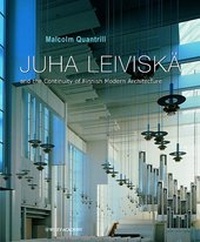
Juha Leiviskä
and the Continuity of Finnish Modern Architecture
Published on 10. October 2001
Book
Paperback/Softback
128 pages
978-0-471-48967-2 (ISBN)
Description
JUHA ILMARI LEIVISKÄ has enjoyed a distinguished career as one of Finland's leading architects. This book provides a perceptive account of his work to date, locating it within both Finnish modernism and that of Dutch De Stijl.
Leiviskä's profound interest in architectural history has not led him to mere imitation of historic forms: even in his faithful adherence to the principles of De Stijl he succeeds in dissolving its formal vocabulary of abstraction by his uncanny and totally unnerving use of daylight. What is reflected in Professor Quantrill's authoritative account is not only Leiviskä's sensitivity to the chemistry of built form when immersed in light, but the interaction of physical form and musical structure in his designs.
Born in Helsinki in 1936, Leiviskä studied architecture at Helsinki's celebrated University of Technology in Otaniemi. After graduating in 1959, he began lecturing there on the history of architecture, and continued to do so until 1971. His architectural practice dates from 1964, when he was only 28, and his best known and most admired work - both executed buildings and projects - has centred on the design of religious buildings for the Lutheran Church. The qualities of his architecture, as well as his own uniquely personal talents as a designer, have been widely recognised since the completion of St Thomas's Parish Church and Centre in Oulu (1975).
Leiviskä was made a member of the Royal Swedish Academy of Fine Arts in 1991, and was appointed as an 'Artist Professor' by the Finnish President in 1992. In 1994 he was made an Honorary Fellow of the American Institute of Architects. He was awarded the prestigious Carlsberg Prize in 1995, and in 1997 he followed Alvar Aalto and Reima Pietilä in becoming the architecture Member of the Academy of Finland.
Ein neuer Band aus der erfolgreichen Wiley-Reihe 'Architectural Monographs' und die erste Monographie über den berühmten finnischen Architekten Juha Leiviska, der 1996 mit dem Carlsberg Preis ausgezeichnet wurde. Dieser Band ist das Produkt der 15-jährigen Freundschaft, die den Autor Malcolm Quantrill mit dem Architekten Juha Leiviska verbindet. Er vermittelt das Wesen von Leiviskas ganz persönlichem Designansatz, wonach der Architekt fest in seiner Heimaterde verwurzelt sein sollte. Quantrill erläutert Leiviskas Hintergrund, die Einflüsse auf seine Entwicklung, und wie sich Leiviska als talentierter Musiker von musikalischen Formen und Ideen bei der architektonischen Gestaltung inspirieren lässt. Seine berühmten lutherischen Kirchen und seine weltlichen Bauten, wie z.B. die Deutsche Botschaft in Helsinki, betonen Leiviskas einzigartige Sensibilität für Form und Licht. Mit zahlreichen Farb- und Schwarz-Weiss-Illustrationen.
Leiviskä's profound interest in architectural history has not led him to mere imitation of historic forms: even in his faithful adherence to the principles of De Stijl he succeeds in dissolving its formal vocabulary of abstraction by his uncanny and totally unnerving use of daylight. What is reflected in Professor Quantrill's authoritative account is not only Leiviskä's sensitivity to the chemistry of built form when immersed in light, but the interaction of physical form and musical structure in his designs.
Born in Helsinki in 1936, Leiviskä studied architecture at Helsinki's celebrated University of Technology in Otaniemi. After graduating in 1959, he began lecturing there on the history of architecture, and continued to do so until 1971. His architectural practice dates from 1964, when he was only 28, and his best known and most admired work - both executed buildings and projects - has centred on the design of religious buildings for the Lutheran Church. The qualities of his architecture, as well as his own uniquely personal talents as a designer, have been widely recognised since the completion of St Thomas's Parish Church and Centre in Oulu (1975).
Leiviskä was made a member of the Royal Swedish Academy of Fine Arts in 1991, and was appointed as an 'Artist Professor' by the Finnish President in 1992. In 1994 he was made an Honorary Fellow of the American Institute of Architects. He was awarded the prestigious Carlsberg Prize in 1995, and in 1997 he followed Alvar Aalto and Reima Pietilä in becoming the architecture Member of the Academy of Finland.
Ein neuer Band aus der erfolgreichen Wiley-Reihe 'Architectural Monographs' und die erste Monographie über den berühmten finnischen Architekten Juha Leiviska, der 1996 mit dem Carlsberg Preis ausgezeichnet wurde. Dieser Band ist das Produkt der 15-jährigen Freundschaft, die den Autor Malcolm Quantrill mit dem Architekten Juha Leiviska verbindet. Er vermittelt das Wesen von Leiviskas ganz persönlichem Designansatz, wonach der Architekt fest in seiner Heimaterde verwurzelt sein sollte. Quantrill erläutert Leiviskas Hintergrund, die Einflüsse auf seine Entwicklung, und wie sich Leiviska als talentierter Musiker von musikalischen Formen und Ideen bei der architektonischen Gestaltung inspirieren lässt. Seine berühmten lutherischen Kirchen und seine weltlichen Bauten, wie z.B. die Deutsche Botschaft in Helsinki, betonen Leiviskas einzigartige Sensibilität für Form und Licht. Mit zahlreichen Farb- und Schwarz-Weiss-Illustrationen.
More details
Series
Edition
1. Auflage
Language
English
Place of publication
London
United Kingdom
Publishing group
John Wiley and Sons Ltd
Target group
College/higher education
Professional and scholarly
Illustrations
colour and b&w illustrations
Dimensions
Height: 30.5 cm
Width: 25 cm
Thickness: 0.9 cm
Weight
700 gr
ISBN-13
978-0-471-48967-2 (9780471489672)
Schweitzer Classification
Person
MALCOLM QUANTRILL studied architecture at the universities of Liverpool and Pennsylvania, and received his doctorate in urbanism from the Technical University of Wroclaw. He is a former Director of the Architectural Association, London, and Dean of the School of Environmental Design in the University of North London. Since 1986 he has been the Distinguished Professor of Architecture at Texas A&M University. He began studying modern Finnish architecture in 1959 and Juha Leiviskä and the continuity of Finnish modern architecture is his sixth book on this subject.
Content
GROUNDWORK, BACKGROUND AND FOREGROUND.
Introduction to Juha Leiviskä in the Context of Finnish Modern Architecture.
REVIEW OF SELECTED WORKS.
Kouvola Town Hall, Kouvola, Finland.
Villa Nikamaa, Lemi, Finland.
Cemetery and Chapels of Rest, Vaasa, Finland.
Nakkila Parish Hall, Nakkila, Finland.
Town Plan for the Centre of Puolivälinkangas, with St Thomas's Church and Parish Centre, Oulu, Finland.
Parish Church and Centre for Myyrmäki, Vantaa, Finland.
Branch Library and Day Nursery for the suburb of Vallila, Helsinki, Finland.
Kajaani Art Museum, Kajaani, Finland.
Embassy for the Federal Republic of Germany, Helsinki, Finland.
Parish Church and Centre for the suburb of Männisto, Kuopio, Finland.
Newspaper Offices, Väterås, Sweden.
Villa Thorén-Söderström, Tammisaari, Finland.
Church and Parish Centre, Pirkkala, Finland.
Museum of Contemporary Art, Helsinki, Finland.
National Museum of Art, Tallinn, Estonia.
Harju Funeral Chapel: Remodelling and Additions, Mikkeli, Finland.
Dar Al-Kalima Academy, Meeting Hall and Restaurant, Bethlehem, Palestine.
JUHA LEIVISKÄ: BIOGRAPHICAL NOTES.
CATALOGUE RAISONNÉ.
BIBLIOGRAPHY.
Introduction to Juha Leiviskä in the Context of Finnish Modern Architecture.
REVIEW OF SELECTED WORKS.
Kouvola Town Hall, Kouvola, Finland.
Villa Nikamaa, Lemi, Finland.
Cemetery and Chapels of Rest, Vaasa, Finland.
Nakkila Parish Hall, Nakkila, Finland.
Town Plan for the Centre of Puolivälinkangas, with St Thomas's Church and Parish Centre, Oulu, Finland.
Parish Church and Centre for Myyrmäki, Vantaa, Finland.
Branch Library and Day Nursery for the suburb of Vallila, Helsinki, Finland.
Kajaani Art Museum, Kajaani, Finland.
Embassy for the Federal Republic of Germany, Helsinki, Finland.
Parish Church and Centre for the suburb of Männisto, Kuopio, Finland.
Newspaper Offices, Väterås, Sweden.
Villa Thorén-Söderström, Tammisaari, Finland.
Church and Parish Centre, Pirkkala, Finland.
Museum of Contemporary Art, Helsinki, Finland.
National Museum of Art, Tallinn, Estonia.
Harju Funeral Chapel: Remodelling and Additions, Mikkeli, Finland.
Dar Al-Kalima Academy, Meeting Hall and Restaurant, Bethlehem, Palestine.
JUHA LEIVISKÄ: BIOGRAPHICAL NOTES.
CATALOGUE RAISONNÉ.
BIBLIOGRAPHY.