

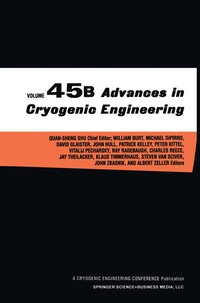
Advances in Cryogenic Engineering
Published on 27. November 2013
Book
Paperback/Softback
IV, 975 pages
978-1-4613-6892-2 (ISBN)
Description
In recent years, the technology of cryogenic comminution has been widely applied in the field of chemical engineering, food making, medicine production, and particularly in recycling of waste materials. Because of the increasing pollution of waste tires and the shortage of raw rubber resource, the recycling process for waste rubber products has become important and commercially viable. This technology has shown a great number of advantages such as causing no environmental pollution, requiring low energy consumption and producing high quality products. Hence, the normal crusher which was used to reclaim materials, such as waste tires, nylon, plastic and many polymer materials at atmospheric 12 temperature is being replaced by a cryogenic crusher. In the cryogenic crusher, the property of the milled material is usually very sensitive to temperature change. When a crusher is in operation, it will generate a great deal of heat that causes the material temperature increased. Once the temperature increases over the vitrification temperature, the material property will change and lose the brittle behavior causing the energy consumption to rise sharply. Consequently, the comminution process cannot be continued. Therefore, it is believed that the cryogenic crusher is the most critical component in the cryogenic comminution system. The research on the temperature increase and energy consumption in the cryogenic crusher is not only to reduce the energy consumption of the crasher, but also to reduce the energy consumption of the cryogenic system.
Reviews / Votes
about previous volumes:` The Advances in Cryogenic Engineering series provides a timely and authoritative entrée to the field for the outsider. For the insider, it is a must. '
Materials Science and Engineering
` Provides in-depth coverage of current research on technical materials of primary interest in the cryogenic engineering community, reviews important breakthroughs of the past, and outlines directions for future research. '
Cryogenic Information Report
` An interdisciplinary review of all areas of low-temperature technology, this significant series annually updates existing knowledge of cryogenic processes, equipment, instrumentation, properties, and applications....The literature source for many important new discoveries in the field. '
IEEE Spectrum
More details
Series
Edition
Softcover reprint of the original 1st ed. 2000
Language
English
Place of publication
New York
United States
Target group
Professional and scholarly
Research
Illustrations
IV, 975 p.
Dimensions
Height: 235 mm
Width: 155 mm
Thickness: 53 mm
Weight
1457 gr
ISBN-13
978-1-4613-6892-2 (9781461368922)
DOI
10.1007/978-1-4615-4215-5
Schweitzer Classification
Other editions
Additional editions
Quan-Sheng Shu | Peter Kittel | David Glaister
Advances in Cryogenic Engineering
Book
10/2000
1st Edition
Kluwer Academic/Plenum Publishers
€318.50
Article not available at the moment
Content
Foreword. Samuel C. Collins Award. Russell B. Scott, Memorial Awards. Student Awards. 1999 Cryogenic Engineering Conference Board. Acknowledgments. Part A: Pulse Tube Cryocoolers: (I). Pulse Tube Cryocoolers: (II). G-M and Stirling Cryocoolers. Regenerators: Materials and Analyses. Cryogenic Space Applications. Other Cryocooler Applications. Superconducting Magnets. Superconducting Magnets: Materials. Superconducting Cavities: (I). Superconducting RF Cavities: (II). Part B: He II Systems. He II Phenomena. Fluid Mechanism and Heat Transfer: (I). Fluid Mechanism and Heat Transfer: (II). Large Scale Refrigerators and Liquefiers: (I). Large Scale Refrigerators and Liquefiers: (II). SC Power Leads and Cable. Cryogenic Electronics. Other Superconducting Devices. Cryostat and Thermal Insulation. Other Novel Devices. Cryogenic Instruments and Controls.