

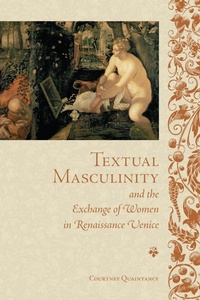
Textual Masculinity and the Exchange of Women in Renaissance Venice
Published on 22. April 2015
Book
Hardback
272 pages
978-1-4426-4913-2 (ISBN)
Description
Textual Masculinity and the Exchange of Women in Renaissance Venice is a provocative analysis of the pornographic poetry written in patrician poet Domenico Venier's social circle. While Venier and his salon were renowned for elegant love sonnets featuring unattainable female beloveds, among themselves they wrote and circulated poems in Venetian dialect in which women were prostitutes whose defiled bodies were available to all.
Courtney Quaintance analyses poetry, letters, plays, and verse dialogues to show how male writers established, sustained, and publicized their relationships to one another through the exchange of fictional women. She also shows how Gaspara Stampa and Veronica Franco, two women writers with ties to the salon, appropriated and transformed tropes of female sexuality and male literary collaboration to position themselves within this homosocial literary economy. Based on archival work and Quaintance's exceptional knowledge of Venetian dialect poetry, Textual Masculinity and the Exchange of Women in Renaissance Venice is an unprecedented window into the understudied world of Venetian literature.
Courtney Quaintance analyses poetry, letters, plays, and verse dialogues to show how male writers established, sustained, and publicized their relationships to one another through the exchange of fictional women. She also shows how Gaspara Stampa and Veronica Franco, two women writers with ties to the salon, appropriated and transformed tropes of female sexuality and male literary collaboration to position themselves within this homosocial literary economy. Based on archival work and Quaintance's exceptional knowledge of Venetian dialect poetry, Textual Masculinity and the Exchange of Women in Renaissance Venice is an unprecedented window into the understudied world of Venetian literature.
Reviews / Votes
'Textual Masculinity elegantly weaves together social class and language, and cultures of manuscript exchange and print, academies and libertinism, in the late Venetian Renaissance.'- Holly S. Hurlburt (Renaissance and Reformation, vol 39:02:2016) 'Quintances' translations are lively and effective... We have much to learn from the material she analyzes.'
- Mary Gallucci (Renaissance Quarterly vol 69:04:2016) 'Textual Masculinity is an important work providing innovative, more sophisticated, and broader understanding of the production of literature on women in sixteenth-century Venice. It will have to be taken into account in any future study the Renaissance Venetian literary world.'
- Paula C. Clarke (Journal of Modern History vol 89:02:2017) 'Textual Masculinities is full of new information, even about well-known subjects like Stampa and Franco... It includes a wealth of Venetian poetry that she has translated and published for the first time.'
- Deanna Shemek (Early Modern Women Journal vol 12:01:2017) 'This book is a major contribution to the field of early modern gender studies and a groundbreaking text that brilliantly approaches the understudies issues related to masculine identity.'
- Chiara Girardi (Gender/Sexuality/Italy vol 4:2017)
More details
Series
Language
English
Place of publication
Toronto
Canada
Target group
College/higher education
Product notice
sewn/stitched
Cloth over boards
With dust jacket
Dimensions
Height: 231 mm
Width: 150 mm
Thickness: 28 mm
Weight
544 gr
ISBN-13
978-1-4426-4913-2 (9781442649132)
Copyright in bibliographic data and cover images is held by Nielsen Book Services Limited or by the publishers or by their respective licensors: all rights reserved.
Schweitzer Classification
Person
Courtney Quaintance is an associate professor in the Department of French and Italian at Dartmouth College.
Content
Introduction: Writing the Whore in Renaissance Venice
1. Gang Rape and Literary Fame
2. Fictional Ladies and Literary Fraternity
3. The Erotics of Venetian Dialect
4. Dialect and Homosociality from Manuscript to Print
5. Women Writers Between Men
1. Gang Rape and Literary Fame
2. Fictional Ladies and Literary Fraternity
3. The Erotics of Venetian Dialect
4. Dialect and Homosociality from Manuscript to Print
5. Women Writers Between Men