

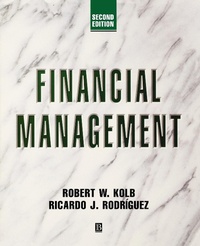
Financial Management
2nd Edition
Published on 3. April 1996
Book
Paperback/Softback
470 pages
978-1-55786-844-2 (ISBN)
Description
Intended for an introduction or intermeduate course in corporate finance, Financial Management stresses a finance function orientation over the more traditional accounting orientation. Consistent with this approach, the text focuses on two main ideas: maximising shareholder wealth as the goal of financial management, and the persistent trade-offs confronting financial managers as they attempt to reach that goal.
More details
Edition
2nd edition
Language
English
Place of publication
New York
United States
Target group
College/higher education
Professional and scholarly
Product notice
Paperback (trade)
Unsewn / adhesive bound
Dimensions
Height: 235 mm
Width: 191 mm
Thickness: 25 mm
Weight
870 gr
ISBN-13
978-1-55786-844-2 (9781557868442)
Copyright in bibliographic data and cover images is held by Nielsen Book Services Limited or by the publishers or by their respective licensors: all rights reserved.
Schweitzer Classification
Persons
ROBERT W. KOLB was John S. and James L. Knight Professor of Finance at the University of Miami until 1995. He is author or coauthor of finance texts on a range of topics including futures, options, financial derivatives, investments, corporate finance, and financial institutions. He was founder and president of Kolb Publishing Company, sold to Blackwell Publishers in 1995. His research has been published in Financial Management, the Journal of Finance, the Journal of Risk and Insurance, the Journal of Financial Economics, and the Journal of Futures Markets.
Content
1. Financial Management and the Business Environment. 2. The Time Value of Money.
3. The Time Value of a Series of Payments.
4. Bond Valuation.
5. Stock Valuation.
6. Capital Budgeting Techniques.
7. Special Problems in Capital Budgeting.
8. Risk and Required Rate of Return.
9. The Market Price of Risk.
10. Leverage and Risk.
11. Capital Structure.
12. Divident Policy.
13. Sources of Long-Term Financing.
14. Inventory and Cash Management.
15. Accounts Receivable Management.
16. Short-Term Financing.
17. Financial Analysis.
18. Financial Planning.
19. The Efficient Market Hypothesis.
20. Lensing.
21. Option Valuation.
22. Mergers and Acquisitions.
23. International Financial Management.
Appendix.
Index.
3. The Time Value of a Series of Payments.
4. Bond Valuation.
5. Stock Valuation.
6. Capital Budgeting Techniques.
7. Special Problems in Capital Budgeting.
8. Risk and Required Rate of Return.
9. The Market Price of Risk.
10. Leverage and Risk.
11. Capital Structure.
12. Divident Policy.
13. Sources of Long-Term Financing.
14. Inventory and Cash Management.
15. Accounts Receivable Management.
16. Short-Term Financing.
17. Financial Analysis.
18. Financial Planning.
19. The Efficient Market Hypothesis.
20. Lensing.
21. Option Valuation.
22. Mergers and Acquisitions.
23. International Financial Management.
Appendix.
Index.