

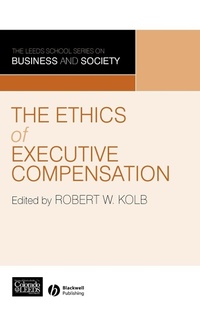
The Ethics of Executive Compensation
1st Edition
Published on 10. January 2006
Book
Hardback
196 pages
978-1-4051-3341-8 (ISBN)
Description
The first volume in the Leeds School Series on Business & Society, this collection of lectures demonstrates the valuable results of a timely exchange of ideas regarding the nature of executive compensation.
Includes discussions across academic disciplines, perspectives, and intellectual orientations on the oft-debated topic of executive compensation.
Gathers for the first time a series of lectures delivered at the 2004 Japha Symposium at the University of Colorado.
Provides the reader with insight into the fundamental problems from a social and ethical perspective, and proposes a myriad of possible solutions.
Includes discussions across academic disciplines, perspectives, and intellectual orientations on the oft-debated topic of executive compensation.
Gathers for the first time a series of lectures delivered at the 2004 Japha Symposium at the University of Colorado.
Provides the reader with insight into the fundamental problems from a social and ethical perspective, and proposes a myriad of possible solutions.
More details
Series
Language
English
Place of publication
Hoboken
United Kingdom
Publishing group
John Wiley and Sons Ltd
Target group
Professional and scholarly
Product notice
Unsewn / adhesive bound
Paper over boards
Dimensions
Height: 240 mm
Width: 161 mm
Thickness: 15 mm
Weight
466 gr
ISBN-13
978-1-4051-3341-8 (9781405133418)
Copyright in bibliographic data and cover images is held by Nielsen Book Services Limited or by the publishers or by their respective licensors: all rights reserved.
Schweitzer Classification
Person
Robert Kolb is the Assistant Dean for Business and Society at the Leeds School of Business, University of Colorado, as well as the author and editor of over a dozen books and numerous articles on finance and investments. He currently devotes his time to writing and research, especially in the areas of futures markets, investments, and bond portfolio management.
Content
Contributors. An Introduction (Robert W. Kolb).
Part I: Insights of Empirical Research.
1. Executive Preference for Compensation Structure and Normative Myopia: A Business and Society Research Project. (Diane L. Swanson and Marc Orlitzky).
2. Does Firm Performance Reduce Managerial Opportunism?: The Impact of Performance-based Compensation and Firm Performance on Illegal Accounting Restatements. (Jegoo Lee, Byung-Hee Lee, Sandra Waddock, and Samuel B. Graves).
3. A Preliminary Investigation into the Association between Canadian Corporate Social Responsibility and Executive Compensation. (Lois S. Mahoney ad Linda Thorne).
Part II: Justice-based Analyses of Executive Compensation.
4. How Much is Too Much? A Theoretical Analysis of Executive Compensation from the Standpoint of Distributive Justice. (Jared Harris).
5. Justice, Incentives, and Executive Compensation. (William H. Shaw).
6. CEO Compensation and Virtue Ethics. (Michael Potts).
7. Chihuahuas in the Gardens of Corporate Capitalism. (Lyla D. Hamilton).
Part III: Broadening the Perspective.
8. The Obligation of Corporate Boards to Set and Monitor Compensation. (Carmen M. Alston).
9. Executive Pay in Public Academia: A Non-Justice-Based Argument for the Reallocation of Compensation. (James Stacey Taylor).
10. How to (Try to) Justify CEO Pay. (Jeffrey Moriarty).
11. Executive Compensation: Just Procedures and Outcomes. (Joe DesJardins).
Index.
Part I: Insights of Empirical Research.
1. Executive Preference for Compensation Structure and Normative Myopia: A Business and Society Research Project. (Diane L. Swanson and Marc Orlitzky).
2. Does Firm Performance Reduce Managerial Opportunism?: The Impact of Performance-based Compensation and Firm Performance on Illegal Accounting Restatements. (Jegoo Lee, Byung-Hee Lee, Sandra Waddock, and Samuel B. Graves).
3. A Preliminary Investigation into the Association between Canadian Corporate Social Responsibility and Executive Compensation. (Lois S. Mahoney ad Linda Thorne).
Part II: Justice-based Analyses of Executive Compensation.
4. How Much is Too Much? A Theoretical Analysis of Executive Compensation from the Standpoint of Distributive Justice. (Jared Harris).
5. Justice, Incentives, and Executive Compensation. (William H. Shaw).
6. CEO Compensation and Virtue Ethics. (Michael Potts).
7. Chihuahuas in the Gardens of Corporate Capitalism. (Lyla D. Hamilton).
Part III: Broadening the Perspective.
8. The Obligation of Corporate Boards to Set and Monitor Compensation. (Carmen M. Alston).
9. Executive Pay in Public Academia: A Non-Justice-Based Argument for the Reallocation of Compensation. (James Stacey Taylor).
10. How to (Try to) Justify CEO Pay. (Jeffrey Moriarty).
11. Executive Compensation: Just Procedures and Outcomes. (Joe DesJardins).
Index.