

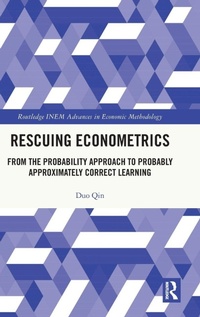
Rescuing Econometrics
From the Probability Approach to Probably Approximately Correct Learning
1st Edition
Published on 1. December 2023
Book
Hardback
100 pages
978-1-032-58605-2 (ISBN)
Description
Haavelmo's 1944 monograph, The Probability Approach in Econometrics, is widely acclaimed as the manifesto of econometrics. This book challenges Haavelmo's probability approach, shows how its use is delivering defective and inefficient results, and argues for a paradigm shift in econometrics towards a full embrace of machine learning, with its attendant benefits.
Machine learning has only come into existence over recent decades, whereas the universally accepted and current form of econometrics has developed over the past century. A comparison between the two is, however, striking. The practical achievements of machine learning significantly outshine those of econometrics, confirming the presence of widespread inefficiencies in current econometric research. The relative efficiency of machine learning is based on its theoretical foundation, and particularly on the notion of Probably Approximately Correct (PAC) learning. Careful examination reveals that PAC learning theory delivers the goals of applied economic modelling research far better than Haavelmo's probability approach. Econometrics should therefore renounce its outdated foundation, and rebuild itself upon PAC learning theory so as to unleash its pent-up research potential. The book is catered for applied economists, econometricians, economists specialising in the history and methodology of economics, advanced students, philosophers of social sciences.
Machine learning has only come into existence over recent decades, whereas the universally accepted and current form of econometrics has developed over the past century. A comparison between the two is, however, striking. The practical achievements of machine learning significantly outshine those of econometrics, confirming the presence of widespread inefficiencies in current econometric research. The relative efficiency of machine learning is based on its theoretical foundation, and particularly on the notion of Probably Approximately Correct (PAC) learning. Careful examination reveals that PAC learning theory delivers the goals of applied economic modelling research far better than Haavelmo's probability approach. Econometrics should therefore renounce its outdated foundation, and rebuild itself upon PAC learning theory so as to unleash its pent-up research potential. The book is catered for applied economists, econometricians, economists specialising in the history and methodology of economics, advanced students, philosophers of social sciences.
More details
Series
Language
English
Place of publication
London
United Kingdom
Publishing group
Taylor & Francis Ltd
Target group
College/higher education
Postgraduate
Illustrations
3 s/w Abbildungen, 3 s/w Zeichnungen
3 Line drawings, black and white; 3 Illustrations, black and white
Dimensions
Height: 240 mm
Width: 161 mm
Thickness: 11 mm
Weight
344 gr
ISBN-13
978-1-032-58605-2 (9781032586052)
Copyright in bibliographic data and cover images is held by Nielsen Book Services Limited or by the publishers or by their respective licensors: all rights reserved.
Schweitzer Classification
Other editions
Additional editions
Duo Qin
Rescuing Econometrics
From the Probability Approach to Probably Approximately Correct Learning
Book
05/2025
1st Edition
Routledge
€66.80
Shipment within 10-20 days
Duo Qin
Rescuing Econometrics
From the Probability Approach to Probably Approximately Correct Learning
E-Book
12/2023
1st Edition
Taylor & Francis
€60.49
Available for download
Duo Qin
Rescuing Econometrics
From the Probability Approach to Probably Approximately Correct Learning
E-Book
12/2023
1st Edition
Taylor & Francis
€60.49
Available for download
Person
Duo Qin is Emeritus Professor of Economics at SOAS, University of London.
Content
1. Abstract Modelling of Reality 2. Learnability of Economic Relations 3. Basic Functions of Probability in Econometrics 4. Roles of Hypothesis Testing and Economic Model Formulation 5. Problems and Potentials of Estimation 6. Cognitive Problems of Prediction