

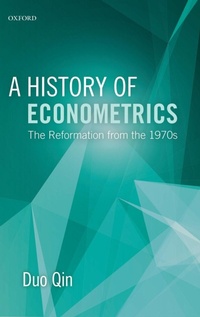
A History of Econometrics
The Reformation from the 1970s
Published on 25. July 2013
Book
Hardback
258 pages
978-0-19-967934-8 (ISBN)
Description
Reformation of Econometrics is a sequel to The Formation of Econometrics: A Historical Perspective (1993, OUP) which traces the formation of econometric theory during the period 1930-1960. This book provides an account of the advances in the field of econometrics since the 1970s. Based on original research, it focuses on the reformists' movement and schools of thought and practices that attempted a paradigm shift in econometrics in the 1970s and 1980s.
It describes the formation and consolidation of the Cowles Commission (CC) paradigm and traces and analyses the three major methodological attempts to resolve problems involved in model choice and specification of the CC paradigm. These attempts have reoriented the focus of econometric research from internal questions (how to optimally estimate a priori given structural parameters) to external questions (how to choose, design, and specify models). It also examines various modelling issues and problems through two case studies - modelling the Phillips curve and business cycles. The third part of the book delves into the development of three key aspects of model specification in detail - structural parameters, error terms, and model selection and design procedures. The final chapter uses citation analyses to study the impact of the CC paradigm over the span of three and half decades (1970-2005). The citation statistics show that the impact has remained extensive and relatively strong in spite of certain weakening signs. It implies that the reformative attempts have fallen short of causing a paradigm shift.
It describes the formation and consolidation of the Cowles Commission (CC) paradigm and traces and analyses the three major methodological attempts to resolve problems involved in model choice and specification of the CC paradigm. These attempts have reoriented the focus of econometric research from internal questions (how to optimally estimate a priori given structural parameters) to external questions (how to choose, design, and specify models). It also examines various modelling issues and problems through two case studies - modelling the Phillips curve and business cycles. The third part of the book delves into the development of three key aspects of model specification in detail - structural parameters, error terms, and model selection and design procedures. The final chapter uses citation analyses to study the impact of the CC paradigm over the span of three and half decades (1970-2005). The citation statistics show that the impact has remained extensive and relatively strong in spite of certain weakening signs. It implies that the reformative attempts have fallen short of causing a paradigm shift.
Reviews / Votes
A History of Econometrics is meticulously researched, thoughtfully arranged, and is an excellent text for those seeking to integrate the history of econometrics into larger narratives within the social sciences. * Sarah Ruggins, Journal of Cultural Economy *More details
Language
English
Place of publication
Oxford
United Kingdom
Target group
Professional and scholarly
Illustrations
13 Figures and 7 Tables
Dimensions
Height: 240 mm
Width: 161 mm
Thickness: 19 mm
Weight
555 gr
ISBN-13
978-0-19-967934-8 (9780199679348)
Copyright in bibliographic data and cover images is held by Nielsen Book Services Limited or by the publishers or by their respective licensors: all rights reserved.
Schweitzer Classification
Other editions
Additional editions
E-Book
07/2013
1st Edition
OUP eBook
€104.99
Available for download
Person
Duo Qin is Professor of Economics at SOAS, University of London. Her research expertise covers broadly two aspects: The history and the methodology of econometrics; and applied macro-econometrics with particular reference to transitional and emerging market economies, especially China and economies of the Southeast Asian region, as well as international economic/financial issues. She is also interested in normative issues concerning social, ethnic, and cultural problems associated with economic development.
Content
Introduction ; 1. Consolidation of the Cowles Commission Research Programme ; 2. Rise of Bayesian Econometrics ; 3. Rise of the VAR Approach ; 4. Rise of the LSE Approach ; 5. Case Study One: Modelling the Phillips Curve ; 6. Case Study Two: Modelling Business Cycles ; 7. Shifting Targets of Structural Parameters ; 8. Evolving Roles of Error Terms ; 9. Calibration of Model Selection and Design Procedure ; 10. Impact of the CC Programme through Citation Analysis ; Epilogue