

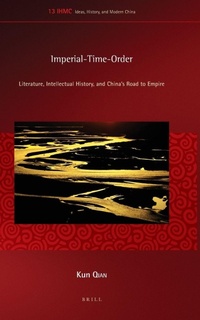
Imperial-Time-Order
Literature, Intellectual History, and China's Road to Empire
Published on 4. December 2015
Book
Hardback
368 pages
978-90-04-30929-6 (ISBN)
Description
Imperial-Time-Order is an engagingly written critical study on a persistent historical way of thinking in modern China. Defined as normalization of unification and moralization of time, Qian suggests, the imperial-time-order signifies a temporal structure of empire that has continued to shape the way modern China developed itself conceptually. Weaving together intellectual debates with literary and media representations of imperial history since the late Qing period, ranging from novels, stage plays, films, to television series, Qian traces the different temporalities of each period and takes "time" as the analytical node by which issues of empire, nation, family, morality, individual and collective subjectivity are constructed and contested.
More details
Series
Language
English
Place of publication
Leiden
Netherlands
Target group
Professional and scholarly
Product notice
sewn/stitched
Cloth over boards
Dimensions
Height: 236 mm
Width: 157 mm
Thickness: 25 mm
Weight
662 gr
ISBN-13
978-90-04-30929-6 (9789004309296)
Copyright in bibliographic data and cover images is held by Nielsen Book Services Limited or by the publishers or by their respective licensors: all rights reserved.
Schweitzer Classification
Person
Kun Qian, Ph.D (2009), Cornell University, is Assistant Professor of Chinese Literature and Film at the University of Pittsburgh. She has published critical essays and encyclopaedia entries on modern Chinese literature and cinema in both English and Chinese language.
Content
Acknowledgements
Note on Romanization and Script
List of Illustrations
Introduction
Part One: The Imperial-Time-Order
1. The Imperial-Time-Order: The Eternal Return of the Chinese Empire
Part Two: Time, Unity, and Morality from the Late Qing to Mao's China
2. Suspended Time: Grounding the Present in the Late Qing
3. Split Time: Enlightenment and its Discontent
4. Continuous Time: Heroes in the 'Protracted War'
5. Transitional Time: Defining the 'People' and the 'Nation' in Mao's China
Part Three: The Return of 'Empire' in the post-Mao Period
6. Resurgent Time: The Return of 'Empire' in Post-socialist Representation
7. Love or Hate: The First Emperor on the Cinematic Screen
8. The Fascinating Empire: Emperors in Contemporary Novels
9. Tianxia Revisited: Empire and Family on the Television Screen
10. Becoming-Minority: Chinese Characteristics in Minority Historical Fiction
Conclusion
Bibliography
Index
Note on Romanization and Script
List of Illustrations
Introduction
Part One: The Imperial-Time-Order
1. The Imperial-Time-Order: The Eternal Return of the Chinese Empire
Part Two: Time, Unity, and Morality from the Late Qing to Mao's China
2. Suspended Time: Grounding the Present in the Late Qing
3. Split Time: Enlightenment and its Discontent
4. Continuous Time: Heroes in the 'Protracted War'
5. Transitional Time: Defining the 'People' and the 'Nation' in Mao's China
Part Three: The Return of 'Empire' in the post-Mao Period
6. Resurgent Time: The Return of 'Empire' in Post-socialist Representation
7. Love or Hate: The First Emperor on the Cinematic Screen
8. The Fascinating Empire: Emperors in Contemporary Novels
9. Tianxia Revisited: Empire and Family on the Television Screen
10. Becoming-Minority: Chinese Characteristics in Minority Historical Fiction
Conclusion
Bibliography
Index