

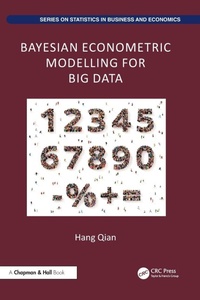
Bayesian Econometric Modelling for Big Data
1st Edition
Published on 19. June 2025
Book
Hardback
466 pages
978-1-032-91525-8 (ISBN)
Description
This book delves into scalable Bayesian statistical methods designed to tackle the challenges posed by big data. It explores a variety of divide-and-conquer and subsampling techniques, seamlessly integrating these scalable methods into a broad spectrum of econometric models.
In addition to its focus on big data, the book introduces novel concepts within traditional statistics, such as the summation, subtraction, and multiplication of conjugate distributions. These arithmetic operators conceptualize pseudo data in the conjugate prior, sufficient statistics that determine the likelihood, and the posterior as a balance between data and prior information, adding an intriguing dimension to Bayesian analysis. This book also offers a deep dive into Bayesian computation. Given the intricacies of floating-point representation of real numbers, computer programs can sometimes yield unexpected or theoretically impossible results. Drawing from his experience as a senior statistical software developer, the author shares valuable strategies for designing numerically stable algorithms.
The book is an essential resource for a diverse audience: graduate students seeking foundational knowledge in Bayesian econometric models, early-career statisticians eager to explore cutting-edge advancements in scalable Bayesian methods, data analysts struggling with out-of-memory challenges in large datasets, and statistical software users and developers striving to program with efficiency and numerical stability.
In addition to its focus on big data, the book introduces novel concepts within traditional statistics, such as the summation, subtraction, and multiplication of conjugate distributions. These arithmetic operators conceptualize pseudo data in the conjugate prior, sufficient statistics that determine the likelihood, and the posterior as a balance between data and prior information, adding an intriguing dimension to Bayesian analysis. This book also offers a deep dive into Bayesian computation. Given the intricacies of floating-point representation of real numbers, computer programs can sometimes yield unexpected or theoretically impossible results. Drawing from his experience as a senior statistical software developer, the author shares valuable strategies for designing numerically stable algorithms.
The book is an essential resource for a diverse audience: graduate students seeking foundational knowledge in Bayesian econometric models, early-career statisticians eager to explore cutting-edge advancements in scalable Bayesian methods, data analysts struggling with out-of-memory challenges in large datasets, and statistical software users and developers striving to program with efficiency and numerical stability.
More details
Series
Language
English
Place of publication
United Kingdom
Publishing group
Taylor & Francis Ltd
Target group
Professional and scholarly
Academic
Illustrations
19 s/w Abbildungen, 19 s/w Zeichnungen, 15 s/w Tabellen
15 Tables, black and white; 19 Line drawings, black and white; 19 Illustrations, black and white
Dimensions
Height: 260 mm
Width: 183 mm
Thickness: 31 mm
Weight
1104 gr
ISBN-13
978-1-032-91525-8 (9781032915258)
Copyright in bibliographic data and cover images is held by Nielsen Book Services Limited or by the publishers or by their respective licensors: all rights reserved.
Schweitzer Classification
Other editions
Additional editions
E-Book
06/2025
1st Edition
Chapman and Hall
€138.99
Available for download
E-Book
06/2025
1st Edition
Chapman and Hall
€138.99
Available for download
Person
Hang Qian is the principal engineer of the Econometrics Toolbox for MATLAB and has been dedicated to statistical software development at MathWorks since 2012. He earned his PhD in economics, specializing in Bayesian statistics, big data analysis, and computational finance. His research has been published in journals such as Bayesian Analysis, Journal of Business & Economic Statistics, and Journal of Econometrics.
Content
Preface 1. Linear Regressions 2. Markov Chain Monte Carlo Methods 3. Shrinkage and Variable Selection 4. Correlation, Heteroscedasticity and Non-Gaussian Regressions 5. Limited Dependent Variable Models 6. Linear State Space Models 7. Nonlinear State Space Models 8. Applications of State Space Models Bibliography Index