

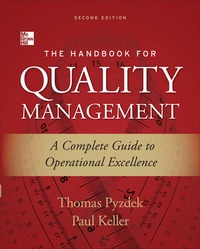
The Handbook for Quality Management, Second Edition
A Complete Guide to Operational Excellence
2nd Edition
Published on 16. December 2012
Book
Hardback
512 pages
978-0-07-179924-9 (ISBN)
Description
Publisher's Note: Products purchased from Third Party sellers are not guaranteed by the publisher for quality, authenticity, or access to any online entitlements included with the product.The definitive guide to organizational excellence--completely updatedFully revised for the latest American Society for Quality (ASQ) Certified Manager of Quality/Organizational Excellence (CMQ/QE) Body of Knowledge, The Handbook for Quality Management: A Complete Guide to Operational Excellence, Second Edition offers in-depth guidance on effectively applying the principles of quality management in today's business environment and delivering superior results. Designed to help you prepare for and pass the ASQ CMQ/QE exam, this authoritative volume also serves as an essential on-the-job reference.
Coverage includes:
Business-integrated quality systems
Organizational structures
The quality function
Approaches to quality
Customer-focused organizations
Integrated planning
Strategic planning
Understanding customer expectations and needs
Benchmarking
Organizational assessment
Process control
Quantifying process variation
Quality audits
Supply chain management
Continuous improvement
Effective change management
Six Sigma methodology, including detailed descriptions of the DMAIC and DMADV approaches
Management of human resources
Motivation theories and principles
Management styles
Resource requirements to manage the quality function
Over the past 40 years, the quality management discipline has undergone steady evolution from disparate quality assurance efforts to strategic, business-integrated functions. Today's quality manager must be able to plan and implement measurable, cost-effective process-improvement initiatives across the organization.
Written by two of the foremost authorities on the subject and fully updated for the latest American Society for Quality (ASQ) Certified Manager of Quality/Organizational Excellence (CMQ/OE) Body of Knowledge, The Handbook for Quality Management, Second Edition provides an operational guide to the proper understanding and application of quality management in the current business environment. It serves as a primary reference source for an organization's quality program and for anyone seeking to pass the CMQ/OE exam, given by the ASQ.
The Handbook for Quality Management: A Complete Guide to Operational Excellence, Second Edition:
Clearly defines quality management principles and their application within a cross section of industries
Integrates the application of Theory of Constraints, Six Sigma, and Lean thinking into the Quality Management discipline
Contains detailed methods for planning, including customer needs recognition, benchmarking, and organizational assessments
Discusses controls such as statistical process control, audits, and supply chain management
Explains the stages of continuous improvement
Incorporates classic motivation theory with more current management practices advocated by Joiner, Senge, and Deming, among others
Coverage includes:
Business-integrated quality systems
Organizational structures
The quality function
Approaches to quality
Customer-focused organizations
Integrated planning
Strategic planning
Understanding customer expectations and needs
Benchmarking
Organizational assessment
Process control
Quantifying process variation
Quality audits
Supply chain management
Continuous improvement
Effective change management
Six Sigma methodology, including detailed descriptions of the DMAIC and DMADV approaches
Management of human resources
Motivation theories and principles
Management styles
Resource requirements to manage the quality function
Over the past 40 years, the quality management discipline has undergone steady evolution from disparate quality assurance efforts to strategic, business-integrated functions. Today's quality manager must be able to plan and implement measurable, cost-effective process-improvement initiatives across the organization.
Written by two of the foremost authorities on the subject and fully updated for the latest American Society for Quality (ASQ) Certified Manager of Quality/Organizational Excellence (CMQ/OE) Body of Knowledge, The Handbook for Quality Management, Second Edition provides an operational guide to the proper understanding and application of quality management in the current business environment. It serves as a primary reference source for an organization's quality program and for anyone seeking to pass the CMQ/OE exam, given by the ASQ.
The Handbook for Quality Management: A Complete Guide to Operational Excellence, Second Edition:
Clearly defines quality management principles and their application within a cross section of industries
Integrates the application of Theory of Constraints, Six Sigma, and Lean thinking into the Quality Management discipline
Contains detailed methods for planning, including customer needs recognition, benchmarking, and organizational assessments
Discusses controls such as statistical process control, audits, and supply chain management
Explains the stages of continuous improvement
Incorporates classic motivation theory with more current management practices advocated by Joiner, Senge, and Deming, among others
More details
Edition
2nd edition
Language
English
Place of publication
United States
Publishing group
McGraw-Hill Education - Europe
Target group
Professional and scholarly
Illustrations
180 Illustrations
Dimensions
Height: 241 mm
Width: 229 mm
Thickness: 38 mm
Weight
1065 gr
ISBN-13
978-0-07-179924-9 (9780071799249)
Schweitzer Classification
Persons
Thomas Pyzdek is a quality consultant, entrepreneur, author, educator, software developer, and speaker. He writes a regular column for Quality Digest and is a Fellow of the American Society for Quality (ASQ). He conducts seminars on Six Sigma for the American Society for Quality, and has received that organizations "Edwards" award. His clients and employers cover a wide range of industries including Ford, GM, McDonald's, Avon, Hughes Aircraft Company Missile Systems Group, and the Tucson Medical Center.
McGraw-Hill authors represent the leading experts in their fields and are dedicated to improving the lives, careers, and interests of readers worldwide
McGraw-Hill authors represent the leading experts in their fields and are dedicated to improving the lives, careers, and interests of readers worldwide
Content
I: Quality Standards
Total quality management (TQM); Continuous process improvement; Cycle-time reduction; Supplier management; Customer service; Quality award/quality standards criteria
II: Customer Satisfaction/ Focus
Elements of customer-driven organizations; Customer expectations, priorities, needs, and "voice"; Predictability of systems; Customer feedback systems; Customer management and conflict resolution; Benchmarking; Innovation
III: A Model for Business-Integrated Quality SystemsContinual Organizational Assessments:
* Cost of Quality
* Value Stream Analysis
* Risk Assessment
Integrated Quality Functions; Communication within the organization
IV: Constraint Management
The systems approach; Basic constraint management principles and concepts; Tools of constraint management; Constraint management measurements
V: Lean Thinking
Value; V Stream; Flow; Pull; Perfection
VI: Six Sigma Design and Improvement Methods
What is Six Sigma; Six Sigma in terms of cost; Success stories; Infrastructure; Project focus; Methodology
VII: Supply Chain Management
VIII: Statistical Analysis of Processes
Total quality management (TQM); Continuous process improvement; Cycle-time reduction; Supplier management; Customer service; Quality award/quality standards criteria
II: Customer Satisfaction/ Focus
Elements of customer-driven organizations; Customer expectations, priorities, needs, and "voice"; Predictability of systems; Customer feedback systems; Customer management and conflict resolution; Benchmarking; Innovation
III: A Model for Business-Integrated Quality SystemsContinual Organizational Assessments:
* Cost of Quality
* Value Stream Analysis
* Risk Assessment
Integrated Quality Functions; Communication within the organization
IV: Constraint Management
The systems approach; Basic constraint management principles and concepts; Tools of constraint management; Constraint management measurements
V: Lean Thinking
Value; V Stream; Flow; Pull; Perfection
VI: Six Sigma Design and Improvement Methods
What is Six Sigma; Six Sigma in terms of cost; Success stories; Infrastructure; Project focus; Methodology
VII: Supply Chain Management
VIII: Statistical Analysis of Processes