

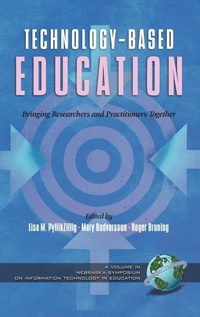
Technology-Based Education
Bringing Researchers and Practitioners Together
Will be published approx. on 1. March 2005
Book
Hardback
292 pages
978-1-59311-221-9 (ISBN)
Description
This volume will highlight papers presented at the second Nebraska Symposium on Information Technology in Education. With chapters focusing on the latest research findings and theoretical principles for using technology in education, the volume will extend findings from current research on technology-mediated instruction into a set of practical principles for designers, teachers, and managers of educational technology. Contributors will identify technical and design features required for sharing of content and assessment tools and will target promising areas for future research and development in technology-based learning, instruction, and assessment.
More details
Series
Language
English
Place of publication
Charlotte
United States
Publishing group
Emerald Publishing Inc
Target group
Professional and scholarly
Dimensions
Height: 240 mm
Width: 161 mm
Thickness: 20 mm
Weight
605 gr
ISBN-13
978-1-59311-221-9 (9781593112219)
Copyright in bibliographic data and cover images is held by Nielsen Book Services Limited or by the publishers or by their respective licensors: all rights reserved.
Schweitzer Classification
Other editions
Additional editions
Lisa M. Pytlikzillig | Mary Bodvarsson
Technology-Based Education
Bringing Researchers and Practitioners Together
E-Book
05/2006
1st Edition
Information Age Publishing
from
€62.33
Available for download
Persons
Content
Foreword; Arthur I. Zygielbaum and Roger Bruning.
Introduction; Lisa M. PytlikZillig, Mary Bodvarsson, and Roger Bruning.
Chapter 1. Instructional Technology: Promise and Pitfalls; Roxana Moreno.
Chapter 2. Reconceptualizing Teacher Education: Supporting Case-Based Instructional Problem Solving on the World Wide Web; Sharon J. Derry and Cindy Hmelo-Silver.
Chapter 3. Using Technology to Implement Case Studies in Preservice Teacher Education Courses; Lisa M. PytlikZillig, Roger Bruning, Christy A. Horn and Mary Bodvarsson.
Chapter 4. Reinventing Computer Science Curriculum at the University of Nebraska; Ashok Samal, Gwen C. Nugent, Leen-Kiat Soh, and Jeff Lang.
Chapter 5. Building Writing Assessment Skills Using Web-Based Cognitive Support Features; Michael S. Dempsey, Lisa M. PytlikZillig, and Roger Bruning.
Chapter 6. Encoding Disruption Associated with Copy and Paste Note Taking; L. Brent Igo, Roger Bruning, and Matthew T. McCrudden.
Chapter 7. Online Multimedia Instruction and Assessment for K-4 Students; Gwen C. Nugent, Roger Feese, and Oksana Bendus.
Chapter 8. Learning While Holding a Conversation with a Computer; Arthur C. Graesser, Natalie Person, Zhijun Lu, Moon Gee Jeon, and Bethany McDaniel.
Chapter 9. Designing Adaptive, Diagnostic Math Assessments for Sighted and Visually Disabled Students; Valerie J. Shute, Edith Aurora Graf, and Eric G. Hansen.
Chapter 10. I-MINDS: An Innovative Multiagent System to Support Teaching and Learning; Leen-Kiat Soh, Xuesong Zhang, Xuli Liu, and Hong Jiang.
Chapter 11. Affinity Learning: Fostering Critical Thinking Skills Online; Arthur I. Zygielbaum and Roger Feese.
About the Contributors.
Introduction; Lisa M. PytlikZillig, Mary Bodvarsson, and Roger Bruning.
Chapter 1. Instructional Technology: Promise and Pitfalls; Roxana Moreno.
Chapter 2. Reconceptualizing Teacher Education: Supporting Case-Based Instructional Problem Solving on the World Wide Web; Sharon J. Derry and Cindy Hmelo-Silver.
Chapter 3. Using Technology to Implement Case Studies in Preservice Teacher Education Courses; Lisa M. PytlikZillig, Roger Bruning, Christy A. Horn and Mary Bodvarsson.
Chapter 4. Reinventing Computer Science Curriculum at the University of Nebraska; Ashok Samal, Gwen C. Nugent, Leen-Kiat Soh, and Jeff Lang.
Chapter 5. Building Writing Assessment Skills Using Web-Based Cognitive Support Features; Michael S. Dempsey, Lisa M. PytlikZillig, and Roger Bruning.
Chapter 6. Encoding Disruption Associated with Copy and Paste Note Taking; L. Brent Igo, Roger Bruning, and Matthew T. McCrudden.
Chapter 7. Online Multimedia Instruction and Assessment for K-4 Students; Gwen C. Nugent, Roger Feese, and Oksana Bendus.
Chapter 8. Learning While Holding a Conversation with a Computer; Arthur C. Graesser, Natalie Person, Zhijun Lu, Moon Gee Jeon, and Bethany McDaniel.
Chapter 9. Designing Adaptive, Diagnostic Math Assessments for Sighted and Visually Disabled Students; Valerie J. Shute, Edith Aurora Graf, and Eric G. Hansen.
Chapter 10. I-MINDS: An Innovative Multiagent System to Support Teaching and Learning; Leen-Kiat Soh, Xuesong Zhang, Xuli Liu, and Hong Jiang.
Chapter 11. Affinity Learning: Fostering Critical Thinking Skills Online; Arthur I. Zygielbaum and Roger Feese.
About the Contributors.