

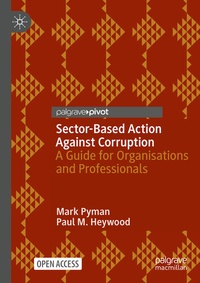
Sector-Based Action Against Corruption
Description
This open access book provides an accessible insight into how to tackle corruption in organisations and institutions. It explains how to recognise and analyse corruption issues, together with knowledge and advice on how they can be avoided, prevented, or minimised. It also provides a framework through which readers can examine what strategies are available to tackle corruption issues, a rationale for how to prioritise strategies depending on circumstances and context, and guidance on how to critique various options. The book will appeal to professionals and practitioners, as well as academics interested in governance and corruption.
Reviews / Votes
"Invaluable Guide to Fighting Corruption - at a Bargain Basement Price." (Richard Messick, The Global Anticorruption Blog, USA)
"I highly recommend this book to anyone in a leadership role aiming to drive progress against corruption in a targeted and effective manner. 'Sector-based Action Against Corruption' is not just a guide, it's a strategic companion for professionals seeking tangible results. Its intensely practical and results-oriented approach equips readers with the tools to navigate the complex terrain of corruption, ultimately contributing to the development of organisations with a steadfast commitment to integrity and ethical conduct." (Maryna Barynina, Head of the Department of Integrity Policy Formation in the Security and Defence Sector, National Agency on Corruption Prevention, Ukraine)
"Pyman and Heywood's excellent book is for anyone who has a role or interest in fighting against corruption within organizations or institutions - which should be most of us! It is an accessible and informative anti-corruption primer, full of valuable suggestions for practice . The book helps readers understand how they can take individual actions, but even more importantly how they can practically harness support from others in addressing corruption as a shared problem with collective solutions. Highly recommended!" (Ian Kaplan, Education Specialist, International)
"This book masterfully presents a structured and action-oriented guide, serving as a reflective roadmap for those seeking to bring about significant changes in the public sector. It reminds us that combating corruption goes beyond generic, decontextualized speeches. It's about an attitude that requires analysis and method, and more importantly, a keen and focused perspective. The book distils decades of academic study and experience in the field of corruption, outlining the most modern and proven approaches to address this issue." (Pepe Tonin, Director of Studies and Development of Public Integrity, Comptroller General, Brazil)
"With this anti-corruption handbook, Mark Pyman and Paul Heywood provide practical, realistic guidance for mid-level leaders whether they be in health care, the military, construction, telecommunications, or other sectors of the economy. For too long, anti-corruption and good governance advice has principally focused on the extremes: either on massive, state-wide reforms to "dekleptify" grossly criminal governments, or admonishments to individuals that primarily boil down to little more than "don't be corrupt." Little has been available for leaders who seek to reform their organizations from the inside." (Jodi Vittori, Professor of Practice, Walsh School of Foreign Service, Georgetown University, USA)
More details
Other editions
Additional editions
Persons
Mark Pyman is co-founder of the online network CurbingCorruption.com, having previously created and led Transparency International's global programme tackling defence and security corruption. He served as a Commissioner in Afghanistan's Anti-Corruption Committee (MEC).
Paul M. Heywood holds the Sir Francis Hill Chair of European Politics at the University of Nottingham, UK. His research focuses on political corruption, institutional design, and state capacity. With Mark, he is also co-founder of the online network CurbingCorruption.com.
Content
Introduction: 1. Corruption Basics.- 2. Corruption as a Management Issue. Part I: Analysis: 3. Sector.- 4. Focus.- Part II: Remediation Approach: 5. Broad Framing.- 6. Specific Measures.- 7. Choosing Options.- 8. Last words.