

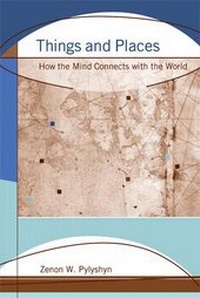
Things and Places
How the Mind Connects with the World
Published on 21. January 2011
Book
Paperback/Softback
272 pages
978-0-262-51614-3 (ISBN)
Description
Problems in linking representation and perceived things in the world are discussed in light of the role played by a preconceptual indexing mechanism that functions to identify, reidentify, and track objects.InThings and Places, Zenon Pylyshyn argues that the process of incrementally constructing perceptual representations, solving the binding problem (determining which properties go together), and, more generally, grounding perceptual representations in experience arise from the nonconceptual capacity to pick out and keep track of a small number of sensory individuals. He proposes a mechanism in early vision that allows us to select a limited number of sensory objects, to reidentify each of them under certain conditions as the same individual seen before, and to keep track of their enduring individuality despite radical changes in their properties-all without the machinery of concepts, identity, and tenses. This mechanism, which he calls FINSTs (for "Fingers of Instantiation"), is responsible for our capacity to individuate and track several independently moving sensory objects-an ability that we exercise every waking minute, and one that can be understood as fundamental to the way we see and understand the world and to our sense of space.Pylyshyn examines certain empirical phenomena of early vision in light of the FINST mechanism, including tracking and attentional selection. He argues provocatively that the initial selection of perceptual individuals is our primary nonconceptual contact with the perceptual world (a contact that does not depend on prior encoding of any properties of the thing selected) and then draws upon a wide range of empirical data to support a radical externalist theory of spatial representation that grows out of his indexing theory.
More details
Series
Language
English
Place of publication
Cambridge, Mass.
United States
Publishing group
MIT Press Ltd
Target group
Professional and scholarly
Interest Age: From 18 years
Product notice
Paperback (trade)
Illustrations
26 figs. illus.; 52 Illustrations
Dimensions
Height: 229 mm
Width: 152 mm
Thickness: 11 mm
Weight
386 gr
ISBN-13
978-0-262-51614-3 (9780262516143)
Copyright in bibliographic data and cover images is held by Nielsen Book Services Limited or by the publishers or by their respective licensors: all rights reserved.
Schweitzer Classification
Other editions
Additional editions
Book
10/2007
MIT Press
€9.85
Article exhausted; check different version
Person
Zenon W. Pylyshyn is Board of Governors Professor of Cognitive Science at Rutgers Center for Cognitive Science. He is the author of Seeing and Visualizing: It's Not what You Think (2003) and Computation and Cognition: Toward a Foundation for Cognitive Science (1984), both published by The MIT Press, as well as over a hundred scientific papers on perception, attention, and the computational theory of mind.
Content
Series Foreword vii Preface and Acknowledgments 1 Introduction to the Problem Connecting Perception and the World 1 1.1 Background 1 1.2 What's the Problem of Connecting the Mind with the World? Doesn't Every Computational Theory of Vision Do That? 2 1.3 The Need for a Direct Way of Referring to Certain Individual Tokens in a Scene 10 1.4 Some Empirical Phenomena Illustrating the Role of Indexes 22 1.5 What Are We to Make of Such Empirical Demonstrations? 29 2 Indexing and Tracking Individuals 31 2.1 Individuating and Tracking 31 2.2 Indexes and Primitive Tracking 34 2.3 What Goes On in MOT? 37 2.4 Other Empirical and Theoretical Issues Surrounding MOT 40 2.5 The Infant's Capacity for Individuating and Tracking Objects 49 2.6 Summary and Implications for the Foundations of Cognitive Science 52 3 Selection: The Key to Linking Representations and Things 59 3.1 Selection: The Role of Focal Attention 59 3.2 Selection and Demonstrative Reference The Role of FINSTs 67 3.3 Problems with Selection by Location 79 3.4 Feature Placing and Sentience 91 3.5 What Do FINSTs Select? Some Consequences of the Present View 94 4 Conscious Contents and Nonconceptual Representation 99 4.1 Nonconceptual Representation and Perceptual Beliefs 99 4.2 The Role of Conscious Experience in the Study of Perception and Cognition 101 4.3 What Subjective Experience Reveals about Psychological Processes 112 4.4 The Phenomenal Experience of Seeing 119 4.5 The Phenomenal Experience of Mental Imagery 125 4.6 Does Phenomenal Appearance Correspond to a Level of Representation? 143 5 How We Represent Space Internal versus External Constraints 147 5.1 What Does It Mean to Represent Space? 148 5.2 Internalizing General Spatial Constraints 151 5.3 Internalizing Spatial Properties by Mapping Them Onto an Inner Space 156 5.4 What Is Special about Representing Space? 169 5.5 Externalizing Spatial Properties The Index Projection Hypothesis 179 5.6 Index Projection in Nonvisual Modalities 191 Conclusions 205 References 211 Index