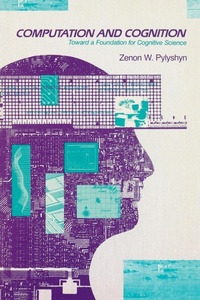
The question, "What is Cognitive Science?" is often asked but seldom answered to anyone's satisfaction. Until now, most of the answers have come from the new breed of philosophers of mind. This book, however, is written by a distinguished psychologist and computer scientist who is well-known for his work on the conceptual foundations of cognitive science, and especially for his research on mental imagery, representation, and perception.
In Computation and Cognition, Pylyshyn argues that computation must not be viewed as just a convenient metaphor for mental activity, but as a literal empirical hypothesis. Such a view must face a number of serious challenges. For example, it must address the question of "strong equivalents" of processes, and must empirically distinguish between phenomena which reveal what knowledge the organism has, phenomena which reveal properties of the biologically determined "functional architecture" of the mind. The principles and ideas Pylyshyn develops are applied to a number of contentious areas of cognitive science, including theories of vision and mental imagery. In illuminating such timely theoretical problems, he draws on insights from psychology, theoretical computer science, artificial intelligence, and psychology of mind.
A Bradford Book
Series
Language
Place of publication
Cambridge, Mass.
United States
Publishing group
Target group
College/higher education
Professional and scholarly
Interest Age: From 18 years
Product notice
Dimensions
Height: 229 mm
Width: 152 mm
Thickness: 17 mm
Weight
ISBN-13
978-0-262-66058-7 (9780262660587)
Copyright in bibliographic data and cover images is held by Nielsen Book Services Limited or by the publishers or by their respective licensors: all rights reserved.
Schweitzer Classification
Zenon W. Pylyshyn is Board of Governors Professor of Cognitive Science at Rutgers University. He is the author of Things and Places: How the Mind Connects with the World (MIT Press) and other books.
Author
Rutgers University - New Brunswick