

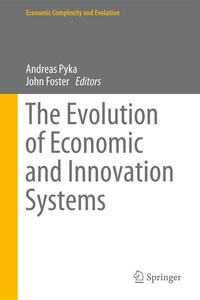
The Evolution of Economic and Innovation Systems
Published on 25. March 2015
Book
Hardback
VII, 641 pages
978-3-319-13298-3 (ISBN)
Description
This book is at the cutting edge of the ongoing 'neo-Schumpeterian' research program that investigates how economic growth and its fluctuation can be understood as the outcome of a historical process of economic evolution. Much of modern evolutionary economics has relied upon biological analogy, especially about natural selection. Although this is valid and useful, evolutionary economists have, increasingly, begun to build their analytical representations of economic evolution on understandings derived from complex systems science. In this book, the fact that economic systems are, necessarily, complex adaptive systems is explored, both theoretically and empirically, in a range of contexts. Throughout, there is a primary focus upon the interconnected processes of innovation and entrepreneurship, which are the ultimate sources of all economic growth. Twenty two chapters are provided by renowned experts in the related fields of evolutionary economics and the economics of innovation.
More details
Series
Language
English
Place of publication
Cham
Switzerland
Publishing group
Springer International Publishing
Target group
Professional and scholarly
Research
Illustrations
63 farbige Abbildungen, 39 s/w Abbildungen
VII, 641 p. 102 illus., 63 illus. in color.
Dimensions
Height: 241 mm
Width: 160 mm
Thickness: 41 mm
Weight
1133 gr
ISBN-13
978-3-319-13298-3 (9783319132983)
DOI
10.1007/978-3-319-13299-0
Schweitzer Classification
Other editions
Additional editions
Andreas Pyka | John Foster
The Evolution of Economic and Innovation Systems
Book
10/2016
Springer
€160.49
Shipment within 10-15 days
Andreas Pyka | John Foster
The Evolution of Economic and Innovation Systems
E-Book
03/2015
1st Edition
Springer
€149.79
Available for download
Persons
Andreas Pyka is Professor of Economics and holds the chair of innovation economics at the Business and Economics Faculty of the University of Stuttgart-Hohenheim, Germany. He has degrees in management sciences and economics (University of Augsburg) and he received his PhD from the University of Augsburg. His main fields of research are industrial dynamics, Neo-Schumpeterian Economics and innovation networks drawing on numerical approaches, in particular agent-based modeling.John Foster is Professor of Economics at the University of Queensland, Brisbane, Australia, Fellow of the Academy of Social Science in Australia, Life Member of Clare Hall College, Cambridge, Director of the UQ Energy Economics and Management Group and past President of the International J.A. Schumpeter Society. He has degrees in Business (Coventry University) and Economics (University of Manchester); he received his PhD from the University of Manchester. His current research areas include: the macroeconomy as a complex adaptive system; evolutionary modeling of economic growth; the application of self-organization theory to statistical/econometric modeling in the presence of structural transition; the economics of innovation, the economics of renewable energy.
Content
The Evolution of Economic Systems.- The Evolution of Innovation Systems.- Entrepreneurship and Innovation Competition.