

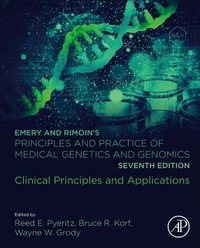
Emery and Rimoin's Principles and Practice of Medical Genetics and Genomics
Clinical Principles and Applications
7th Edition
Published on 23. November 2018
Book
Hardback
412 pages
978-0-12-812536-6 (ISBN)
Description
For decades, Emery and Rimoin's Principles and Practice of Medical Genetics and Genomics has served as the ultimate resource for clinicians integrating genetics into medical practice. With detailed coverage in contributions from over 250 of the world's most trusted authorities in medical genetics and a series of 11 volumes available for individual sale, the Seventh Edition of this classic reference includes the latest information on seminal topics such as prenatal diagnosis, genome and exome sequencing, public health genetics, genetic counseling, and management and treatment strategies to complete its coverage of this growing field for medical students, residents, physicians, and researchers involved in the care of patients with genetic conditions. This comprehensive yet practical resource emphasizes theory and research fundamentals related to applications of medical genetics across the full spectrum of inherited disorders and applications to medicine more broadly.Clinical Principles and Applications thoroughly addresses general methods and approaches to genetic counseling, genetic diagnostics, treatment pathways, and drug discovery. Additionally, new and updated chapters explore the clinical implementation of genomic technologies, analytics, and therapeutics, with special attention paid to developing technologies, common challenges, patient care, and ethical and legal aspects.With regular advances in genomic technologies propelling precision medicine into the clinic, the seventh edition of Emery and Rimoin's Principles and Practice of Medical Genetics and Genomics bridges the gap between high-level molecular genetics and practical application and serves as an invaluable clinical tool for the health professionals and researchers.
More details
Edition
7th edition
Language
English
Place of publication
San Diego
United States
Publishing group
Elsevier Science Publishing Co Inc
Target group
Professional and scholarly
College/higher education
Students, physicians, and researchers in the field of medical genetics and personalized medicine; medical practitioners across medical disciplines as well as systems biology, molecular medicine, and genetic epidemiology; genetic counselors; genetic researchers in industry and pharma
Product notice
sewn/stitched
Cloth over boards
Dimensions
Height: 236 mm
Width: 193 mm
Thickness: 25 mm
Weight
1021 gr
ISBN-13
978-0-12-812536-6 (9780128125366)
Copyright in bibliographic data and cover images is held by Nielsen Book Services Limited or by the publishers or by their respective licensors: all rights reserved.
Schweitzer Classification
Other editions
Additional editions
Reed E. Pyeritz | Bruce R. Korf | Wayne W. Grody
Emery and Rimoin's Principles and Practice of Medical Genetics and Genomics
Clinical Principles and Applications
E-Book
11/2018
7th Edition
Academic Press
€109.00
Available for download
Persons
Dr. Reed Pyeritz is a medical genetics doctor in Philadelphia, Pennsylvania and is affiliated with Hospitals of the University of Pennsylvania-Penn Presbyterian. Dr. Pyeritz focuses his research in two areas - Mendelian disorders of the cardiovascular system (especially those involving defects of connective tissue) and ethical, legal and social implications of human genetics. He is continuing his studies, begun over 20 years ago, of Marfan syndrome and related conditions - diseases in which the aorta and occasionally major arterial branches gradually enlarge and dissect, leading to early demise if untreated. Current efforts include a multicenter trial of angiotensin receptor blockade in Marfan syndrome, the identification of additional genes that predispose to arteriopathy, and improving methods for diagnosing and treating arterio-venous malformations, especially in hereditary hemorrhagic telangiectasia (HHT). Dr. Pyeritz directs Penn CIGHT (Center for the Integration of Genetic Healthcare Technologies). Supported by the ELSI Branch of the National Human Genome Research Institute, Penn CIGHT conducts research in the broad area of 'uncertainty' as related to the introduction of evolving approaches to assaying a patient's genotype. Bruce R. Korf is the director of the Heflin Center for Human Genetics and chairman of the Department of Genetics at the University of Alabama at Birmingham. In April 2009, he began a two-year term as president of the American College of Medical Genetics (ACMG). Korf received his M.D. from Cornell University Medical College and his Ph.D. in genetics and cell biology from Rockefeller University. He completed a residency in pediatrics, pediatric neurology, and genetics at Children's Hospital, Boston. Prior to his appointment at the University of Alabama, he served as clinical director in the Division of Genetics at Children's Hospital from 1986 to 1999, and as the medical director of the Harvard-Partners Center for Genetics and Genomics from 1999 to 2002. He was associate professor of neurology at Harvard Medical School and directed postdoctoral training in medical and laboratory genetics at hospitals affiliated with Harvard. Korf's principal area of research is neurofibromatosis. Korf is the author of Human Genetics: A Problem-Based Approach, an introductory graduate textbook used by medical students and genetic counselors. He is co-author, with Dorian Pritchard, of Medical Genetics at a Glance, and an editor of Emery and Rimoin's Principles and Practice of Medical Genetics and Genomics. Wayne W. Grody, M.D., Ph.D. is a Professor in the Departments of Pathology & Laboratory Medicine, Pediatrics, and Human Genetics at the UCLA School of Medicine. He is the director of the Diagnostic Molecular Pathology Laboratory within the UCLA Medical Center, and is also an attending physician in the Department of Pediatrics, specializing in the care of patients with or at risk for genetic disorders. He has been one of the primary developers of quality assurance and ethical guidelines for DNA-based genetic testing for a number of governmental and professional agencies including the FDA, AMA, CAP, ACMG, ASHG, NCCLS, CDC, NIH-DOE Human Genome Project (ELSI program), and PSRGN. He served as a member of the NIH-DOE Task Force on Genetic Testing, and was the working group chair for development of national guidelines for cystic fibrosis and factor V-Leiden mutation screening. Most recently, he was appointed chair of an Advisory Committee on Genomic Medicine for the entire VA healthcare system. He did his undergraduate work at Johns Hopkins University, received his M.D. and Ph.D. at Baylor College of Medicine, and completed residency and fellowship training at UCLA. He is double board-certified by the American Board of Pathology (Anatomic and Clinical Pathology, Molecular Genetic Pathology) and the American Board of Medical Genetics (Clinical Genetics, Molecular Genetics, and Biochemical Genetics).
Editor
William Smilow Professor of Medicine and Professor of Genetics, Senior Fellow, Leonard Davis Institute of Health Economics, Perelman School of Medicine, University of Pennsylvania, Smilow Center for Translational Research, Philadelphia, PA, USA
Chief Genomics Officer, UAB Medicine, Wayne H. and Sara Crews Finley Endowed Chair in Medical Genetics, University of Alabama at Birmingham, Birmingham, AL, USA
Content
1. A Clinical Approach to the Dysmorphic Child
2. Clinical Teratology
3. Neurodevelopmental Disabilities: Global Developmental Delay, Intellectual Disability, and Autism
4. Abnormal Body Size and Proportion
5. Cytogenetic Analysis
6. Diagnostic Molecular Genetics
7. Therapies for Lysosomal Storage Diseases
8. Transplantation Genetics
9. Genetic Evaluation for Common, Chronic Disorders of Adulthood 265
10. Carrier Screening and Heterozygote Testing
11. Circadian Rhythms and Disease
12. The Genomic Health Record: Current Status and Vision for the Future
13. Ethical and Social Issues in Clinical Genetics
14. Genetics and Genomics in Public Health
15. Implementation of Genomic Medicine: An International Perspective
2. Clinical Teratology
3. Neurodevelopmental Disabilities: Global Developmental Delay, Intellectual Disability, and Autism
4. Abnormal Body Size and Proportion
5. Cytogenetic Analysis
6. Diagnostic Molecular Genetics
7. Therapies for Lysosomal Storage Diseases
8. Transplantation Genetics
9. Genetic Evaluation for Common, Chronic Disorders of Adulthood 265
10. Carrier Screening and Heterozygote Testing
11. Circadian Rhythms and Disease
12. The Genomic Health Record: Current Status and Vision for the Future
13. Ethical and Social Issues in Clinical Genetics
14. Genetics and Genomics in Public Health
15. Implementation of Genomic Medicine: An International Perspective