

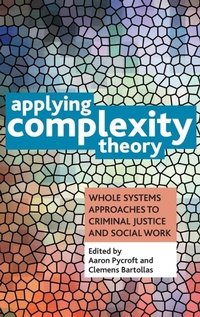
Applying Complexity Theory
Whole Systems Approaches to Criminal Justice and Social Work
1st Edition
Published on 28. May 2014
Book
Hardback
328 pages
978-1-4473-1140-9 (ISBN)
Description
Approaches based around complexity theory are increasingly being used in the study of organisations and the delivery of services. This is the first book to explore the application of complexity theory to difficult practice issues in criminal justice and social work and is intended to stimulate debate. It brings together experts in this emerging field to address complexity theory from a range of perspectives (positivist, realist, and constructivist), providing a detailed but accessible discussion of the key issues to whole systems approaches. The chapters cover theory and research on the nature of complex adaptive systems, their application to key areas of service delivery and the efficacy and ethics of criminal justice and social work interventions. The book argues for the usefulness of applying complexity theory to address significant and intractable social problems and also challenges the reductionist approaches to solving those problems currently favoured by policy makers. It will be of interest to academics and postgraduate students in social work and criminal justice.
Reviews / Votes
"This book provides persuasive arguments for breaking away from the Newtonian paradigm of a linear, controllable world and working with the complexity of social systems" Professor Eileen Munro, London School of Economics "A challenging, insightful and engaging text that goes a long way in convincing readers of the value of applying complexity theory to criminal justice and social work" The Howard Journal of Criminal JusticeMore details
Edition
First Edition
Language
English
Place of publication
Bristol
United Kingdom
Publishing group
Bristol University Press
Target group
College/higher education
Illustrations
4 s/w Tabellen, 14 s/w Abbildungen
4 Tables, black and white; 14 Illustrations, black and white
Dimensions
Height: 240 mm
Width: 161 mm
Thickness: 22 mm
Weight
658 gr
ISBN-13
978-1-4473-1140-9 (9781447311409)
Copyright in bibliographic data and cover images is held by Nielsen Book Services Limited or by the publishers or by their respective licensors: all rights reserved.
Schweitzer Classification
Other editions
Additional editions
Aaron Pycroft | Clemens Bartollas
Applying Complexity Theory
Whole Systems Approaches to Criminal Justice and Social Work
E-Book
05/2014
1st Edition
Policy Press
€278.99
Available for download
Persons
Aaron Pycroft is Senior Lecturer in Addiction Studies at the Institute of Criminal Justice Studies at the University of Portsmouth, where he teaches, writes and researches on theory, policy and interventions related to substance misuse.
Clemens Bartollas PhD is a Professor of Sociology at the University of Northern Iowa School of Sociology, Anthropology and Criminology. He has written extensively in the areas of criminology and criminal justice, penology and corrections.
Clemens Bartollas PhD is a Professor of Sociology at the University of Northern Iowa School of Sociology, Anthropology and Criminology. He has written extensively in the areas of criminology and criminal justice, penology and corrections.
Content
Introduction ~ Aaron Pycroft and Clemens Bartollas;
Complexity Theory: An over view ~ Aaron Pycroft;
Risk, Attractors and Organisational Behaviour ~ Paul Jennings;
Why Do People Commit Crime? An Integrated Systems Perspective ~ Matthew Robinson;
Complexity and the Emergence of Grassroots Social Work and Criminal Justice Programmes ~ Michael Wolf Branigin;
Child Protection Practice and Complexity ~ Peter Hassett and Irene Stevens;
Youth justice: From linear risk paradigm to complexity ~ Stephen Case and Kevin Haines;
The Stephen Lawrence Inquiry: A case study in policing and complexity ~ John Grieve;
Intersecting Contexts of Oppression within Complex Public System ~ Charmaine McPherson and Elizabeth McGibbon;
Complexity Theory, Trans-disciplinary Working and Reflective Practice ~ Fiona McDermott;
Probation Practice and Creativity in England and Wales: A Complex Systems Analysis ~ Aaron Pycroft;
Responding to Domestic Abuse: Multi Agented Systems, Probation Programmes and Emergent Outcomes ~ Sarah Lewis;
Complexity, Law and Ethics ~ Bruce Arrigo and Christopher Williams;
Constituting the System: Radical Developments in Post Positivist Society ~ Clemens Bartollas;
Conclusion ~ Clemens Bartollas and Aaron Pycroft.
Complexity Theory: An over view ~ Aaron Pycroft;
Risk, Attractors and Organisational Behaviour ~ Paul Jennings;
Why Do People Commit Crime? An Integrated Systems Perspective ~ Matthew Robinson;
Complexity and the Emergence of Grassroots Social Work and Criminal Justice Programmes ~ Michael Wolf Branigin;
Child Protection Practice and Complexity ~ Peter Hassett and Irene Stevens;
Youth justice: From linear risk paradigm to complexity ~ Stephen Case and Kevin Haines;
The Stephen Lawrence Inquiry: A case study in policing and complexity ~ John Grieve;
Intersecting Contexts of Oppression within Complex Public System ~ Charmaine McPherson and Elizabeth McGibbon;
Complexity Theory, Trans-disciplinary Working and Reflective Practice ~ Fiona McDermott;
Probation Practice and Creativity in England and Wales: A Complex Systems Analysis ~ Aaron Pycroft;
Responding to Domestic Abuse: Multi Agented Systems, Probation Programmes and Emergent Outcomes ~ Sarah Lewis;
Complexity, Law and Ethics ~ Bruce Arrigo and Christopher Williams;
Constituting the System: Radical Developments in Post Positivist Society ~ Clemens Bartollas;
Conclusion ~ Clemens Bartollas and Aaron Pycroft.