

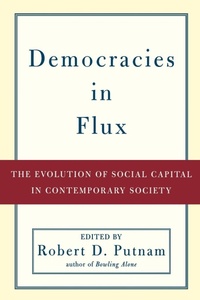
Democracies in Flux
The Evolution of Social Capital in Contemporary Society
Published on 25. March 2004
Book
Paperback/Softback
528 pages
978-0-19-517160-0 (ISBN)
Description
In his national bestseller Bowling Alone, Robert Putnam illuminated the decline of social capital in the US. Now, in Democracies in Flux, Putnam brings together a group of leading scholars who broaden his findings as they examine the state of social capital in eight advanced democracies around the world.
The book is packed with many intriguing revelations. The contributors note, for instance, that waning participation in unions, churches, and political parties seems to be virtually universal, a troubling discovery as these forms of social capital are especially important for empowering less educated, less affluent portions of the population. Indeed, in general, the researchers found more social grouping among the affluent than among the working classes and they find evidence of a younger generation that is singularly uninterested in politics, distrustful both of politicians and of others, cynical about public affairs, and less inclined to participate in enduring social organizations. Yet social capital appears as strong as ever in Sweden, where 40% of the adult population participate in "study circles"--small groups who meet weekly for educational discussions.
Social capital--good will, fellowship, sympathy, and social intercourse--is vitally important both for the health of our communities and for our own physical and psychological well being. Offering a panoramic look at social capital around the world, this book makes an important contribution to our understanding of these phenomena and why they are important in today's world.
The book is packed with many intriguing revelations. The contributors note, for instance, that waning participation in unions, churches, and political parties seems to be virtually universal, a troubling discovery as these forms of social capital are especially important for empowering less educated, less affluent portions of the population. Indeed, in general, the researchers found more social grouping among the affluent than among the working classes and they find evidence of a younger generation that is singularly uninterested in politics, distrustful both of politicians and of others, cynical about public affairs, and less inclined to participate in enduring social organizations. Yet social capital appears as strong as ever in Sweden, where 40% of the adult population participate in "study circles"--small groups who meet weekly for educational discussions.
Social capital--good will, fellowship, sympathy, and social intercourse--is vitally important both for the health of our communities and for our own physical and psychological well being. Offering a panoramic look at social capital around the world, this book makes an important contribution to our understanding of these phenomena and why they are important in today's world.
Reviews / Votes
"Putnam's thesis, about the virtue of connectiveness, gains here much additional depth. We see it in a comparative, cross-cultural perspective, with each study illuminating all others. A masterpiece of social science."--Amitai Etzioni, author of The New Golden Rule "A grand tour of our times--elegant, exciting and unsettling. Democracies in Flux maps the vitality of civil society in eight industrial nations. Their experiences--sometimes similar, often entirely different--add up to a vivid report on the health of democracy in a global era."--James Morone, author of The Democratic Wish and Hellfire NationMore details
Language
English
Place of publication
New York
United States
Target group
Professional and scholarly
Illustrations
numerous figures & tables
Dimensions
Height: 229 mm
Width: 152 mm
Thickness: 31 mm
Weight
842 gr
ISBN-13
978-0-19-517160-0 (9780195171600)
Copyright in bibliographic data and cover images is held by Nielsen Book Services Limited or by the publishers or by their respective licensors: all rights reserved.
Schweitzer Classification
Other editions
Additional editions
Book
08/2002
Oxford University Press Inc
€131.50
Shipment within 15-20 days
E-Book
08/2002
1st Edition
OUP eBook
€22.49
Available for download
E-Book
08/2002
1st Edition
OUP USA
€22.49
Available for download
Person
Robert D. Putnam is Peter and Isabel Malkin Professor of Public Policy at Harvard University. He is the founder of the Saguaro Seminar on Civic Engagement and author of the best-selling Bowling Alone.