

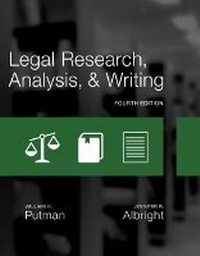
Legal Research, Analysis, and Writing
4th Edition
Will be published approx. on 10. July 2017
Book
Paperback/Softback
832 pages
978-1-305-94837-2 (ISBN)
Description
Be the "go to" paralegal at your firm with the fourth edition of LEGAL RESEARCH, ANALYSIS, AND WRITING! This book shows you how to conduct reliable legal research, analyze the results, and write clear memoranda and other legal documents that are on-point and well supported. In addition to an easy-to-read format, this student favorite offers hypothetical scenarios, examples, and exercises that clarify the important work paralegals do every day to help law offices and legal departments run smoothly. Of course, the fourth edition offers the latest updates, with special attention to the electronic legal research tools common today. And, to add to your success, optional MindTap tools cater to your personal learning style with interactive quizzing, flashcards, and practice assignments that help you build momentum and confidence quickly.
More details
Edition
4th edition
Language
English
Place of publication
Clifton Park
United States
Publishing group
Cengage Learning, Inc
Target group
College/higher education
Dimensions
Height: 25 mm
Width: 213 mm
Thickness: 274 mm
Weight
1380 gr
ISBN-13
978-1-305-94837-2 (9781305948372)
Copyright in bibliographic data and cover images is held by Nielsen Book Services Limited or by the publishers or by their respective licensors: all rights reserved.
Schweitzer Classification
Other editions
New editions
William Putman | Jennifer Albright
Legal Research, Analysis, and Writing
Book
01/2023
5th Edition
Delmar Cengage Learning
€85.50
Shipment within 15-20 days
Previous edition
William Putman | Jennifer Albright
Legal Research, Analysis, and Writing
Book
01/2013
3rd Edition
Delmar Cengage Learning
€104.17
Article not available at the moment
Persons
William Putman is a lawyer and former instructor in the programs for Legal Assistant Studies at Central New Mexico Community College in Albuquerque and Paralegal Studies at Santa Fe Community College. A member of the New Mexico Bar since 1975, he received his Juris Doctor degree from the University of New Mexico School of Law. Jennifer Albright was an instructor and the director of the paralegal studies and judicial studies programs at Central New Mexico Community College in Albuquerque. She is currently an adjunct faculty member in legal assistant studies at Phoenix College and a professor of practice at the University of Arizona James E. Rogers College of Law. Professor Albright received her Juris Doctor degree from Southern Illinois University School of Law and her L.L.M. from Arizona State University. She a been a member of the New Mexico Bar since 1999.
Content
PART I: INTRODUCTION TO RESEARCH, ANALYTICAL PRINCIPLES, AND THE LEGAL PROCESS.
1. Introduction to Legal Principles and Authorities.
2. Introduction to Legal Research and Analysis.
PART II: LEGAL RESEARCH.
3. Constitutions, Statutes, Administrative Law, and Court Rules-Research and Analysis.
4. Case Law-Research and Briefing.
5. Secondary Authority and Other Research Sources-Encyclopedias, Treatises, American Law Reports, Digests, Shepard's.
6. Secondary Authority-Periodicals, Restatements, Uniform Laws, Dictionaries, Legislative History, and Other Secondary Authorities.
7. Computers and Internet Legal Research.
8. Commercial Internet Research.
PART III: THE SPECIFICS OF LEGAL ANALYSIS.
9. Legal Analysis-Key Facts.
10. Legal Analysis-Issue Identification (Spotting the Issue).
11. Legal Analysis-Stating the Issue.
12. Case Law Analysis-Is a Case on Point?
13. Counteranalysis.
PART IV: LEGAL WRITING.
14. Fundamentals of Writing.
15. The Writing Process for Effective Legal Writing.
16. Office Legal Memorandum: Issues and Facts.
17. Office Legal Memorandum: Analysis to Conclusion.
18. External Memoranda: Court Briefs.
19. Correspondence.
Appendix A: Court Opinions Referred to in the Text.
Appendix B: Appellate Court Brief.
Glossary.
Index.
1. Introduction to Legal Principles and Authorities.
2. Introduction to Legal Research and Analysis.
PART II: LEGAL RESEARCH.
3. Constitutions, Statutes, Administrative Law, and Court Rules-Research and Analysis.
4. Case Law-Research and Briefing.
5. Secondary Authority and Other Research Sources-Encyclopedias, Treatises, American Law Reports, Digests, Shepard's.
6. Secondary Authority-Periodicals, Restatements, Uniform Laws, Dictionaries, Legislative History, and Other Secondary Authorities.
7. Computers and Internet Legal Research.
8. Commercial Internet Research.
PART III: THE SPECIFICS OF LEGAL ANALYSIS.
9. Legal Analysis-Key Facts.
10. Legal Analysis-Issue Identification (Spotting the Issue).
11. Legal Analysis-Stating the Issue.
12. Case Law Analysis-Is a Case on Point?
13. Counteranalysis.
PART IV: LEGAL WRITING.
14. Fundamentals of Writing.
15. The Writing Process for Effective Legal Writing.
16. Office Legal Memorandum: Issues and Facts.
17. Office Legal Memorandum: Analysis to Conclusion.
18. External Memoranda: Court Briefs.
19. Correspondence.
Appendix A: Court Opinions Referred to in the Text.
Appendix B: Appellate Court Brief.
Glossary.
Index.