

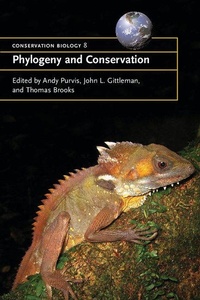
Phylogeny and Conservation
Published on 22. September 2005
Book
Paperback/Softback
448 pages
978-0-521-53200-6 (ISBN)
Description
Phylogeny is a potentially powerful tool for conserving biodiversity. This book explores how it can be used to tackle questions of great practical importance and urgency for conservation. Using case studies from many different taxa and regions of the world, the volume evaluates how useful phylogeny is in understanding the processes that have generated today's diversity and the processes that now threaten it. The novelty of many of the applications, the increasing ease with which phylogenies can be generated, the urgency with which conservation decisions have to be made and the need to make decisions that are as good as possible together make this volume a timely and important synthesis which will be of great value to researchers, practitioners and policy-makers alike.
Reviews / Votes
'Conservation books rarely display such optimism.' Biologist '... a judicious volume that combines the original work and reviews of a wide range of experts into four main sections, within and across which chapters are well edited to interconnect, with cohesively styled and clear graphics. ...This book is an excellent example of how diligent editors can pull together a controversial part of a field, particularly if backed by institutions with sufficient clout and resources to attract top participants. With its timely contributions, this volume will be valuable as supplementary reading for any course in conservation genetics, and will be particularly useful to advanced graduate students.' OryxMore details
Series
Language
English
Place of publication
Cambridge
United Kingdom
Target group
Professional and scholarly
Product notice
Paperback (trade)
Illustrations
30 Tables, unspecified; 2 Plates, color; 1 Halftones, unspecified; 32 Line drawings, unspecified
Dimensions
Height: 229 mm
Width: 152 mm
Thickness: 26 mm
Weight
722 gr
ISBN-13
978-0-521-53200-6 (9780521532006)
Copyright in bibliographic data and cover images is held by Nielsen Book Services Limited or by the publishers or by their respective licensors: all rights reserved.
Schweitzer Classification
Other editions
Additional editions
Andrew Purvis | John L. Gittleman | Thomas Brooks
Phylogeny and Conservation
E-Book
09/2005
1st Edition
Cambridge University Press
€67.99
Available for download
Andrew Purvis | John L. Gittleman | Thomas Brooks
Phylogeny and Conservation
Book
09/2005
Cambridge University Press
€93.00
Article exhausted; check for reprint
Previous edition
Andrew Purvis | John L. Gittleman | Thomas Brooks
Phylogeny and Conservation
Book
09/2005
Cambridge University Press
€93.00
Article exhausted; check for reprint
Persons
ANDY PURVIS is Reader in Biodiversity at Imperial College London. His research interests include phylogenetics, macroevolution and conservation biology, and his current research focuses on using phylogenies to study macroevolution and extinction. JOHN GITTLEMAN is Professor of Biology at the University of Virginia. He is the author of many scientific papers and several books, including Carnivore Conservation (2001, ISBN 0 521 66232 X). His current research examines global patterns and processes of speciation and extinction in mammals. THOMAS BROOKS is head of the Conservation Synthesis Department in Conservation International's Center for Applied Biodiversity Science. His interests lie in species conservation, particularly birds, and tropical forest hotspots.
Content
1. Phylogeny and conservation Andy Purvis, John L. Gittleman and Thomas M. Brooks; Part I. Units and Currencies: 2. Molecular phylogenetics for conservation biology Elizabeth A. Sinclair, Marcos Perez-Losada and Keith A. Crandall; 3. Species: demarcation and diversity Paul-Michael Agapow, 4. Phylogenetic units and currencies above and below the species level John C. Avise; 5. Integrating phylogenetic diversity in the selection of priority areas for conservation: does it make a difference? Ana S. L. Rodrigues, Thomas M. Brooks and Kevin J. Gaston; 6. Evolutionary heritage as a metric for conservation Arne O. Mooers, Stephen B. Heard and E. Chrostowski; Part II. Inferring Evolutionary Processes: 7. Age and area revisited: identifying global patterns and implications for conservation Kate E. Jones, Wes Sechrest and John L. Gittleman; 8. Putting process on the map: why ecotones are important for preserving biodiversity Thomas B. Smith, Sassan Saatchi, Catherine Graham, Hans Slabbekoorn and Greg Spicer; 9. The oldest rainforests in Africa: stability or resilience for survival and diversity? Jon C. Lovett, Rob Marchant, James Taplin and Wolfgang Kueper; 10. Late Tertiary and Quaternary climate change and centres of endemism in the southern African flora Guy F. Midgley, Gail Reeves and C. Klak; 11. Historical biogeography, diversity and conservation of Australia's tropical rainforest herpetofauna Craig Moritz, Conrad Hoskin, Catherine H. Graham, Andrew Hugall and Adnan Moussalli; Part III. Effects of Human Processes: 12. Conservation status and geographic distribution of avian evolutionary history Thomas M. Brooks, J. D. Pilgrim, Ana S. L. Rodrigues and Gustavo A. B. da Fonseca; 13. Correlates of extinction risk: phylogeny, biology, threat and scale Andy Purvis, Marcel Cardillo, Richard Grenyer and Ben Collen; 14. Mechanisms of extinction in birds: phylogeny, ecology and threats Peter M. Bennett, Ian P. F. Owens, Daniel Nussey, Stephen T. Garnett and Gabriel M. Crowley; 15. Primate diversity patterns and their conservation in Amazonia Jose M. Cardoso da Silva, Anthony B. Rylands, Jose S. Silva Junior, Claude Gascon and Gustavo A. B. da Fonseca; 16. Predicting which species will become invasive: what's taxonomy got to do with it? Julie Lockwood; Part IV. Prognosis: 17. Phylogenetic futures after the latest mass extinction Sean Nee; 18. Predicting future speciation Timothy G. Barraclough and T. Jonathan Davies.