

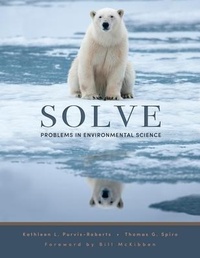
Solve
Problems in environmental science
Published on 21. October 2022
Book
Paperback/Softback
477 pages
978-1-940380-10-0 (ISBN)
Description
SOLVE: Problems in Environmental Science delivers up a robust set of engaging quantitative problems geared toward students in guided problem-solving groups and Environmental Science courses.
In response to repeated requests for more problems in environmental science, Katie Purvis-Roberts (Claremont McKenna, Pitzer and Scripps Colleges) and Tom Spiro (University of Washington), authors of Chemistry of the Environment, with a team of experienced environmental science teachers, have developed SOLVE: Problems in Environmental Science. This sleek and affordable stand-alone "problems" book serves up a broad array of quantitative problems addressing real-world issues in an approachable fashion. Requiring only algebra and a basic understanding of general chemistry, SOLVE is designed for use in traditional Environmental Science courses, as well as in student-centered guided problem-solving courses. Worked problems are followed by practice problems, with brief answers that allow students to check their work. With this text, your students will use their reasoning ability to tackle and solve problems ranging from global warming to GMOs. An Instructor's Manual with detailed solutions is also available to adopting professors.
In response to repeated requests for more problems in environmental science, Katie Purvis-Roberts (Claremont McKenna, Pitzer and Scripps Colleges) and Tom Spiro (University of Washington), authors of Chemistry of the Environment, with a team of experienced environmental science teachers, have developed SOLVE: Problems in Environmental Science. This sleek and affordable stand-alone "problems" book serves up a broad array of quantitative problems addressing real-world issues in an approachable fashion. Requiring only algebra and a basic understanding of general chemistry, SOLVE is designed for use in traditional Environmental Science courses, as well as in student-centered guided problem-solving courses. Worked problems are followed by practice problems, with brief answers that allow students to check their work. With this text, your students will use their reasoning ability to tackle and solve problems ranging from global warming to GMOs. An Instructor's Manual with detailed solutions is also available to adopting professors.
More details
Language
English
Place of publication
United States
Target group
College/higher education
Professional and scholarly
Product notice
Paperback (trade)
Dimensions
Height: 280 mm
Width: 218 mm
Thickness: 24 mm
Weight
1118 gr
ISBN-13
978-1-940380-10-0 (9781940380100)
Copyright in bibliographic data and cover images is held by Nielsen Book Services Limited or by the publishers or by their respective licensors: all rights reserved.
Schweitzer Classification
Persons
Kathleen Purvis-Roberts, Thomas G. Spiro
Content
Preface
Part I. Introduction
Chapter 1. Introduction
Part II. Energy and Materials
Chapter 2. Energy Flows and Supplies
Chapter 3. Energy Utilization
Chapter 4. Renewable Energy
Chapter 5. Fossil Fuels
Chapter 6. Nuclear Energy
Part III. Atmosphere
Chapter 7. Climate Change
Chapter 8. Free Radical Chemistry – Nitrogen Oxide, Ozone, and Combusion
Chapter 9. Air Pollution
Chapter 10. Stratospheric Ozone Shield
Part IV. Hydrosphere and Lithosphere
Chapter 11. Water Resources
Chapter 12. Water as Solvents: Acids and Bases
Chapter 13. Water and the Lithosphere
Chapter 14. Oxygen and Life
Chapter 15. Water Pollution and Water Treatment
Part V. Biosphere
Chapter 16. Nitrogen and Food Production
Chapter 17. Pest Control
Chapter 18. Toxicity of Chemicals
Appendixes
Appendix A. Organic Structures
Appendix B. Mathematical Fundamentals
Appendix C. Answers to the Starred Questions
Part I. Introduction
Chapter 1. Introduction
Part II. Energy and Materials
Chapter 2. Energy Flows and Supplies
Chapter 3. Energy Utilization
Chapter 4. Renewable Energy
Chapter 5. Fossil Fuels
Chapter 6. Nuclear Energy
Part III. Atmosphere
Chapter 7. Climate Change
Chapter 8. Free Radical Chemistry – Nitrogen Oxide, Ozone, and Combusion
Chapter 9. Air Pollution
Chapter 10. Stratospheric Ozone Shield
Part IV. Hydrosphere and Lithosphere
Chapter 11. Water Resources
Chapter 12. Water as Solvents: Acids and Bases
Chapter 13. Water and the Lithosphere
Chapter 14. Oxygen and Life
Chapter 15. Water Pollution and Water Treatment
Part V. Biosphere
Chapter 16. Nitrogen and Food Production
Chapter 17. Pest Control
Chapter 18. Toxicity of Chemicals
Appendixes
Appendix A. Organic Structures
Appendix B. Mathematical Fundamentals
Appendix C. Answers to the Starred Questions