

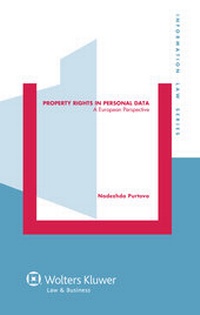
Property Rights in Personal Data
A European Perspective
1st Edition
Published on 13. December 2011
Book
Hardback
328 pages
978-90-411-3802-6 (ISBN)
Description
Personal data, at least in the European legal lexicon, is not a conventional object of property rights. Yet, regardless of the actual legal circumstances, lively markets in personal data have become a reality. The so-called information industry routinely collects and deals in databases containing personal details of people as both citizens and consumers, and appears to regard this data as its property. Moreover, individuals also treat data pertaining to them as 'their own', and habitually disclose personal data in exchange for money, goods, services, and online 'social' interaction.
This important new book defends the ground-breaking proposal to 'propertise' personal data. 'Propertisation' arguably improves the position of a data subject to exercise control over his/her personal data by creating more effective tools of accountability and monitoring. It can also be used, the author shows, to enforce existing data protection rights as expressed in the EC Data Protection Directive (1995), Council of Europe Convention for the Protection of Human Rights and Fundamental Freedoms (1945) and Convention No. 108 (1981).
This book inquires to what extent the propertisation of personal data is legally possible in Europe, and examines what benefits and limitations would ensue. It provides:
a systematic understanding of the developments and concerns with regard to personal data;
a detailed examination of the main arguments for and against the concept of property in personal data; and
a European perspective on property rights in personal data.
The result is a book full of original insights that breaks new ground in addressing the problems of personal data in the European law of data protection and informational privacy.
This important new book defends the ground-breaking proposal to 'propertise' personal data. 'Propertisation' arguably improves the position of a data subject to exercise control over his/her personal data by creating more effective tools of accountability and monitoring. It can also be used, the author shows, to enforce existing data protection rights as expressed in the EC Data Protection Directive (1995), Council of Europe Convention for the Protection of Human Rights and Fundamental Freedoms (1945) and Convention No. 108 (1981).
This book inquires to what extent the propertisation of personal data is legally possible in Europe, and examines what benefits and limitations would ensue. It provides:
a systematic understanding of the developments and concerns with regard to personal data;
a detailed examination of the main arguments for and against the concept of property in personal data; and
a European perspective on property rights in personal data.
The result is a book full of original insights that breaks new ground in addressing the problems of personal data in the European law of data protection and informational privacy.
More details
Other editions
Additional editions
E-Book
11/2011
Kluwer Law International
€174.99
Available for download
Content
Chapter 1 Introduction. Part I Setting the Stage. Chapter 2 The Personal Data Problem: The Developments Raising Personal Data Related Issues. Chapter 3 The Personal Data Problem: Concerns. Chapter 4 Introduction to Property Discourse. Part II Origins of the Idea of Propertisation. Chapter 5 Limitations of US Information Privacy Law in Dealing with the Personal Data Problem. Chapter 6 Correcting Shortcomings of the US Information Privacy Law by Propertisation. Chapter 7 Review of the European Data Protection Regime. Chapter 8 The Possibility of Propertisation of Personal Data in the EU Legal Order. Chapter 9 Human Rights Nature of Data Protection as a Limit on Propertisation. Chapter 10 The Property Rights Solution. Chapter 11 Conclusion. Table of Cases. Bibliography. Index