

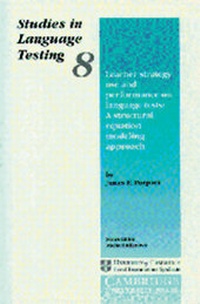
Learner Strategy Use and Performance on Language Tests
A Structural Equation Modeling Approach
Published on 25. November 1999
Book
Hardback
272 pages
978-0-521-65102-8 (ISBN)
Description
Learner Strategy Use and Performance on Language Tests investigates the relationships between learner strategy use and performance on second language tests. To this effect, it examines the construct validity of two questionnaires, designed within a model of human information processing, that purport to measure testakers' self-reported cognitive and metacognitive strategy use. It then examines the construct validity of the FCE Anchor test, developed by the University of Cambridge Local Examinations Syndicate, to measure second language proficiency. It is a useful resource for those interested in understanding the effects of strategy use on performance, for those interested in training students to use strategies in language classrooms and for those interested in using structural equation modelling as an analytic tool for examining the effects of socio-psychological background variables on performance.
More details
Series
Language
English
Place of publication
Cambridge
United Kingdom
Target group
ELT/ESL
Dimensions
Height: 235 mm
Width: 156 mm
Thickness: 22 mm
Weight
521 gr
ISBN-13
978-0-521-65102-8 (9780521651028)
Copyright in bibliographic data and cover images is held by Nielsen Book Services Limited or by the publishers or by their respective licensors: all rights reserved.
Schweitzer Classification
Other editions
New editions
James E. Purpura
Learner Strategy Use and Performance on Language Tests
Book
11/1999
Cambridge University Press
€92.70
Shipment within 15-20 days
Additional editions
James E. Purpura
Learner Strategy Use and Performance on Language Tests
Book
11/1999
Cambridge University Press
€92.70
Shipment within 15-20 days
Content
1. Introduction; 2. Strategy use and second language performance: theories and empirical research; 3. The structure equation modelling approach: single and multi-group procedures; 4. Item-level analysis; 5. Modelling strategy use and test performance; 6. Multiple-group analysis; 7. Conclusions